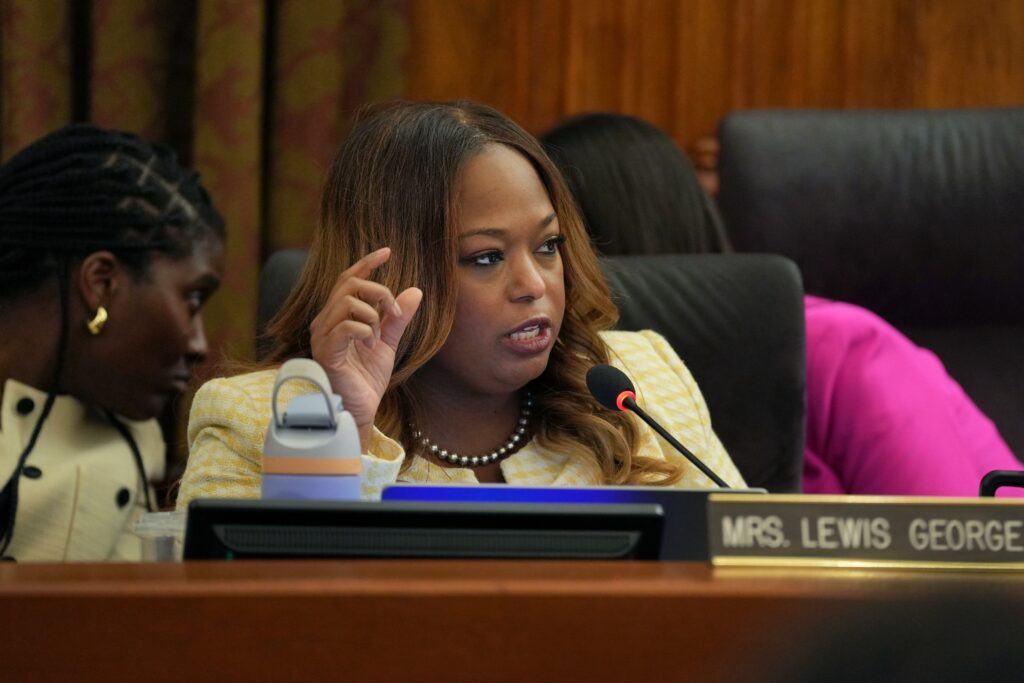
D.C. mayoral candidate Janeese Lewis George picked up key labor support Wednesday with endorsements from five unions, showing early momentum in a race in which she remains, at least for now, the only high-profile candidate.
“We’re here today to ensure working people’s voices are not an afterthought as we get ready to elect our next mayor of Washington, D.C.,” Jaime Contreras, executive vice president of SEIU 32BJ, said at a rally Wednesday evening for Lewis George (D), who represents Ward 4 on the D.C. Council.
The early endorsements — from five groups with a strong local organizing presence and network — underscore the central role that labor is expected to play in Lewis George’s campaign, and allow her to lock in influential union backing before even having to compete with another major candidate. Council member Kenyan R. McDuffie (I-At Large) announced Tuesday that he is resigning from the council, which he must do to run for mayor, but he has yet to formally declare his candidacy.
Contreras said in an interview that SEIU — which represents office cleaners, airport workers and others — did speak with McDuffie before deciding to endorse Lewis George, whom members found more persuasive.
“She has done all the right things in the city, whether it’s standing up for D.C. [Health Care] Alliance, whether it’s standing up for labor as the negotiations for the RFK Stadium were going on … the list goes on and on,” he said.
SEIU joined in the endorsements with ATU Local 689, which represents transit workers; UFCW Local 400, which represents grocery, retail and health care workers; and Unite Here Local 23 and Local 25, which represent hospitality and food service workers.
Lewis George, a democratic socialist who was elected to the council in 2020, kicked off her campaign Dec. 1, becoming the first major candidate to enter the ring after Mayor Muriel E. Bowser (D) opted not to seek reelection. According to Lewis George’s campaign finance report, by Dec. 10 she had raised nearly $120,000, which she can multiply with public matching funds.
She said in an interview that union workers’ early encouragement to run played a significant role in her decision to step into the race, and she indicated they will be a key part of her citywide grassroots strategy. “That made me feel comfortable stepping out there and knowing that I had the ability and capacity to build the type of volunteer and people-powered movement to actually win this election,” she said.
On Wednesday evening, several dozen restaurant workers, transit workers, office cleaners and others gathered at the rally at the Unite Here Local 25 office in downtown D.C.
Giving an early taste of a campaign stump speech, Lewis George recalled growing up going to union meetings with her postal worker mother, and, while in law school, working two jobs as a waitress and a Nordstrom clerk to help her mother pay rising rent.
“And so I have stood alongside union members across the District because it’s deeply personal for me and because I understand how important this fight is,” she said.
She pledged that if elected mayor, she would “take on companies” engaged in union-busting, protect workers from displacement fueled by artificial intelligence and “fight against immigrant worker exploitation.” She also pledged to “uphold our sanctuary values law” and forcefully prohibit D.C. police from cooperating with immigration authorities.
Union leaders said they were swayed to back Lewis George because of her support for expanding paid family leave, and project labor agreements and her vocal backing of immigrants during the Trump administration’s crackdown, among other things.
Raymond Jackson, president of ATU Local 689, said Lewis George has shown up on picket lines to back transit workers numerous times over the years. “I can tell you, whenever we called her, sometimes without even calling her, she showed up,” he said.
Regina Welch, a member of Unite Here Local 25, credited Lewis George for firmly standing by Initiative 82, which increases wages of restaurant workers and others and phases out the tipped minimum wage, and for opposing legislation this year overhauling it.
Contreras, whose union includes many immigrant workers, applauded Lewis George’s vote against the 2026 D.C. budget because of its social safety net cuts, including to the D.C. Health Care Alliance, a program immigrants have relied on for health insurance. And he pointed to the key role she played in the RFK Stadium development negotiations to secure a massive project labor agreement; the mayor’s proposed deal had included a much more limited agreement.
Lewis George sought to draw a distinction with McDuffie in that chapter. McDuffie, who as chair of the economic development committee was involved in the negotiations with the Washington Commanders, had also said he backed a project labor agreement. But when unions objected that it was not nearly strong enough, Lewis George and council member Zachary Parker (D-Ward 5) brokered an amendment to secure a new, more expansive project labor agreement that would ensure thousands of union jobs both during and — crucial to the unions — after construction.
“We stayed in contract negotiations to the very end. We held the line together,” Lewis George said. “And because of it, we were able to secure the largest PLA and labor peace agreement in D.C. history.”
Lewis George and McDuffie, who is expected announce a mayoral bid in early January, are likely to compete aggressively on the workers’ rights issue. In an interview Monday, McDuffie also touted his workers’ rights bona fides, pointing to efforts to enhance wage transparency and strengthen laws against misclassifying workers to pay them less, such as at construction sites.
The post Lewis George gains early momentum in D.C. mayoral bid with union support appeared first on Washington Post.