Following a year of guiding an unruly House Republican conference to legislative victories, there are signs that Speaker Mike Johnson (R-Louisiana) is losing his grip.
For the fourth time in recent weeks, a group of frustrated Republicans banded with Democrats to try to force a vote on legislation that Johnson fought to keep from reaching the House floor. Tensions boiled over Wednesday when four moderate Republicans — scorned by Johnson’s decision to withhold votes on their health care proposals — joined all Democrats in muscling the House to vote next month on a bill led by Minority Leader Hakeem Jeffries (D-New York) that would extend enhanced Affordable Care Act tax credits for three years.
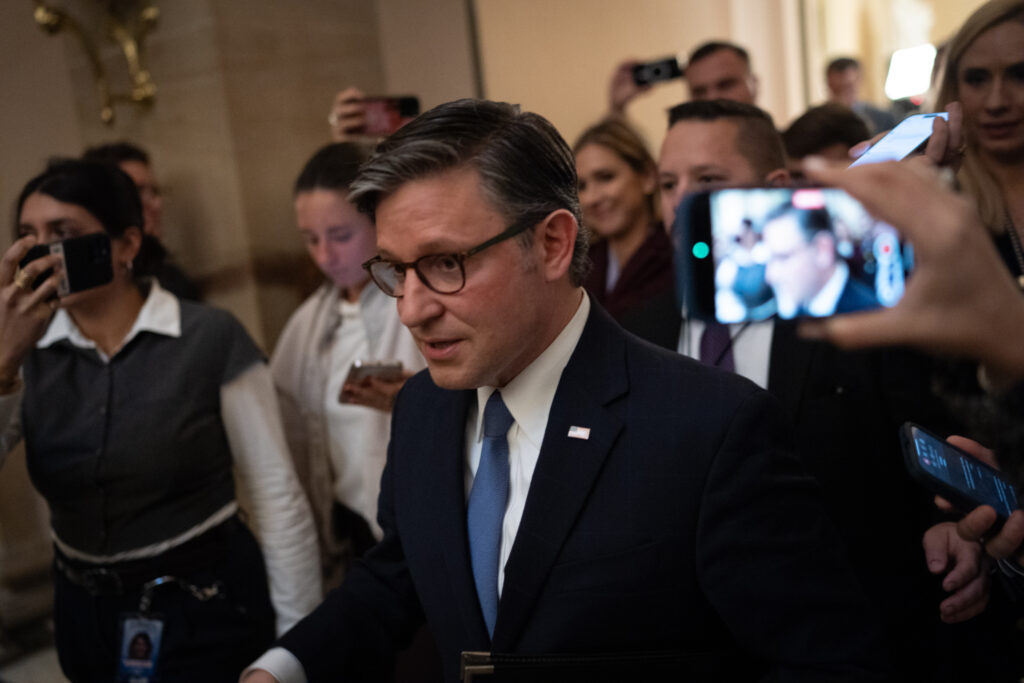
With the House adjourning for the year on Thursday, Johnson is downplaying tensions among Republicans that for months he had tamped down with the help of President Donald Trump. On Wednesday, Johnson insisted that he has “not lost control of the House.”
But some of his colleagues are beginning to question that.
House Republicans’ narrow majority has tested Johnson’s hold on the speaker’s gavel since he unexpectedly ascended to the job in October 2023. Johnson often finds himself in the middle of warring GOP factions, taking his time to decide what a majority of his colleagues would support and hoping that an opposing flank does not spark a rebellion.
Since Trump took office in January, Johnson has been able to rely on him to smooth out tensions among House Republicans. Lawmakers — including the speaker himself — have said that Trump’s massive tax and immigration bill would not have been possible without the president’s heavy involvement.
But over the last month, Trump’s waning interest in Congress coupled with Johnson’s stubbornness at times has contributed to lawmakers feeling a sense of aimlessness as they step into a midterm election year facing significant headwinds, according to multiple GOP lawmakers, aides and consultants, some of whom spoke on the condition of anonymity to discuss private deliberations.
It has made negotiations with the speaker as of late feel particularly tense, some say.
“There’s kindling everywhere. You’re basically in a room full of gun powder, paper and cloth. You’re in a room full of all the accelerants. No one’s lit a match … because they know what kind of chaos it plunges us into,” said one House Republican.
The chaos GOP lawmakers are trying to avoid is a repeat of the process two years ago that resulted in the ouster of then-Speaker Kevin McCarthy (R-California) and Johnson’s selection after a tortuous three-week process.
A motion to consider removing Johnson as speaker would require nine votes from the Republican conference. Such a coalition has not yet emerged. For now, lawmakers are unwilling to remove Johnson from the speakership, because Trump still backs him and there is no guarantee lawmakers can quickly get behind a candidate.
“If you vacate the chair, then there is no speaker and nothing can happen. So not really a good solution,” Rep. Kevin Kiley (R-California) said. “That would not be fun. We’re here on Christmas on our 15th speaker vote — that would not be great.”
Kiley added that the way Johnson has “run the House, especially the last several months, leave a lot to be desired.”
Many Republicans sympathize with Johnson, who often finds himself “haggling” and “bargaining,” as Rep. Nick LaLota (R-New York) put it, with a slim majority to reach a desired outcome.
Rep. Greg Murphy (R-North Carolina) said GOP leadership is “navigating difficult water” with the party’s razor-thin majority, and “one of them is someone who would vote against puppies” — a reference to Rep. Thomas Massie (R-Kentucky), who often votes against the majority.
“So I think [leaders are] doing a very good job,” Murphy said.
Other Republicans say Johnson has made mistakes that could have been prevented. Many voiced frustration with his decision to keep the House out of session for more than 50 days around the government shutdown. That, they say, forced the House to jam 11 weeks of votes into five. Members also have pushed back on leadership for allowing too little time, in their view, to negotiate policies before they hit the floor.
“We could have done a lot of things,” said Rep. Morgan Luttrell (R-Texas), who is retiring next year. “This place frustrates me. I think if we had the ability to coalesce between each other, we get a lot of things, a lot more things accomplished.”
The lack of inaction on policies inspired several Republicans to file discharge petitions in an effort to get their bills on the floor without Johnson’s consent. Rep. Marjorie Taylor Greene (R-Georgia) signed onto petitions that would ban lawmakers from trading stock and extend ACA subsidies “to help bills get to the floor for a vote because leadership never lets anyone’s bills go to the floor,” she told The Washington Post.
Keeping the House away during the shutdown conveyed to the public that Republicans were hesitant to vote on releasing files related to convicted sex-offender Jeffrey Epstein, despite many lawmakers clamoring for a vote, some GOP lawmakers say.
A bipartisan group of lawmakers later successfully circumvented Johnson’s blockade, allowing such a vote. It amounted to an embarrassing rebuke for the speaker after all, but one House member voted to pass the resolution, sending it to the Senate. Making matters worse, Johnson ultimately voted for releasing the files, believing the Senate would change the resolution to his liking, but Senate Majority Leader John Thune (R-South Dakota) refused to do so, citing the near unanimous GOP support in the House.
Johnson, who during the shutdown said the House would not consider extending expiring enhanced ACA subsidies, felt the pressure to do so after two discharge petitions were filed last week that gained bipartisan support, according to several lawmakers.
Johnson and moderate Republicans negotiated over the past week to allow for a vote that would extend subsidies. Allowing such a vote, however, would have led many conservatives to vote against the bill because they preferred seeing the subsidies. Some also demanded including federal limits to funding abortions in the bill in exchange for their votes.
“I think if you talk to everybody across the conference, they’ll say, ‘I’m not sure how it could have been handled any differently or any better.’ It’s a very delicate situation. Let’s look at the reality. Health care is a very complicated issue,” Johnson said.
The GOP-led House Rules Committee ultimately blocked moderates from holding floor votes on their amendments, an outcome that moderates warned days earlier would come with consequences.
One Republican lawmaker said Johnson’s handling of the issue led to the Democratic bill — which extends ACA subsidies for three years — garnering enough GOP support to get a floor vote with the discharge petition.
“If that’s not political and legislative malpractice, I don’t know what is,” the Republican said.
Johnson and his predecessors often face rebellions from the far-right flank of the House GOP conference. And while moderates often threaten to rebel, they often fall in line out of respect for their leadership.
But that changed Wednesday when the four Republicans signed onto the Democrats’ bill to extend enhanced subsidies for three years, teeing up a vote upon the House’s return in January. The expiration at the end of December is expected to push up costs for most of the 24 million Americans who buy health insurance on the ACA marketplace.
“To me, the clean three-year extension is not ideal,” Rep. Michael Lawler (R-New York) said. “But doing nothing is not an answer.”
Republicans are now leaving Washington disappointed with how the year ended, foreshadowing difficulty for Johnson in the new year as lawmakers clamor for a concise agenda and message on which to campaign. Trump’s comments this month that he doesn’t want Congress to pass more bills has further complicated matters.
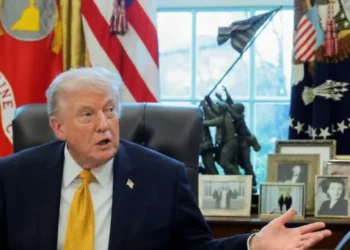
“We don’t need it because we got everything,” Trump said at the White House. “I think Mike Johnson’s been a great speaker. Few people could have done that job.”
Johnson said Tuesday that Trump’s comments must have been taken out of context because the GOP agenda for the new year is “aggressive,” adding, “There is much more to do.”
Johnson highlighted that House Republicans would vote on policies that would bring down the cost of living, including on health care, an issue some lawmakers worry about debating during a midterm year. The lack of action on that subject during Trump’s first term contributed to Democrats gaining the House majority in 2018.
Some Republicans worry that it’s a little too late to focus on the issue. Democrats hammered their messages on affordability and lowering health care costs for weeks while the House was out of session during the longest government shutdown in U.S. history.
Public polling has shown a precipitous drop in Republicans’ favorability since the start of the shutdown in October, making it more glaring to lawmakers that Trump’s sprawling legislative agenda that he signed in July — the One Big Beautiful Bill — is not resonating with voters.
Johnson and GOP leaders say voters will start to feel relief during tax season next year, but some lawmakers worry it may not make a difference as prices rise elsewhere.
“They’re entitled to their view. I just disagree with it. Things are very expensive right now,” said Rep. Brian Fitzpatrick (R-Pennsylvania), who sided with Democrats over Johnson to address expiring subsidies.
Republican lawmakers and aides are hoping to coalesce around another policy package, in part because such exercises can remind lawmakers they’re on the same team. Majority Leader Steve Scalise (R-Louisiana) said Republicans will come back in the new year with a “very full agenda on a lot of items” and that lawmakers will attempt to package policies, including health care, in a similar manner as the One Big Beautiful Bill.
Not all Republicans agree, however, that ambitious of a goal is achievable in an election year when lawmakers will prioritize politics over policy.
“I don’t see a path forward,” House Budget Committee Chairman Jason T. Smith (R-Missouri) said.
The post Johnson says he still controls the House. Some fellow Republicans disagree. appeared first on Washington Post.