It’s mid-November, a full week before Thanksgiving, and the progeny of Francisco Robles, a Mexican immigrant who peddled watermelons in East L.A., have converged in West Covina to commemorate the 76th year of the family’s seasonal business: selling fresh Christmas trees around L.A. from the forests of the Pacific Northwest.
Francisco and his wife, Lucia, left Mexico for a better life in the early 1900s, so it’s hard to imagine what they would make of their thoroughly Americanized descendants today. One of them is looking for a place to plug in her electric car, another is zipping around the large lot on a motorized scooter, and a third is carrying a large, elaborately framed photo of their mother, “the Queen of our hearts,” who died on Mother’s Day, so she can be part of the family photo commemorating the 2025 tree season.
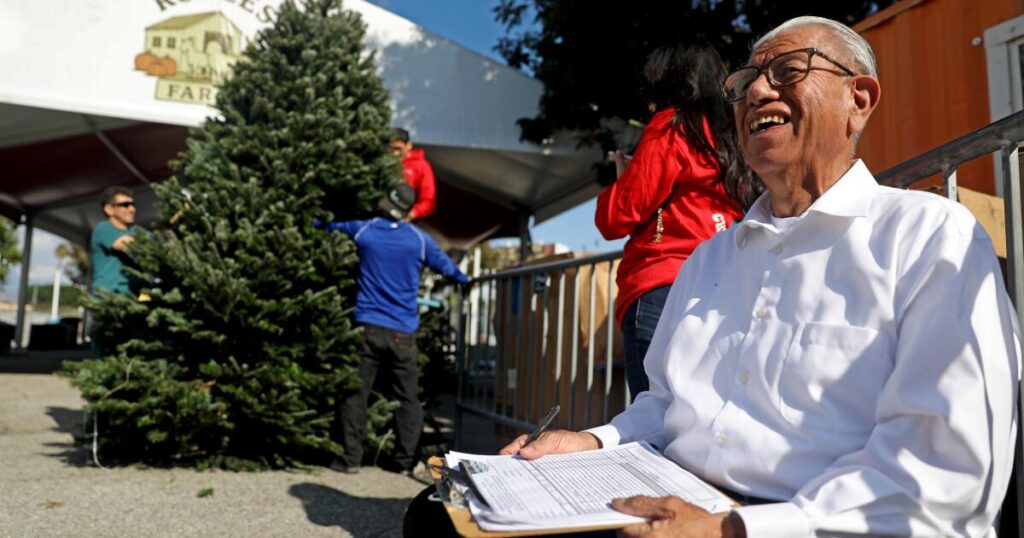
The Robles’ 76-year-old grandson Louis Jr. is keeping track of today’s Christmas tree delivery from a folding chair, wearing horn-rim glasses, slacks and a white, open-neck dress shirt. But most of his family — his three adult children, their spouses and a few of his grandchildren — are casually dressed in red “Robles Christmas Trees”-themed sweatshirts or holiday leggings, laughing and posing for cellphone photos under a huge red-and-white striped tent in the parking lot of the bustling Plaza West Covina mall.
All the pumpkin patch trimmings from October have been put away — the petting zoo, towering inflatable slides, Cyglos and other rides — and now the family is setting up Christmas decor and stands for the trees that will soon be delivered.
It’s a far cry from the dusty streets where Francisco Robles sold his watermelons from a truck more than a century ago. By the end of this day, the massive 53-foot-truck will have delivered its icy bundles of Nordmann, noble and silvertip firs — what Louis Jr. calls “the Cadillac of Christmas trees” — to all three of their lots in Eagle Rock, Plaza West Covina and the Montebello mall.
The Robles family is eager to get the Christmas tree lots going. Sales were slower than usual at their pumpkin patches this year, a slump they blame on ICE raid concerns by their large Latino customer base.
Members of the Robles family talk carefully about ICE and immigration. They are business people and deeply religious — Louis Jr. is an assistant pastor at the Living Word Apostalic Church in El Monte, where they attended as a family for years — and they want to keep their politics private.
“But we are not fearful,” said Gabriel Robles. “We’ve lived here all our lives, born and raised here, and we’ve been through so much. I believe this ICE issue is another moment in time. It will pass like COVID happened and passed, and we can stand whatever they throw at us. Los Angeles is a melting pot of immigrants. We’re all unified together, no matter who is in office, and you can’t get rid of us. We are the fabric of L.A.”
Getting the family together in mid-November is unusual because, from October through December, the Robleses are juggling the family business with their other jobs: Gabriel Robles, operator of the Robles Pumpkin Festival and Christmas Trees in West Covina, is an insurance broker; his wife, Kathy, is a homemaker who manages their books. Gabriel’s older sister, Lisa Nassar, operator of Cougar Mountain Pumpkin and Christmas Trees in Eagle Rock, does security screenings at Disneyland (“I keep Tinker Bell safe,” she says, laughing). Her husband, Sam Nassar, is a counselor at Mt. San Antonio College. Lorraine Robles-Acosta is a massage therapist who does lots of work for her church; her husband, Joseph Acosta, is a drug and alcohol counselor. Together, they run the Robles Pumpkin Patch and Christmas Tree Farm in Montebello.
It’s a grueling schedule, but they cling to Louis Jr.’s motto — “We’ll sleep in January” — because this business is in their blood. Not all of the younger generation of Robleses is as gung-ho about the family business as their parents are. But Gabriel and Kathy’s sons, Roman, 21, and Mason, 19, are already devising plans to improve the family’s presence on social media, and the couple’s art-loving daughter Loren, 15, set up the acrylic paints for pumpkin painting.
Louis Jr.’s children, Lisa, Stephen, Gabriel and Lorraine, played among the trees in their father’s tree lots, first in Monrovia in 1973, Louis Jr. says, then in Rosemead and Pico Rivera. Louis Jr. purchased a small trailer with a tiny space heater to sit on the lot so the kids could eat and rest there while he and his wife sold trees.
“That trailer was so cold at night,” said Lisa, shivering with the memory.
In those early years, when Louis Jr. worked all day at a produce warehouse with his dad before spending his evenings at his Christmas tree lot, he and Madalene used the tree money to create magical Christmases for their children.
“I remember waking up to mountains of presents under the Robles’ tree,” Lorraine said dreamily, “and Mom wrapped every single gift.”
When they were older, Lorraine and her siblings helped set up and sell the trees. They’d chase after the few scalawags who tried to steal them and ultimately they lobbied Louis Jr. to let them have their own lots, which over time expanded from selling a few pumpkins on straw before Halloween to big pumpkin patch extravaganzas with petting zoos, art activities, inflatables and rides. (Stephen, who lives in San Diego, stepped away from the seasonal business.)
Inflatables like bouncy houses and giant slides were Gabriel’s innovation, and so popular he insisted on adding them to his Christmas tree lot too. His dad warned against the idea, but Gabriel said he was determined. He set them up at his lot and they did well for a few days. But then it rained, and his father’s logic became apparent. The inflatables never dried, Gabriel said, and the cold and mud made them even less appealing to visitors. “I still have customers to this day who say, ‘Please put the inflatables out again,’ but they don’t understand they take forever to dry.”
The Robles family is dismissive about big-box competitors (“They’ll never replace the tradition and environment you get at our lots,” said Lisa) and they collectively hiss at the mention of artificial trees.
“My dad has been worried that artificial trees get nicer and nicer, but it hasn’t really changed our sales,” Gabriel said. “The No. 1 reason people come to our lots is the fragrance. They want that fresh pine smell throughout their home, and fake sprays don’t cut it.”
The Robles family hand-select their trees every year from the farms in the Pacific Northwest. (The names of the farms are secret to keep competitors away, Gabriel said.) After the trees are delivered, the family sprays the trees with water every night and keep them shaded from the sun so they don’t dry out. “That’s the secret of our success,” Gabriel said.
Louis Jr. said the biggest part of his family’s success has been adding fresh ideas to expand the business that come from each passing generation, starting with his dad, Louis.
Francisco and Lucia Robles and their five L.A.-born children lived on Brooklyn Avenue in East L.A. All three of their sons went to war for the United States, and two never came home, one lost in World War II and the other in the Korean War. Their third son, Louis Robles, served in WWII, right out of high school. He entered the Army’s 101st Airborne Division and earned a Purple Heart as one of the paratroopers who, at age 20, dropped into German-occupied France on D-Day, June 6, 1944.
When he returned from the war, Louis joined his father selling produce, but he had bigger ideas, Louis Jr. said of his dad. He didn’t want to sell from a truck; instead, he went into the wholesale business, selling watermelons and oranges from a stall at the old Central Wholesale Produce Market at 8th Street and Central Avenue in downtown L.A. He married Elena Ramirez, who helped at the warehouse, keeping the books, and they had four children: three girls — Gail, Priscilla, Denise — and a boy, Louis Jr.
Then, in 1949, the same year his son was born, Louis Robles had another idea: Watermelon sales slowed in the winter. Oranges were plentiful year-round, but he needed another crop that could fill the income gap. He noticed how people went to the railyard in December and bought Christmas trees off boxcars, so fresh they still had ice clinging to their branches. Packing them in snow was how trees were kept fresh during transport from the Pacific Northwest.
Inspired by this, Louis Sr. found a vacant lot in Lincoln Heights and started selling Christmas trees. Being the innovator he was, he didn’t want to rely on other people’s choices for his trees. So he researched tree farms in the Pacific Northwest and visited them himself, selecting his own trees and, for a while, even driving his warehouse’s Robles Produce truck up north to transport them himself.
Eventually, Louis Sr. bought his own produce warehouse, and Louis Jr., always a helper after school and on weekends, joined the business right after graduation. The younger Robles married his high school sweetheart, Madalene Maldonado on Jan. 4, 1969 — after the busy holiday season, of course — and they immediately started a family. Although she helped at the warehouse, Madalene’s main interest “was being a homemaker; raising her children and being a good wife,” Louis Jr. said.
Louis Sr. was considered by his family to be a taskmaster. He was generous about giving out jobs, but he didn’t tolerate people standing around at work. Laughing, Lisa said anytime you saw him coming, you grabbed a broom and started sweeping. “I still carry that mentality — there’s always something to do, even if it’s just pushing a broom,” she said.
Louis Sr. instilled that work ethic in all of his family growing up. “Grandfather was the first one out on the floor, always working and moving, and he took people up with him,” Gabriel said. “He really believed if he succeeded, you were going to succeed. It wasn’t about a handout, it was a hand up.”
Louis Sr. was well-respected by his creditors and so beloved by his employees that they insisted on filling his grave themselves after his sudden death in 1984. But the senior Robles never attended any of his son’s games in high school, Louis Jr. said, and he missed many family activities because of work.
“That was his blind spot. He always put business first,” Louis Jr. said. “I decided I wanted a balance — I would take care of business but I would also take time to go to my children’s games.”
Louis Sr. was such a force of nature, no one was prepared when he fell in December 1984. Because this was the family’s busy season, he insisted on working despite a bad cold that turned into walking pneumonia, Louis Jr. said. He told his family he would rest in January.
He almost made it. Shortly before Christmas Louis Robles had a stroke, then a heart attack and, on Dec. 27, at age 60, he died.
Louis Sr.’s death, so unexpected, required Louis Jr. to take over the business himself, but it also cemented his vow to put God and family first. “I remember playing in the all-stars game in baseball and looking for my dad, and he wasn’t there, and I thought, ‘I’m not going to do that to my kids,’” he said.
Gabriel laughed, saying: “My dad was so much into my basketball games, I got kind of embarrassed.”
Eventually, the watermelon and produce business became too competitive, and Louis Jr. sold the warehouse around 2012. By then, Robles Produce was debt-free, he said. His children were working, getting married and established in their own homes, and he’d been ordained as a pastor in 1999 and was deeply involved in his church. But the family pumpkin patch and Christmas tree business remained a constant.
“It does get in your blood,” said Lorraine’s husband, Joseph, with a laugh. “I got my blood transfusion when I married my wife.”
Today, Louis Jr. acts as an advisor and consultant to his children’s three pumpkin patches and Christmas tree lots. They meet to discuss pricing and inventory, but the siblings run their own lots with each little different from the other. There are disagreements, of course, Gabriel said, “but in the end, the thing that makes us so successful is we’re united — if someone goes against us, we’re a united front.”
It’s not clear how many of Louis Sr.’s seven great-grandchildren will continue the family business, but Gabriel’s sons, Roman and Mason, say they’re on board. Both have opted to skip college for a hands-on business course, soaking up whatever they can from their father and grandfather.
“Our great-great-grandfather started with nothing, and now we have this. And every generation we’ve built it higher,” Mason said.
“Not many kids my age are blessed to have a family business to learn from,” said Roman. “I want to do something more with my life than just showing up.”
The post How one L.A. immigrant’s quest spawned generations of Christmas tree sellers appeared first on Los Angeles Times.