
Kevin Hart is almost impossible to avoid.
The stand-up comic turned actor has spent the past decade as one of Hollywood’s most bankable and visible stars, headlining megahits like the “Jumanji” films alongside a steady output of comedies and animated features, while still selling out arena tours and releasing hit Netflix comedy specials. Off-screen, his face turns up everywhere: pitching banking apps, tequila and energy drinks.
For a long time, that kind of omnipresence carried real security in Hollywood.
In the era of artificial intelligence, though, that guarantee has begun to erode. A quick Google search for “Kevin Hart AI” turns up unofficial versions of his voice, available with a few clicks.
That helps explain why, one evening last month on the Fox lot, the head of Hart’s entertainment company, Hartbeat, was on an industry panel talking not about box office or release strategies but AI. Jeff Clanagan painted a picture of a landscape in which movie stardom is no longer protected by traditional channels, as attention splinters across platforms and audiences fragment. In that environment, AI can be both a risk and a lever.
“The most valuable resource right now is attention,” Clanagan told the audience of 150 studio executives, filmmakers, investors and technologists gathered at Hollywood X, an invitation-only event focused on responsible adoption of AI. “You’re competing for it everywhere — everybody is always on a second screen. That fragmentation is where the disruption is.”
Hollywood was built on the idea that a small number of stars could reliably command attention and turn it into leverage. As AI and algorithm-driven platforms reshape how attention is created and distributed, even the most recognizable names are newly exposed — not only to dilution but to the prospect of being replaced altogether.
In parts of Asia, synthetic performers are no longer hypothetical. In Japan, the anime-style virtual pop star Hatsune Miku has sold out concerts and headlined festivals. In China, AI hosts run shopping streams on the video platform Douyin. And in the U.S., Lil Miquela, a computer-generated influencer created by the Los Angeles startup Brud, has amassed millions of followers and appeared in major fashion campaigns, including a Calvin Klein ad with Bella Hadid.
For studios, brands and producers, the appeal isn’t hard to see. A virtual performer doesn’t call in sick, miss a shoot or carry off-screen baggage. There’s no aging out of roles, no scheduling crunch. They don’t need trailers, negotiate contracts or arrive with riders, entourages and expense accounts in tow.
The old mythology was that a star might be discovered at Schwab’s lunch counter or in an audition room. Hollywood has always chased the “it factor.” What happens when the performer is, quite literally, an it?
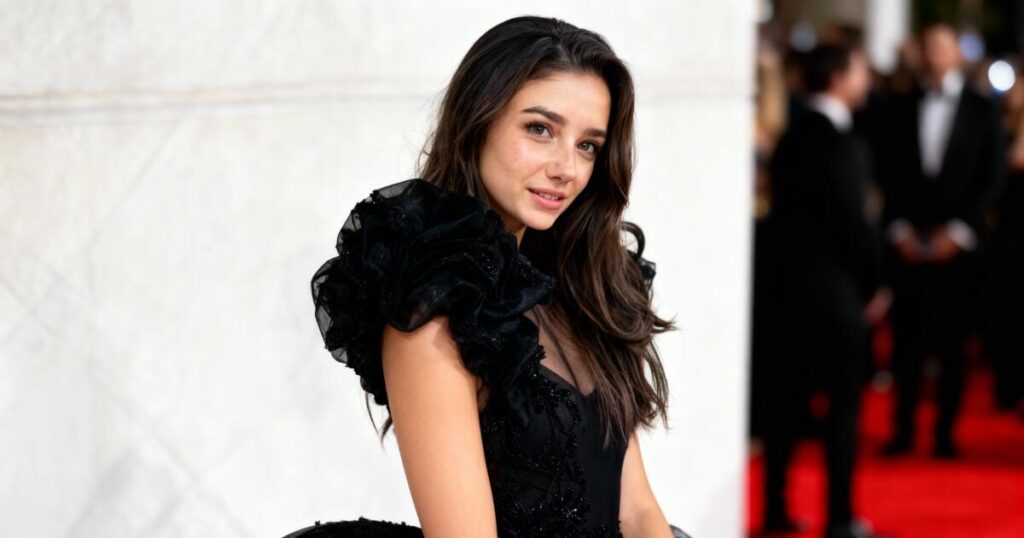
That question came into sharp focus this fall with the appearance of Tilly Norwood, a photorealistic, AI-generated character that took the guise of a rising British actress, styled to read mid-20s and approachable — exactly the kind of star Hollywood is always looking for.
It landed in an industry already on edge. Hollywood was still reelingfrom strikes, layoffs and a prolonged contraction, with anxiety about AI simmering just below the surface. The response was immediate and visceral.
SAG-AFTRA warned that projects like Tilly risked relying on what the union called “stolen performances,” arguing that AI-generated actors draw on the work of real performers without consent or compensation, concerns that were central to the union’s 2023 strike. On a Variety podcast, Emily Blunt was shown an image of Tilly and paused. “No — are you serious? That’s an AI?” she said. “Good Lord, we’re screwed.”
Even some of Hollywood’s most tech-forward figures have drawn a line. On the press tour for his latest film, “Avatar: Fire and Ash,” James Cameron — the director who once warned of Skynet in “The Terminator” — called the idea of AI replacing actors “horrifying,” arguing that human performance would become increasingly “sacred.”
Yves Bergquist, an AI researcher who directs the AI in Media Project at the USC Entertainment Technology Center — a think tank supported by major studios and technology companies — expects AI to continue to encroach on territory once reserved solely for humans.
“Will we see AI movie stars?” Bergquist asks. “Probably.” But he draws a line between what the technology can generate and what audiences are willing to invest in emotionally.
“Prince writing his songs is a great story,” he says. “Pushing a button and making music is not. Very soon — it’s already starting — we’re going to have this us-versus-them mentality. These are the machines and we’re the humans. And we’re not the same.”
The actress that didn’t exist
“Are you allowed to speak to me from L.A.?” Eline van der Velden, the creator of Tilly Norwood, asks with a quick, nervous laugh on a video call from London — a nod to how radioactive the subject of synthetic performers has become.
The question isn’t entirely a joke. Three months ago, when Van der Velden presented her latest project at an industry conference in Zurich, it touched off one of Hollywood’s most heated debates yet over AI and performance, one that still hasn’t fully cooled.
Van der Velden, 39, came up as an actor before pivoting into production, eventually landing in London, where she founded Particle6, a digital production company known for short-form video work for broadcasters and major platforms. She was in Zurich to introduce its newest offshoot, Xicoia, an AI studio designed to build and manage original synthetic characters for entertainment, advertising and social media. “It’s not a talent agency — we’re making characters,” she says. “So it’s really like a Marvel universe studio in a way.”
Tilly Norwood was meant to be the first and most visible example of that approach. Conceived as a recurring character with an unfolding story arc, Tilly was built to exist across short-form videos and scripted scenarios. As part of the Zurich presentation, Van der Velden screened a short satirical video titled “AI Commissioner,” introducing Tilly as a “100% AI-generated” actress — smiling on a red carpet and breaking down on a talk-show couch.
Other short videos featuring Tilly had already circulated online, including a montage placing her in familiar movie genres and a parody riffing on Sydney Sweeney’s controversial American Eagle jeans ad (“My genes are binary”). The “AI Commissioner” video itself had been posted on YouTube months earlier. By then, photorealistic synthetic characters were no longer novel and similar experiments were spreading online.
In Hollywood, it triggered an immediate backlash. Press accounts out of Zurich, amplified by Van der Velden’s remark that Tilly might soon be signed to an agent, collided with an industry already on edge about AI. Van der Velden was stunned at the intensity of the outcry: “Tilly was meant to be for entertainment,” she says. “It’s not to be taken too seriously. I think people have taken her way too seriously.”
Across the industry, working actors, already facing shrinking opportunities, recoiled at the idea of a fabricated performer potentially taking real jobs. Some called for a boycott of any agents who might take on Norwood. Speaking to The Times, SAG-AFTRA President Sean Astin demanded that the real-life actors used for AI modeling be compensated. “They need to know that it’s happening,” he said. “They need to give permission for it and they need to be bargained with.”
As the coverage ricocheted far beyond the trades and went global, the reaction escalated just as quickly. Asked when she knew Tilly had struck a nerve, she answers matter-of-factly: “When I got the death threats. That’s when I was like, oh — this has taken a very different turn.”
Van der Velden understands why the idea of a synthetic performer unsettled people, especially in a business already raw from layoffs, strikes and contraction. “Tilly is showing what we can do with the tech at this moment in time and that is frightening,” she says. But she argues that much of the backlash rests on fears that, in her view, haven’t yet materialized — at least not in the way people imagine them.
“There’s a bad reputation around AI,” she says. “People try to swing all sorts of things at it, like, ‘Oh, it’s taking my job.’ Well, I don’t know of anyone whose acting job has actually been taken by AI. And Tilly certainly hasn’t taken anyone’s job.”
Union representatives argue that displacement is already occurring through subtler mechanisms: background roles increasingly filled by digital doubles, commercials replacing actors with synthetic performers and projects that never get greenlighted because AI offers a cheaper alternative. The impact shows up not in pink slips but in opportunities that vanish before auditions are ever held.
Even as the controversy grew, Van der Velden says she began hearing something else privately. Producers and executives reached out, curious about what Tilly could do, with several asking about placing the character in traditional film or television projects — offers she says she declined. “That’s not what Tilly was made for,” she says.
Van der Velden insists the character was never intended to replace actors, framing Tilly instead as part of a different creative lineage, closer to animation. “I was an actor myself — I absolutely love actors,” she says. “I love pointing a camera at a real actress. Please don’t stop casting actors. That’s not the aim of the game.”
With a background in musical theater and physics, Van der Velden spent her early career in Los Angeles acting, improvising at Upright Citizens Brigade and making YouTube sketches. An alter ego she created, Miss Holland — designed to make fun of rigid beauty standards — won an online comedy award and helped launch her career in the U.K., where she founded Particle6.
Tilly began as an exercise: Could Van der Velden design a virtual character who felt instantly familiar, the kind of approachable young woman audiences would naturally be drawn to? “It’s like building a Barbie doll,” she says, noting at one point she considered making Tilly half robot. “I had fun making her. It was a creative itch.”
She pushes back on the idea that synthetic characters are simply stitched together from parts of real people. “People think you take this actress’ eyes and nose and that actress’ mouth,” she says. “That’s not how it works at all.”
Over six months, a team of about 15 people at Particle6 worked on developing Tilly, generating more than 2,000 visual versions and testing nearly 200 names before selecting Tilly Norwood, one that fit what Van der Velden calls the “English rose” aesthetic they were looking for and wasn’t already taken. “It’s very human-led,” Van der Velden says, likening AI tools to a calculator for creatives. “You need taste. You need judgment. You still have to call the shots.”
Even as the technology advances, the uncanny valley remains a stubborn barrier. Van der Velden says Tilly has improved over the past six months, but only through sustained human steering. “It takes a lot of work to get it right,” she says.
That labor, she says, is what separates an emerging form of storytelling worth taking seriously from AI slop. “I’ve seen some genuinely amazing work coming out of AI filmmaking,” she says. “It’s a different art form but a real one.”
She sees Tilly less as a provocation than as a reflection. “She represents this moment of fear in our industry as a piece of art. But I would say to people: Don’t be fearful. We can’t wish AI away. It’s here. The question is, how do we use it positively?”
Her focus now is on what she calls Tilly’s “inside” — the personality, memory and backstory that give the character continuity over time. That interior life is being built with Particle6’s proprietary system, DeepFame, software designed to give the character memory and behavioral consistency from one appearance to the next.
“People ask me things like what her favorite food is,” Van der Velden says. “I’m not going to answer for Tilly. She has a voice of her own. I’d rather you ask her yourself — very soon.”
Hollywood fights back
While Van der Velden wishes the industry were less afraid of what AI might become, Alexandra Shannon is helping Hollywood arm itself for what’s already here.
As head of strategic development at Creative Artists Agency, one of the industry’s most powerful agencies, Shannon works with actors, filmmakers and estates trying to navigate what generative technology means for their work — and their identities.
The questions she hears tend to fall into two camps. “First is, how do I protect myself — my likeness, my voice, my work?” she says. “And then there’s the flip side: How do I engage with this, but do it safely?”
Those concerns led to the creation of the CAA Vault, a secure repository for approved digital scans of a client’s face and voice. Shannon describes it as a way to capture a likeness once, then allow performers to decide when and where it can be used — for example, in one shot created for one film. It doesn’t eliminate uncertainty, she says, but it gives talent something they’ve rarely had since AI companies entered the picture: control.
“There’s a legitimate way to work with them,” she adds. “Anything outside that isn’t authorized.”
Those risks are no longer abstract. Unauthorized AI-generated images and videos resembling Scarlett Johansson have circulated online. Deepfake ads have falsely enlisted Tom Hanks to promote medical products. AI-generated images have placed Taylor Swift in fabricated scenarios she never endorsed. Once a likeness becomes live and responsive, Shannon says, control can erode quickly.
For all the panic around AI, Shannon rejects the idea that digital likeness will undercut human stars overnight. “It’s not about all of a sudden you can work with Brad Pitt and you can do it for a fraction of the cost,” Shannon says. “That is not where we see the market going.”
What CAA is intent on preserving, she says, isn’t just a face or a voice but the accumulated meaning of a career.
“For an individual artist, their body of work is built over years of creative decisions — what roles to take, what brands or companies to work with, and just as importantly, what roles not to do, what companies not to support,” she adds. “That body of work is a fundamental expression of who they are.”
Shannon doesn’t dispute that the tools are improving or that some AI-native personas will find an audience. But she believes their growth will sharpen, not weaken, what distinguishes human performance in the first place. “In a world where there’s this vast proliferation of AI-generated content, people will continue to crave live, shared, human-centered experiences,” she contends. “I think it’s only going to make those things more valuable.”
Not everyone is convinced the balance will tilt so neatly.
“The genie’s out of the bottle,” Christopher Travers says by phone from Atlanta, where he runs Travers Tech, advising companies and individual creators on generative video and digital-identity strategy. “There are now more than a million characters across all sorts of media, from VTubers to AI-generated performers.”
Travers got his start in generative AI with the backing of Mark Cuban, founding Virtual Humans in 2019, a startup focused on computer-generated performers and digital identities. These days, his journey would have been much easier. “It costs nearly nothing now,” he says. “And when cost drops, volume increases. There’s pressure on celebrities to keep up.”
Having watched countless virtual characters come and go, Travers wasn’t particularly impressed with Tilly Norwood herself. What mattered to him was the reaction.
“Tilly is maybe 1% of the story,” he says. “The other 99% is the worry and the fear. What it did was strike a chord. We all needed to have this conversation.”
What stardom looks like now
Few people have spent more time inside Hollywood’s old star-making system than mega-producer Jerry Bruckheimer, whose films like “Beverly Hills Cop,” “Top Gun” and “Pirates of the Caribbean” helped turn actors into global commodities.
Even amid the disruption reshaping Hollywood, he believes the industry still knows how to discover and elevate stars. “It’ll happen,” he told The Times earlier this year. “Timothée Chalamet is a star and Zendaya is a star. Glen Powell is becoming a star — we’re going to bring him up. Damson Idris is going to be a star. Now they have to be smart and make good choices on what they do. That’s up to them.”
The industry may still know how to make stars, but keeping them there has become harder. Chalamet’s biggest box office successes, like “Wonka” and the “Dune” films, have arrived as part of franchises rather than as standalone vehicles. Powell’s latest film, last month’s remake of “The Running Man,” fell short of expectations.
Bruckheimer himself has been pragmatic about AI. During postproduction on his recent Brad Pitt–led Formula One drama, an AI-based voice-matching tool was briefly used to replicate Pitt’s voice when the actor was unavailable for looping, a demonstration of how AI can extend a star’s reach rather than replace them. “AI is only going to get more useful for people in our business,” he says.
If Hollywood has been having more difficulty launching fresh faces, it has become adept at keeping familiar ones on the screen. AI tools can smooth a face, rebuild a voice or extend a performance long after an actor might otherwise have aged out. Stardom no longer has to end with retirement — or even death.
Stellan Skarsgård, for one, is uneasy with the idea. In recent years, the veteran actor — a current Oscar front-runner for “Sentimental Value” — has been part of two of Hollywood’s most valuable franchises, playing Luthen Rael in the “Star Wars” series “Andor” and Baron Harkonnen in the “Dune” films, roles built to carry on through sequels and spinoffs.
Asked about the prospect of an AI version of himself playing those characters after he’s gone, the 75-year-old Skarsgård bristles. The question carries particular weight. Three years ago he suffered a stroke, an experience that forced a reckoning with his craft and sense of mortality.
“SAG has been very adamant — there was a strike about it,” Skarsgård says. “And I do hope it won’t be like that in the future, that it will be controlled and that money won’t have all the rights.” He pauses. “You should have rights as a person, to your own voice, your own personality.”
Those questions — about control, consent and what survives a person — moved from the abstract to the practical last month at Hollywood X on the Fox lot.
Onstage, Jeff Clanagan mentioned a documentary that Hartbeat, Kevin Hart’s entertainment company, is producing with the estate of comedian Bernie Mac, who died in 2008. Built around Mac’s own audiobook narration, the documentary will rely on authorized existing recordings, not newly generated performances, pairing traditional animation with AI-assisted imagery to visualize moments Mac had already described. Clanagan said the technology offered a faster, less expensive way to bring those scenes to life.
But that took some persuading. An Oscar-winning director attached to the project initially wanted to tell the story entirely through traditional animated reenactments. Clanagan said it took months of persuasion — including creating sample scenes to demonstrate the approach — before that resistance eased. “Once he saw it, he was converted, and now we’re doing a little bit of a hybrid,” he said.
That work, Clanagan added, has become part of the job, not just externally but inside Hartbeat as well. “Part of it is educating the talent community on what you can do and still be aligned,” he said, noting that much of the hesitation comes from fear stoked by headlines and unfamiliarity with the tools. “It’s about helping people understand the process. People are starting to believe.”
As the Hollywood X panel ended, attendees filed out of a theater named for Darryl F. Zanuck, one of the architects of the studio-era star system, then crossed the Fox lot toward a reception. Along the way, they passed by cavernous soundstages, some painted with towering murals: Marilyn Monroe in “The Seven Year Itch,” Julie Andrews in “The Sound of Music,” Bruce Willis in “Die Hard.” They were faces from another era, still watching as the industry weighs what will endure.
The post Hollywood was built on movie stardom. AI is changing the rules appeared first on Los Angeles Times.