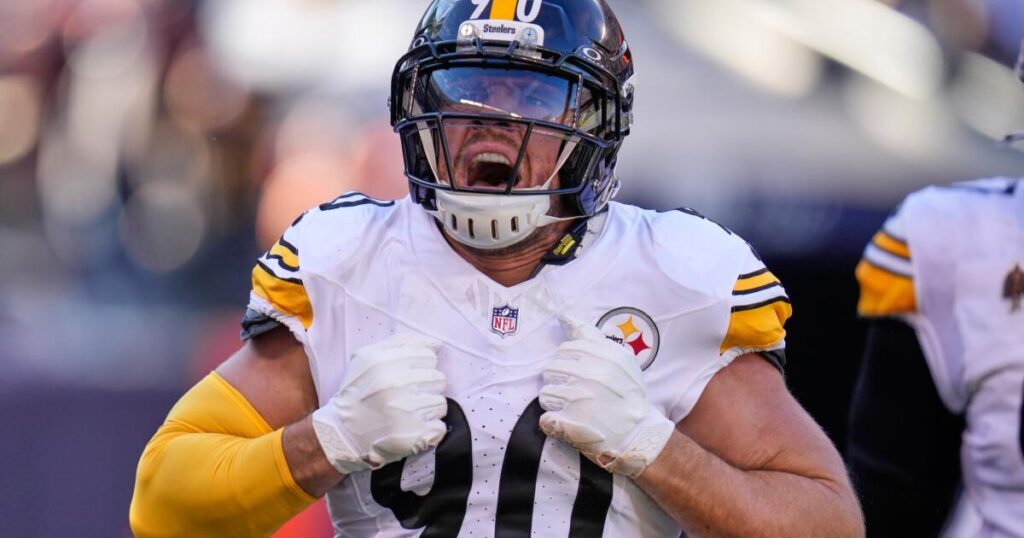
LAKE FOREST, Ill. — Arizona Cardinals tight end Trey McBride heard about what happened to Pittsburgh Steelers star T.J. Watt — and McBride plans to continue his weekly dry-needling sessions.
“It’s something I do frequently. I’ve never had an issue like that,” he said. “But with every treatment, everything that you get done, I mean, there’s risk to everything.”
The risk that goes along with dry needling — at least in certain areas — caught many off guard last week when Watt was sent to the hospital with a partially collapsed lung sustained during the procedure. The 2021 NFL Defensive Player of the Year is out indefinitely after having surgery.
Dry needling is a treatment used by physical therapists and acupuncturists to treat pain and movement issues, according to the Cleveland Clinic. The medical professionals insert needles under the skin to target trigger points — knotted or tender areas — in muscles.
Dry needling gives NFL players relief from tight muscles
Dry needling is often part of a larger pain management plan, according to the Cleveland Clinic. The treatment is designed to alleviate tightness and tender areas in muscles by increasing blood flow to the area. It also can spark the release of endorphins that help with the pain.
The treatment is called dry needling because the thin needles don’t have any medication.
“It just releases tight muscles,” said New York Giants linebacker Bobby Okereke. “Obviously you have some fascial tension, so it helps release some of the fascia, too. It can kind of give you like a targeted trigger-point release where massage might not be able to get the muscle to release or different stretching techniques might not. Sometimes you stick a needle deep into that area, and it just gets it to relax.”
Two of the most common techniques are superficial — when the practitioner inserts the needle into the bottom layer of skin above the trigger point — and deep — when the needle is inserted deep into the muscle to penetrate the trigger point. There is also the pistoning technique, when the practitioner quickly moves the needle up and down through the tissue.
According to the Cleveland Clinic, dry needling is approved for use in 37 states and Washington, D.C. Training and certification can vary by state. Pennsylvania does not explicitly allow or ban the practice.
Washington Commanders guard Sam Cosmi said he started using dry needling during his college days at the University of Texas. Playing his fifth NFL season, he has a session every three weeks or so.
He described the sensation of the needle going in as a “bite.”
“I only do it when I have to do it. It’s not my favorite thing,” Cosmi said.
Despite some concerns, NFL players will likely continue with dry needling
The use of dry needling varies around the NFL.
Baltimore Ravens defensive lineman John Jenkins said he has a session every week. The 36-year-old Jenkins, who is listed at 6-foot-3 and 360 pounds, has been using the treatment for about a decade.
“I do a lot of lower extremities, when it comes to dry needling,” he said. “It helps me loosen up a lot of muscles that are pretty much tense. I’m a bigger person, right? So whatever helps me to loosen the muscles, I’m going to pursue that.”
Tennessee Titans center Lloyd Cushenberry said he uses the treatment when he thinks it’s necessary. He cited his recovery from an Achilles tendon injury in November 2024 and a calf issue this past offseason.
“Sometimes, like with my calf, I felt some relief,” he said. “But most of the time I’ve done it, it’s, I don’t know, maybe a placebo, I don’t know. I haven’t found too much, like it wasn’t a drastic difference afterwards. But when I did it with my calf this offseason … it felt a little better.”
Some players are very particular about the areas where they will have the treatment. Cosmi said he doesn’t have any sessions on his torso. Cushenberry said he sticks to his lower body.
“I’m a lower-body guy. If I’m getting dry-needled, stick it in my legs,” said Commanders receiver Jaylin Lane.
Lane said he heard about what happened with Watt and it made him nervous. Atlanta Falcons offensive lineman Kyle Hinton also was aware of what happened, but he said it hadn’t changed how he felt about the treatment.
“I trust all professionals, at least around here,” Hinton said. “I’m sure they have a great athletic training staff in Pittsburgh as well. But, you know, sometimes stuff just happens.”
Cohen writes for the Associated Press. AP Pro Football Writer Teresa Walker and AP Sports Writers Howard Fendrich, Will Graves, David Brandt, Charles Odum, Stephen Whyno and Noah Trister contributed to this report.
The post Dry needling is common in the NFL, and players aren’t worried despite Watt’s collapsed lung appeared first on Los Angeles Times.