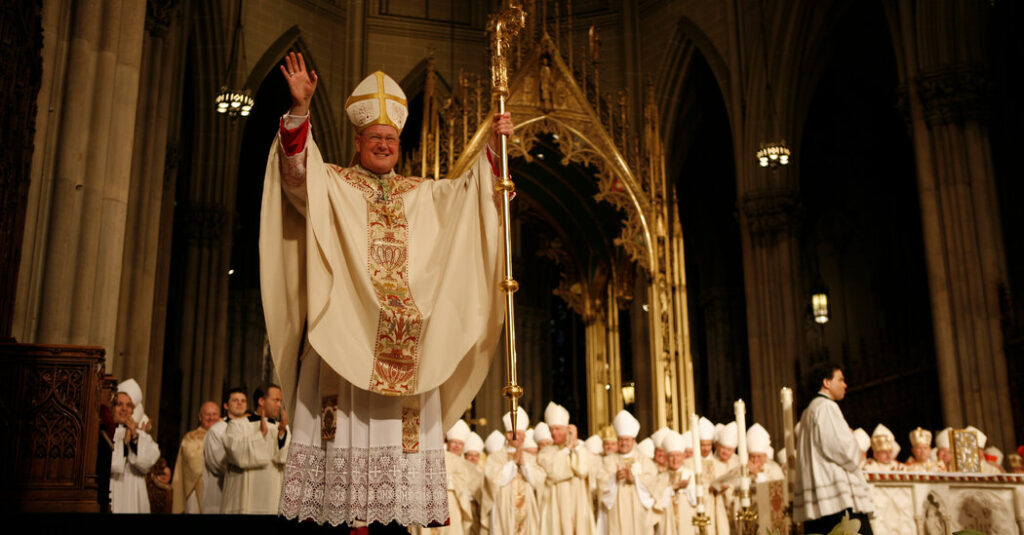
When Archbishop Timothy Dolan arrived to lead the Roman Catholic Archdiocese of New York in 2009, he had never lived or studied in the city.
By the time Pope Leo XIV accepted his resignation on Thursday, Cardinal Dolan had become an expression of it — a gregarious, towering figure who for years represented traditional American Catholicism on a rapidly changing national stage, from one of its most visible pulpits.
Until the pope’s election in May, Cardinal Dolan was perhaps America’s most widely known bishop, given his media savvy and political acumen. He understood that his platform was not limited to spiritual matters but rather provided an opportunity to act as a power broker across the city’s, and the country’s, spheres of influence.
It was an approach he took not only at St. Patrick’s Cathedral, but as an evangelist on most any platform he could find, from “Fox & Friends” to the White House to Terminal 1 at Kennedy International Airport.
He visited the Park Avenue Synagogue after Oct. 7, 2023, condemning antisemitism. He met with Zohran Mamdani before he was elected the city’s first Muslim mayor.
He publicly sat between Hillary Clinton and Donald J. Trump at a charity dinner late in the 2016 presidential race, praying privately with them together backstage. Each time Mr. Trump was elected president, Cardinal Dolan went to Washington to pray at his inauguration ceremony at the U.S. Capitol.
Embracing a role that Pope John Paul II once called “archbishop of the capital of the world,” Cardinal Dolan fostered relationships with Michael Bloomberg, Bill de Blasio and Eric Adams, the mayors who led New York over the 16 years that he helmed the archdiocese. His relationship with Mr. de Blasio was particularly friendly early in the former mayor’s first term, as he sought to calm tensions in the city after the shooting deaths of two police officers and aimed to push through one of his signature prekindergarten programs with participation from Catholic schools.
When it comes to governing New York, there are a handful of relationships that matter intensely, Mr. de Blasio said in an interview on Thursday. But in terms of the city’s cultural life, “I can’t think of a more important relationship to develop than with the archbishop,” he said.
“What I learned is there’s no bully pulpit like St. Patrick’s Cathedral,” he said. “If the archbishop decides to send a message, you know, it is often deeply felt and reaches very far.”
The great-great-grandson of Irish immigrants, Cardinal Dolan championed mainstream Catholic causes and culture of his time, as the American Church became both more Hispanic and more conservative. He spoke out forcefully against abortion and the legalization of gay marriage, and the American bishops elected him to be their conference president in 2010, hoping to reassert church teaching and gain political voice.
It worked, as he made himself the face of the church’s very public fight in 2012 with the Obama administration, over its requirement that Catholic hospitals and schools provide contraception for employees. That year, Pope Benedict XVI elevated him from archbishop to cardinal.
He got involved locally as well, and pushed state lawmakers to raise the minimum wage from $7.25, citing concerns for immigrants and people of color in danger of homelessness and unable to pay for food or medicine.
Becoming a cardinal was a capstone to a wide-ranging career rare among prelates, one where he rose through a full range of leading institutions of the Catholic Church in America.
As a young priest, he worked in a parish in Missouri and got a doctorate in church history. He became a secretary for the Apostolic Nunciature in Washington, the Holy See’s Embassy to the United States. He was made the rector of the Pontifical North American College, a leading seminary for American students in Rome, later returning to the United States to become diocesan bishop. He served as chairman of Catholic Relief Services, the global humanitarian agency for U.S. Catholics, and is a trustee of the Catholic University of America.
In 2012, he gave closing prayers at both the Republican and Democratic National Conventions. But over the past decade, as American politics polarized the Catholic Church, he became visibly friendly with President Trump, rankling progressive Catholics. He recently described the assassinated conservative activist Charlie Kirk as “a modern-day St. Paul.” He serves on Mr. Trump’s Religious Liberty Commission, and joked once in a private phone call that he spoke with the president more than with his own mother.
His career was defined in part by widespread allegations of sexual abuse by priests over the course of decades that burst into public view in the early 2000s. The crisis became the church’s defining challenge this century, entangling institutions from small parishes to the Vatican hierarchy, and scarring the institution’s reputation, its finances and the spiritual lives of millions of Catholics.
As archbishop of Milwaukee, the role he occupied before arriving in New York, he called sexual abuse the most challenging issue of his tenure. “Does it haunt me?” he asked The Milwaukee Journal Sentinel in 2009. “Yes it does. I’m not afraid to admit that.”
Four years later, files released by the archdiocese there revealed that he had quietly requested and received permission from the Vatican to move $57 million of archdiocesan funds into a trust that would protect the assets from sex abuse claims.
His defenders said that the money had been raised for the maintenance of Catholic cemeteries, and that he was rightly preserving it for that use.
The cardinal’s legacy on the issue is mixed, said Terence McKiernan, the president of the watchdog group BishopAccountability.org. In Milwaukee, he was early to recognize the need for a public list of priests who had been credibly accused of sexual abuse.
In New York, Cardinal Dolan commissioned a pioneering independent program to navigate abuse claims and settlements for victims. It was that program that turned up an allegation by a man who said he had been abused as an altar boy by Theodore McCarrick, who eventually became a cardinal in Washington, D.C. That allegation led to others, and Mr. McCarrick was later defrocked and faced criminal charges late in his life; he was found mentally unfit to stand trial and was never convicted.
“What he’ll be remembered for is the decision to take the allegation against McCarrick seriously,” Mr. McKiernan said of Cardinal Dolan. “That could have easily been buried.”
This month, Cardinal Dolan announced the archdiocese was raising at least $300 million in an attempt to negotiate a settlement that would benefit about 1,300 people who have said they were sexually abused as minors by priests and lay staff members in the archdiocese. To that end, last year the institution sold its longtime headquarters for more than $100 million, and has fired employees and reduced its operating budget.
Cardinal Dolan participated in conclaves electing two popes, the first in 2013, when Pope Francis was elected, and the second earlier this year, when the cardinals chose Leo, the first pope from the United States.
Years after the 2013 conclave, reports emerged that Cardinal Dolan had received two votes.
At a news conference in St. Patrick’s Cathedral on Thursday morning, Cardinal Dolan, 75, stood to the left of Bishop Ronald A. Hicks of Joliet, Ill., 58, who will take over as archbishop of New York in February. Asked if he had accomplished all he had set out to do, Cardinal Dolan became reflective, with a chuckle.
“No, and that ain’t bad, because there’s always a lot left to do, and I’m glad he’s here to do it,” he said.
He started naming communities he got to work with, Jewish groups, businesses and political leaders, and he turned to his successor.
“This is a great city, and you’re going to love it,” he said.
Elizabeth Dias is The Times’s national religion correspondent, covering faith, politics and values.
The post Cardinal Timothy Dolan Tapped the Power of the New York Pulpit appeared first on New York Times.