MANILA — The father and son accused of committing Sunday’s deadly mass killing in Australia spent weeks in a hotel in the largest city in the southern Philippines last month, the hotel said, as Australian authorities seek to learn how the pair spent the days and weeks leading up to a massacre they say was inspired by the Islamic State.
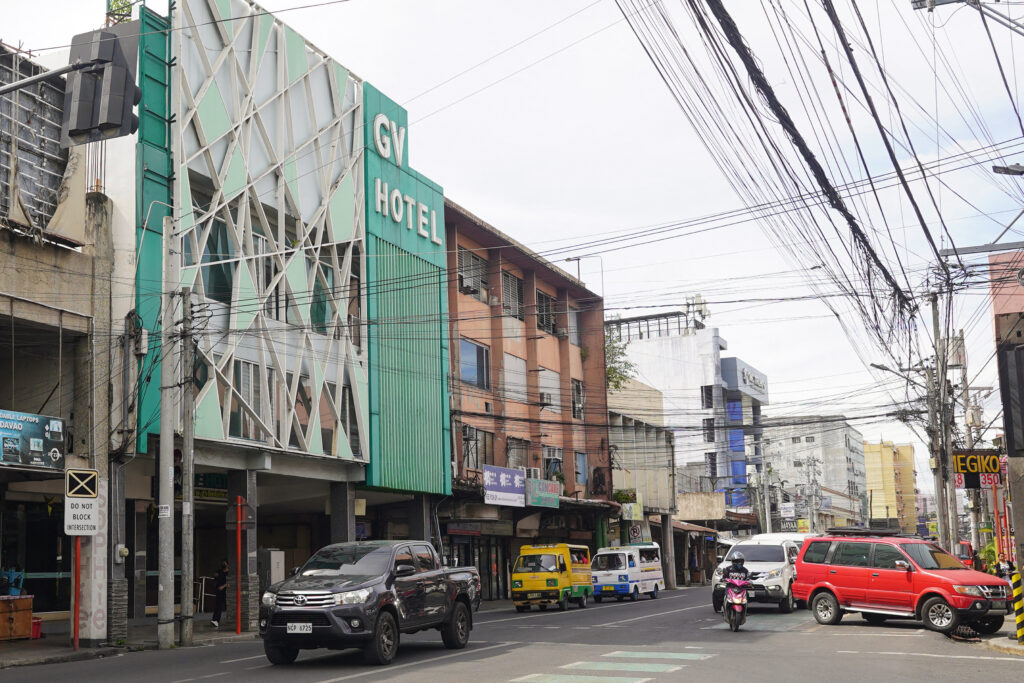
On Thursday, GV Hotel — a budget accommodation in downtown Davao City where two-bedrooms go for $15 a night — confirmed that the two alleged gunmen spent most of November there. Hotel staff told local outlet MindaNews, which broke news of their stay, that the pair rarely left their rooms. GV’s Jenelyn Sayson told MindaNews that the “longest that they would be outside would be around an hour.” They would extend a week’s stay at a time and paid in cash, Sayson told the outlet. The sprawling city of almost 2 million people is part of the southern island group of Mindanao, which has a history, albeit a declining one, of conflict and extremism.
The details come days after a report by the Australian Broadcasting Corporation, citing an anonymous senior counterterrorism official, that alleged that Sajid and Naveed Akram received “military-style training” in the Philippines — a claim that Philippine officials said is baseless and “misleading,” and about which some analysts had expressed skepticism.
The mountainous southern Philippines was once a place where Islamic State-aligned militant groups were very active and to which some foreign fighters flocked for training. But over the past eight years, the groups’ presence has severely diminished — so much so that some experts doubt that any have the capacity for such training, which historically took place in remote areas.
Australian officials allege the two men were inspired by the Islamic State group and said the extremist group’s flags were found at the scene of the Bondi Beach attack.
Naveed Akram, 24, was charged with 59 offenses — including committing a terrorist act — after regaining consciousness in the Sydney hospital where he remains under police guard. His father, 50-year-old Sajid Akram, was killed by police after the pair allegedly opened fire on a crowd at a Hanukkah celebration.
An employee of GV Hotel said national and local police have visited the hotel to investigate. The hotel is still open but is being bombarded with media calls — “too many to count” — said the employee, who spoke on the condition of anonymity because he was not authorized to speak to the public.
It is unclear what the men did — or whether they met anyone — while in Davao. Those details are among those police are interested in learning, Maj. Catherine Dela Rey, a spokesperson for Police Regional Office XI, said in a Wednesday briefing. She urgedcommunity members to come forward with information, assuring them that “your personalities will be confidential.”
The apparent connection between the Philippines and the killing of at least 15 people on Australia’s Bondi Beach has rocked the Southeast Asian country. Top Philippine officials vehemently denied reports declaring that the men underwent training there and raised concerns that international media was wrongly depicting the Philippines.
President Ferdinand Marcos Jr. “strongly rejects the ‘sweeping’ and ‘misleading’ characterizations of the Philippines as an ‘ISIS training hotspot,’” a presidential press officer said Wednesday, adding that no evidence supports the claim.
The alleged gunmen’s destination raised early suspicions because “while terrorist threats are declining [in the southern Philippines], they are not disappearing,” said Rommel Banlaoi, chairman of the Philippine Institute for Peace, Violence and Terrorism Research. There are still “remnants” of a handful of armed groups operating in the region, including Islamic State-East Asia factions.
Islamic State-aligned militants peaked in strength in the Philippines in 2017, during the Marawi Siege, where Filipino and foreign fighters loyal to the extremist group consolidated and seized the Mindanao city, launching five months of destructive urban warfare against U.S.-backed Philippine troops.
In the decades preceding the siege, observers documented training camps that drew overseas militants.
After the Philippine government regained control of Marawi in 2017, the militant groups lost strength. They also became even more ethnocentric and fragmented, cooperating less as one, said Kenneth Yeo Yaoren, a research analyst with the International Center for Political Violence and Terrorism Research. At the same time, peace processes began, and parts of the region once racked by violence were able to begin rebranding as peaceful tourist destinations.
The armed forces of the Philippines in a Wednesday statement reported a significant decline in domestic terrorist threats, saying the manpower of local terrorist groups declined from 1,257 members in 2016 to 50 this year. They cited peacebuilding efforts and military operations that killed more than two dozen “high-value” militants since 2016. Existing groups are “fragmented and largely defensive” with “weakened command structures,” it said.
Sidney Jones, founder and senior adviser at the Institute for Policy Analysis of Conflict, a nonprofit based in Indonesia, said that even if you validly assume that government estimates are an undercount, what you still see is low force numbers and a steady decline of the Islamic State group in recent years. The “major goal” of the groups right now is survival, she said.
This year, the Philippines was ranked 20th on the Global Terrorism Index, which measures the impact of terrorism; it ranked ninth in 2019.
According to Yaoren, the strength of militant groups has diminished significantly in recent years, to the point that he questioned their ability to host overseas fighters. “I don’t think they have the capacity to accommodate training.”
The post Bondi Beach suspects spent weeks in Philippine city, hotel says appeared first on Washington Post.