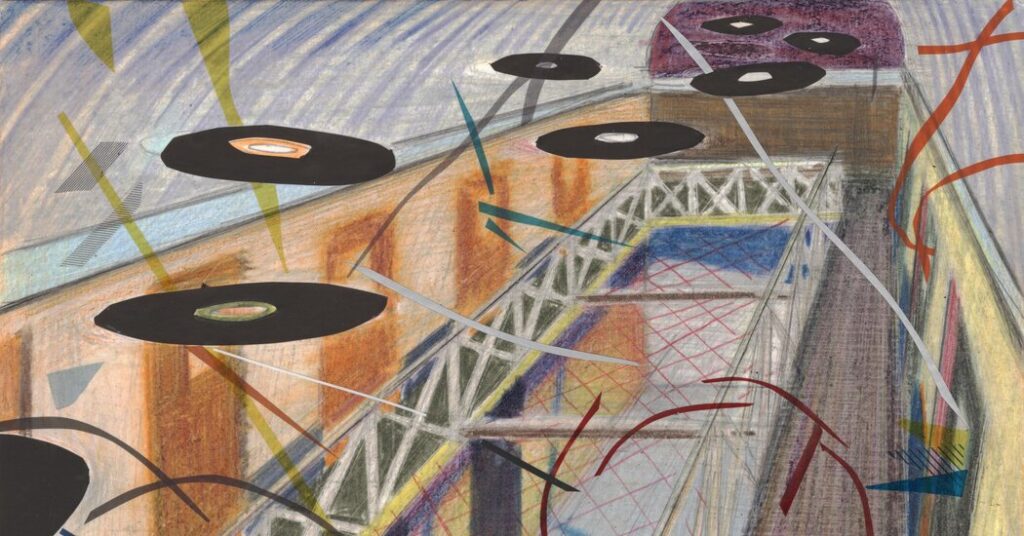
For more than 150 years, the 20-inch-thick bluestone walls of Pentridge Prison saw it all. On one side lay the quiet suburb of Coburg, in Melbourne, Australia, while on the other, some of the country’s most infamous criminals — including Mark Read (a gangster known as Chopper who asked a fellow inmate to slice off his ears) and Ned Kelly (the country’s most notorious 19th-century outlaw) — battled for dominance and survival, enduring solitary confinement and regular uprisings.
Since the facility’s closure in 1997, its grounds have become the home of a luxury hotel complex and a multiscreen cinema, complete with a craft beer bar and pricey wine cellars in the same cells where prisoners once slept. But over the summer, a perfectly preserved piece of the site’s history was rediscovered: the prison’s record collection.
The 1,600 records were played on 3PD, a closed-circuit radio station that officially started in 1956. The station’s sole program was a musical request show broadcast exclusively for the prison’s population, with the songs transmitted through a wall-mounted metal plate that acted as a primitive speaker in each individual cell.
The collection includes dime-a-dozen AC/DC records, but also highly collectible gems like a promo-only compilation by the Aussie hard rock band Krokus and even some old, 78 RPM shellac records dating back to the 1920s. The most remarkable records bear the hallmarks of the prison itself: a Bob Dylan album that was censored to remove the song “Desolation Row,” and a Johnny Cash record that’s been defaced to read “I hate it here.”
“They were pretty much able to get a hold of anything that was available,” said Glen Broome, who served time there in the 1980s. Italian inmates would “come in and somehow they’d get some albums donated to the prison that were in Italian.” The music played came from “across the spectrum.”
On a show that ran between 4 and 10 p.m. every evening, Broome played the spunky sidekick to his co-host, Peter Walker, who resided in a cell connected by a short corridor to a room stuffed with radio equipment and vinyl records donated by local radio stations and the family members of Pentridge’s prisoners.
Together, the pair would spin an eclectic mixture of music and read out correspondence during breaks. Often these messages included a request to play a specific song for a birthday or an anniversary, or to anticipate the result of an impending trial. Writing in via letter, families of the incarcerated would reserve one song for a guilty verdict and another if the prisoner had a happier result.
“Never underestimate the imagination of a prisoner, because they’ve got nothing better to do than just sit around and think,” said Jethro Heller, who served his time working in the prison’s mail office. The requests often included encoded information that reached prisoners via the airwaves. “It was quite ingenious,” he said.
For days and sometimes weeks on end, these records could often be the prisoners’ only correspondence with the outside world. “It’s more than just a record collection,” Heller said. “It’s a time capsule.”
The station’s roots trace back to March 1937, when two local papers reported that the results of professional cricket matches were being discussed among the prisoners, who followed live radio coverage from inside their cells. The story noted that “five wireless sets had been found” after individual parts were smuggled in inside cakes and then “assembled by the prisoners.” By 1940, the prison’s authorities allowed the equipment, and 16 years later, Pentridge introduced 3PD to coincide with the Melbourne Olympics. The station soon became an integral part of prison routine.
In 1966, John Killick, then 24, arrived at Pentridge. More than half a century later, he still remembers the two records that his brother sent there on his behalf: “Wanted Man” by Frankie Laine and “There Goes My Everything” by Engelbert Humperdinck. For Killick, who had spent time in other jails, the ability to request these treasured songs was a revelation. He also remembered Tom Jones’s “Green, Green Grass of Home” — with its narrator dreaming of returning to his childhood sweetheart, only to awaken and find himself in prison on the final day of his life, awaiting his own execution — echoing throughout the cells of Pentridge the day Ronald Ryan became the last man in Australian history to face capital punishment.
“It became the No. 1 hit where we were,” Killick said. “We were playing it all the time.”
The Chiavaroli family, who bought the prison in 1999 with — ultimately unsuccessful — ambitions to redevelop the site into an Italian-style “village,” left the records untouched in a storage vault for almost three decades. Earlier this year, it decided to clear out its estate and invited a local record store to take a look.
“We were actually the second record store on site,” said Joshua Smith of Footscray Records, who landed the haul. “A competitor got there before us and offered way too little money.”
Although the family wasn’t quite sure what it was sitting on, it had a hunch that it was worth more than the 500 Australian dollars it was initially offered. Smith is tight-lipped as to how much he paid, but estimates that there are some single records in the collection worth 500 Australian dollars alone.
After posting online about their new acquisition earlier this year, Smith and his staff have been inundated with interest from journalists, private collectors and even a well-respected publishing house. But before making grand plans for the collection’s future, Smith first hopes to make some sense of its past.
Three months after making the purchase, he remains hard at work cataloging the records, and has put out an open call for any ex-prisoners who can shed light on the collection’s history. “It’s just like this strange enigma that happened,” he said.
And for Killick, there is a hope that he might be reunited with his Humperdink seven-inch more than half a century later. “When they do catalog it, I’ll find out if my records are there,” he said, and “I might even buy them.”
The post An Infamous Australian Prison Held the Unexpected: A Record Collection appeared first on New York Times.