The arc of history, wise people have assured us, bends towards justice. But this year it has taken a very circuitous route according to many of the global aid agencies. Rich nations have cut off financial aid to poor nations. Wars have lasted longer and killed more people. Those who break international laws have suffered no consequences. Stable and resource-filled countries have turned inward, and escapees from dysfunction and chaos have flooded into already beleaguered regions. One agency, the International Rescue Committee (IRC), which looks after refugees, calls the current situation “a new world disorder.”
[time-brightcove not-tgx=”true”]
In 2024, according to the Peace Research Institute Oslo (PRIO), there were 61 wars taking place across 36 countries, the highest number since World War II. “This is not just a spike–it’s a structural shift,” a PRIO researcher said at the time. Indeed in 2025, most of these conflicts dragged on and their effects were exacerbated. Waging war is expensive and the longer conflicts last, and the more desperate each side gets, aid workers say, the more likely opportunistic factions are to take advantage of the discord by trading weapons or cash for access to extractive resources or land at bargain prices. These outside agents then have a motive for obstructing peace efforts.
Fighting has also pushed people away from their homes and farms, which leads to food shortages and famine. Save the Children’s analysis found that 60 million children were left starving because of wars this year and 11 million of them faced “emergency levels of hunger that necessitate desperate survival measures to stave off the risk of death.” The World Food Program (WFP) is projecting that in 2026, 318 million people will face crisis-level hunger or worse, twice as many as in 2019.
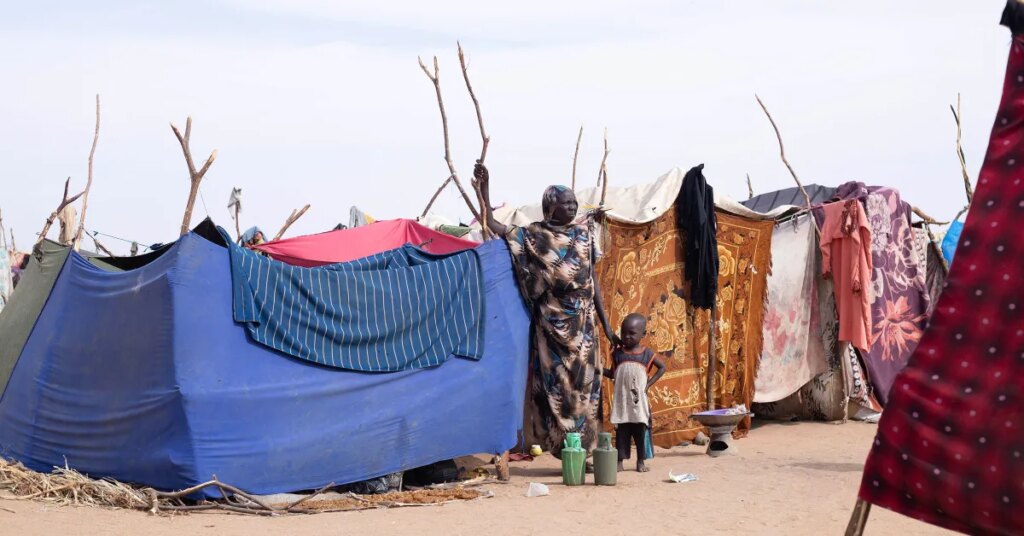
To Bob Kitchen, IRC’s vice president for emergencies, no country embodies this lethal confluence of events as well as Sudan. More than two years of civil war have led to famine conditions and mass displacement. “I can attest to the fact that it’s the largest humanitarian crisis anywhere in the world,” he says from Addis Ababa airport, having just returned from the Tawila refugee campin Darfur. “Sixty to 70% of the population is urgently in need of humanitarian assistance. There is a larger number of people in Phase 5 [the most severe category of famine] in Sudan than anywhere else in the world, including in Gaza pre-ceasefire.”
In December of last year, the U.N.’s 2025 Sudan Humanitarian Needs and Response Plan projected it would need the global community to commit $4.2 billion to help people inside Sudan, plus a separate $1.1 billion for Sudanese refugees in neighboring states. Why so much? Partly because of how many people are having to flee the violence, and partly because the war means much of the aid has to be trucked from Chad over a mountain range that leads into Darfur via a route that Kitchen calls “a donkey track.” The 45-mile journey takes aid trucks three days to complete.
“The sheer number of people who are being displaced on an ongoing basis means that the scale of our operations is very large, and the complexity of the locations we’re working in is off-the-charts complex,” says Kitchen. “From basic shelter to food to water to latrines to education to clothing items, everything has to be provided because they have nothing, and they have almost no coping capacity after what they’ve been through.”
But it’s not just war. Changes in climate have left many countries struggling to grow enough crops. New analyses from the Famine Early Watch System Network (FEWS NET) forecast that up to 3.5 million people in Kenya and up to 5 million people in Somalia will be in need of humanitarian food assistance at least until May 2026, because of record-breaking high temperatures and low rainfall.
At the same time, 2025 has seen a large-scale withdrawal of humanitarian and development funding of more impoverished nations by the world’s richer countries. This year the American foreign-assistance agency, USAID, which provided about $44 billion in foreign aid in 2023, was abruptly told to stop its work, then was shut down,and its diminished responsibilities transferred to the State Department. Cuts to foreign-assistance budgets were also announced by the U.K., Canada, Austria, the Netherlands, France, Germany, Belgium, New Zealand, Finland, Switzerland, and Sweden. Measured by nominal GDP, these countries account for about 43% of the world’s economic output.
As the year draws to a close, agencies around the world have begun to take stock of the effects of those cuts and many are sounding the alarm. The reductions have left the WFP able to feed only about 110 million—just over a third— of those who are going hungry, according to a new report. Oxfam’s modeling of the USAID shutdown suggested that it could result in 95 million people losing access to basic health care and 23 million children being pushed out of school. Mercy Corps said it shut down 42 programs, affecting 3.6 million people.
The impact on the ground is also becoming clearer, even in lower-middle-income countries. “In Kenya, we have a very huge increase in new [HIV] infection among children,” said Maurine Murenga, head of the Kenyan community organization Lean on Me, at a briefing organized by Devex on Dec. 17 to announce a new report on the aid cuts. “These children are children to adolescent girls and young women, and the reason they are getting new infections is immediately after the stop-work order, all the standalone HIV clinics were closed.” The pregnant women were directed to use the outpatient department of the hospitals instead of the clinic, but “in the outpatient department, we don’t have specialists,” says Murenga. “You just get the general practitioner who does not have detailed information about HIV prevention.” Experts also report seeing a rise in infections in babies in Uganda and among victims of sexual violence in Ethiopia and the DRC.
So far, most of these distress signals are being ignored. The Sudan Response Plan got just about a third of what was requested. Starting in January, the WFP will reduce food rations to “70% for communities that are facing famine, and 50% for those that are at risk of famine,” a WFP director told reporters. “As of April we will fall off a cliff when it comes to funding.”
The post 2025 Was Uniquely Bad for Poor Countries appeared first on TIME.