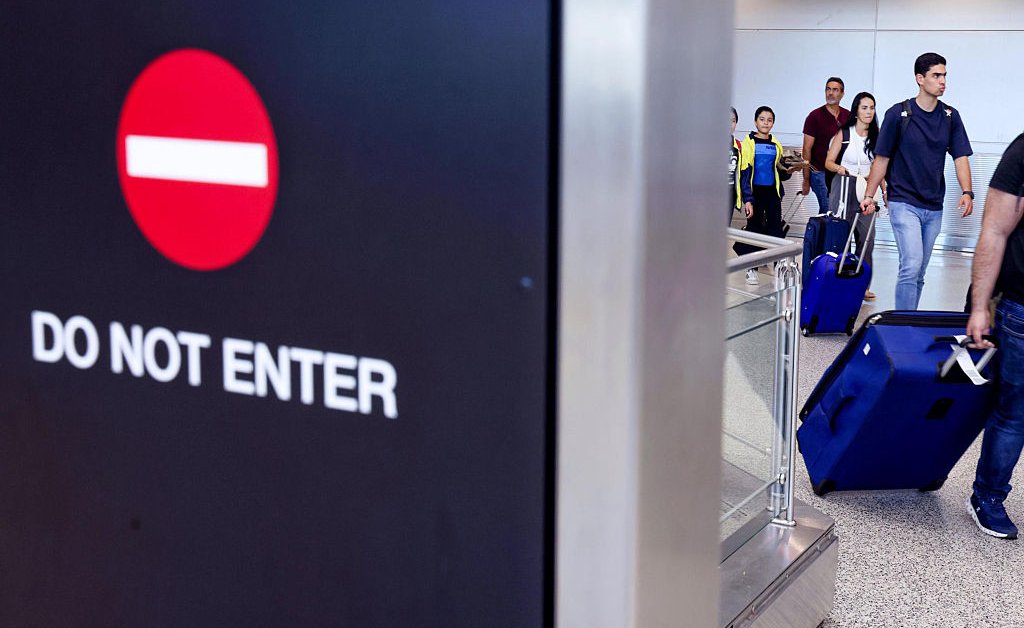
President Donald Trump has doubled the number of countries affected by his sweeping travel ban.
People holding passports from an additional 20 countries and the Palestinian Authority will be restricted or limited from travel to the United States, the Trump Administration announced on Tuesday. Nationals of 19 countries already faced entry restrictions to the U.S. as part of a June announcement. It is not yet clear when the new restrictions will take effect.
[time-brightcove not-tgx=”true”]
The move comes after Trump warned he would further restrict immigration into the U.S. following the arrest of an Afghan national in connection with the shooting of two National Guard members on the eve of Thanksgiving, one of whom died. The suspect has pleaded not guilty to murder and assault charges.
Read more: People Are Being Turned Away From Their Citizenship Ceremonies in Trump’s New Immigration Crackdown
The Trump Administration unveiled a spate of measures to curtail immigration in the wake of the attack, including announcing that it would “permanently pause migration from all Third World Countries,” “remove anyone who is not a net asset to the United States,” “end all Federal benefits and subsidies to noncitizens of our Country, denaturalize migrants who undermine domestic tranquility, and deport any Foreign National who is a public charge, security risk, or non-compatible with Western Civilization.” The U.S. Citizenship and Immigration Services said it would review the immigration statuses of lawful permanent residents and green card holders already in the U.S. from the 19 countries that were restricted in June.
Immigrant advocacy groups have criticized the move as an unfair attempt to use national security as an excuse to carry out Trump’s mass deportation agenda.
“Blanket travel bans based on entire nationalities or visa categories do not make the United States safer,” NAFSA: Association of International Educators said in a statement. “In fact, they do the opposite. They make us weaker.”
Here’s what to know about the new restrictions.
What does the new order say?
The proclamation bans citizens of five countries from entering the U.S.—Burkina Faso, Mali, Niger, South Sudan, and Syria—and fully restricts entry for people holding passports issued by the Palestinian Authority.
The Palestinian Authority (PA) has issued passports, subject to Israeli approval, since 1995. Palestinians already faced significant restrictions on entering the U.S. after the Trump Administration temporarily suspended nearly all nonimmigrant visas—including for medical treatment, business, work, tourism, or education—for those holding a PA passport in August. Earlier in August, the Administration had begun revoking and denying the visas of Palestinian officials ahead of the September U.N. General Assembly meeting, and stopped issuing visitor visas to Palestinians from Gaza, including those seeking humanitarian and medical treatment.
The Trump Administration said the reason for the move was that “U.S.-designated terrorist groups operate actively in the West Bank or Gaza Strip and have murdered American citizens.” It comes after Trump secured a fragile cease-fire between Israel and Hamas to end the two-year-long bombardment of Gaza, which includes terms for the dismantlement of Hamas and the end of Israel’s occupation of the territory.
Fifteen more countries also face partial restrictions: Angola, Antigua and Barbuda, Benin, the Ivory Coast, Dominica, Gabon, Gambia, Malawi, Mauritania, Nigeria, Senegal, Tanzania, Tonga, Zambia, and Zimbabwe.
The Trump Administration also moved to fully restrict nationals from Laos and Sierra Leone, which had faced partial restrictions in June. In June, Trump brought back his hallmark first-term travel ban. He banned nationals of 12 countries from entering the U.S.: Afghanistan, Myanmar, Chad, the Republic of the Congo, Equatorial Guinea, Eritrea, Haiti, Iran, Libya, Somalia, Sudan, and Yemen. He also partially restricted the entry of nationals from seven other countries: Burundi, Cuba, Laos, Sierra Leone, Togo, Turkmenistan, and Venezuela.
The restrictions apply to people seeking both U.S. immigrant and nonimmigrant visas—in other words, to anyone seeking to either emigrate to the U.S. or simply visit. Existing visa holders, U.S. permanent residents, and applicants for certain visa categories, including diplomats and athletes, are exempt from the new restrictions.
The Trump Administration also modified the partial restrictions placed on nationals of Turkmenistan, noting that the country “has engaged productively with the United States and demonstrated significant progress in improving its identity-management and information-sharing procedures.” The proclamation lifted restrictions on nonimmigrant visas for nationals of Turkmenistan, while entry as an immigrant remains suspended.
The countries affected by the ban were chosen because of “persistent, chronic vetting deficiencies” for citizens seeking to travel to the U.S., according to the proclamation, including “poor civil documentation and recordkeeping practices, widespread corruption and fraud, unreliable or inaccessible criminal records, and unreliable government travel documents.” The Trump Administration also cited high rates of people overstaying their visas as a reason for the policy, as well as blaming governments that have historically refused to take back citizens that the U.S. sought to deport.
NAFSA said visa overstay rates are “known to be deeply flawed,” and that using that as a basis for immigration policy is “misleading.”
How else has the Trump Administration tightened immigration?
The move is an escalation of the Trump Administration’s existing effort to tighten U.S. immigration. Days before the attack on the National Guard in D.C., the Trump Administration said it would reinterview all refugees admitted under the Biden Administration. It also sought to restrict certain lawful immigrants’ access to housing programs, and proposed giving immigration officers the discretion to refuse permanent residency to lawful immigrants who have made use of Medicaid and other safety net programs.
The Administration has targeted thousands of both legal and undocumented immigrants for detention and deportation this year, revoked visas on the basis of what it deemed divisive speech, and introduced more stringent criteria for U.S. citizenship applicants to “root out anti-Americanism.” It has also heightened scrutiny of tourists and visitors, as well as of international students.
Critics have warned that Trump’s anti-immigration moves could cost the U.S. both global talent and its influence on the world stage, especially as its rival China has opened itself up to more tourists, immigrants, and students, as well as sought to position itself diplomatically as a potential global leader.
“Relying on travel bans to act as a shield rather than relying on the strength of U.S. vetting protocols is essentially a retreat from global engagement,” NAFSA said. “Our isolationism will create a vacuum that other enterprising nations will gladly fill.”
The post What to Know About Trump’s Expanded Travel Ban appeared first on TIME.