Rochanne Douglas sat in a D.C. Superior Court room last Thursday wondering how her months-long dispute would end.
Would the person who had refused to leave her property since October be allowed to remain there? Or would the judge agree with Douglas that she should be ousted?
The case, first reported on by ABC7, had sparked debates on local social media about how to protect the rights of both tenants and property owners in the District. But for Douglas, it had become a “nightmare,” she said, costing her about $20,000 in lost rent, legal fees and property damage.
It was not a situation she could have imagined. “If I wasn’t living this, I would be like, ‘No way,’” she said.
The battle
The saga began in late February, when Shadija Romero signed a 32-day Airbnb rental contract for the rowhouse Douglas, 49, has owned in Northeast Washington since 2019.
Romero, Douglas said, asked for the long-term rental because she had been forced out of her previous apartment by a fire and the repairs would take a little more than a month. Douglas, a realtor and entrepreneur in Maryland, said she felt sympathy for her and was happy to do so.
Romero paid the $100-per-night fee through Airbnb and moved in for the temporary stay.
Temporary turned out to be much longer than Douglas expected. Or wanted.
After the first month, Douglas said Romero, who has a website that sells clothing and perfume, told her the repairs were taking longer and asked to stay another month. This time, instead of paying through Airbnb, she began paying Douglas directly.
What Romero hadn’t told Douglas was that she was in the process of being evicted from her prior apartment for not paying rent. Romero owed nearly $50,000 in back rent for an apartment in the District in 2024, according to court records reviewed by The Washington Post.
In 2023, D.C. Superior Court ordered Romero’s eviction from another D.C. apartment building for nonpayment of rent. A public records search reveals that Romero had at least a dozen judgments or liens filed against her going back to 2008, most of them landlord-tenant disputes in Maryland and Virginia.
Romero, who did not respond to multiple requests for an interview, initially made her payments to Douglas on time. But by June, payments were partial or late and Romero had begun asking for extensions, Douglas said.
At that point Douglas began searching court records and discovered Romero’s history as a tenant. When Romero’s August payment hadn’t arrived by the middle of the month and she asked for another extension, Douglas had had enough.
Douglas sent Romero an immediate vacate notice as well as a 30-day vacate notice.
“I told her she needed to vacate the property. And I specifically told her this is why I’m not a landlord because this is the kind of correspondence I don’t want to do,” Douglas said. “Airbnb is very clear. You book it, they pay you the next day. … I didn’t want to be in a situation where I had to listen to this every month.”
Romero paid her August charges. But in September, Douglas said, the situation repeated itself.
‘You will not stay in my house for free’
After receiving the September payment in installments, Douglas said she again issued vacate notices to Romero and told her if she wasn’t out by Oct. 15, she would have the power turned off.
“I don’t even want your money,” Douglas said she told Romero. “We don’t have an agreement.”
On the 15th, when she still had not heard back from Romero, Douglas had the power turned off. But when she went to check on the house, the power was back on.
Romero, Douglas said, had transferred the Pepco account into her name and had the electricity restored. Douglas said Romero told her she couldn’t turn off the power because she was a tenant and had tenant rights.
According to the DC Tenant Bill of Rights, a written lease is not required to establish a tenancy. But whether there is a lease or not, a tenant can be evicted for not paying rent after notice is served by the owner.
Airbnb said the agreement Douglas made with Romero was after the original Airbnb rental contract had ended and thus had nothing to do with Airbnb.
“This agreement was separate from any prior booking made through Airbnb,” an Airbnb spokesperson wrote in an email to The Post. “While issues like this are rare, hosts and guests should always communicate, book, and pay on Airbnb, so they’re covered by our policies and protections.”
After consulting with her lawyer, who told her that D.C. housing laws could allow Romero to halt any eviction for months, Douglas offered a deal.
If Romero would agree to leave by Nov. 15 and waive all rights of tenancy, she wouldn’t be charged anything for October or November. Douglas also offered $2,500 to help Romero relocate.
Romero signed the agreement on Oct. 23, and it was filed with the court. But Nov. 15 came and went, and still, she refused to leave. Douglas, infuriated, took a copy of the agreement to the police and asked for help to remove Romero from the property.
When she arrived at the property with police, Douglas said Romero again asserted she was a tenant and wasn’t going anywhere.
“I told her you will not stay in my house for free. My mortgage is four thousand dollars a month. You have not paid anything,” Douglas recalled saying. “I cannot afford for you to stay here. It’s not fair.”
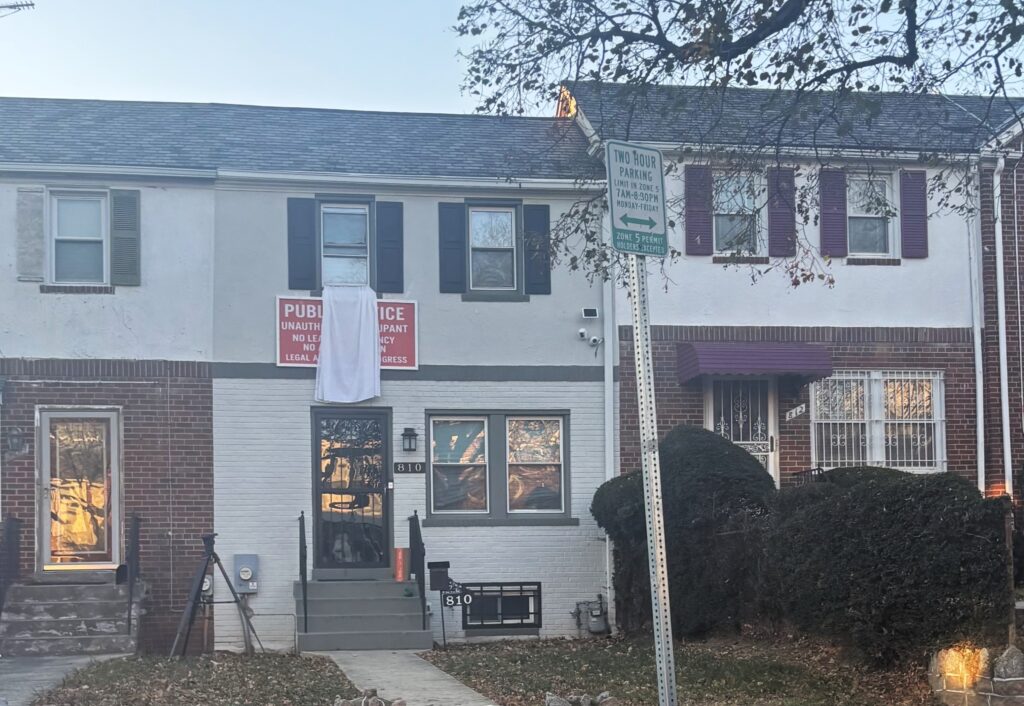
According to Douglas, Romero disabled security cameras at the home and called police to have Douglas’s car towed from her driveway. At that point, Douglas installed a large red sign with white lettering on the front of the home that read in part: Public Notice Unauthorized Occupant. Romero draped a sheet over it, but it was still visible.
On the night before Thanksgiving, Douglas heard from neighbors of the property that Romero appeared to have moved out.
The next morning Douglas went back with police and entered the home. No one was inside, and the police, Douglas said, told her she could change the locks and secure the property. She took batteries out of the electronic locks and had contractors board up the home. Later she had the electricity and water turned off. Police informed Douglas, she said, that if Romero reentered the property she could be arrested for breaking and entering.
But just a few days later neighbors again reached out to Douglas to tell her Romero was back in the property, this time accompanied by police. Douglas said police allowed Romero to remove the locks and reenter the home. She was right back where she started.
Douglas said she felt like her rights as a homeowner were being violated.
In an emergency court hearing held virtually on Dec. 4, Douglas was ordered to restore electricity and water to the home until a final decision in the case could be reached.
A decision
On Thursday, after hearing evidence from Douglas and her lawyer and from Romero, Judge Maurice Ross made his decision.
By signing the agreement to leave the property by Nov. 15, in which she acknowledged she didn’t have tenant rights, Romero gave up any claim on tenancy. Ross told Douglas she could take back possession of her home and did not have to wait the standard 20 days to do so.
“You can begin the process immediately,” he said.
The ruling was welcomed by D.C. Council member Zachary Parker (D-Ward 5), in whose district the disputed property is located. In a statement emailed to The Post, Parker said he was glad the court ruling brought a resolution to the case.
“My team and I are reviewing District laws to better understand how this was allowed to happen,” he said.
Joel Cohn, legislative director at DC Office of the Tenant Advocate, said he couldn’t speak to Romero’s case specifically, but he noted that short-term rental laws exist in the District to protect long-term rental housing stock.
Douglas wasted little time enforcing the judge’s ruling. Thursday afternoon, she and her husband brought friends and family members to help remove Romero’s belongings — candles and books, sheets and towels, electronic equipment and kitchenware — and place them in the driveway behind the home.
Romero posted a tearful video message on TikTok continuing to question some of the things that had been said about her and lamenting the judge’s ruling.
“The narrative that I was staying at a place since February and have not made a payment since March, that was also not true,” she said. Romero also lashed out at her critics and said she would take some time for herself.
“Because I know love up close, I know I will be okay,” she said.
According to Douglas, Romero came by the house Thursday evening and loaded her belongings into a U-Haul van. She hasn’t talked to her since.
The post What started as a 31-day stay became a ‘nightmare’ for D.C. Airbnb host appeared first on Washington Post.