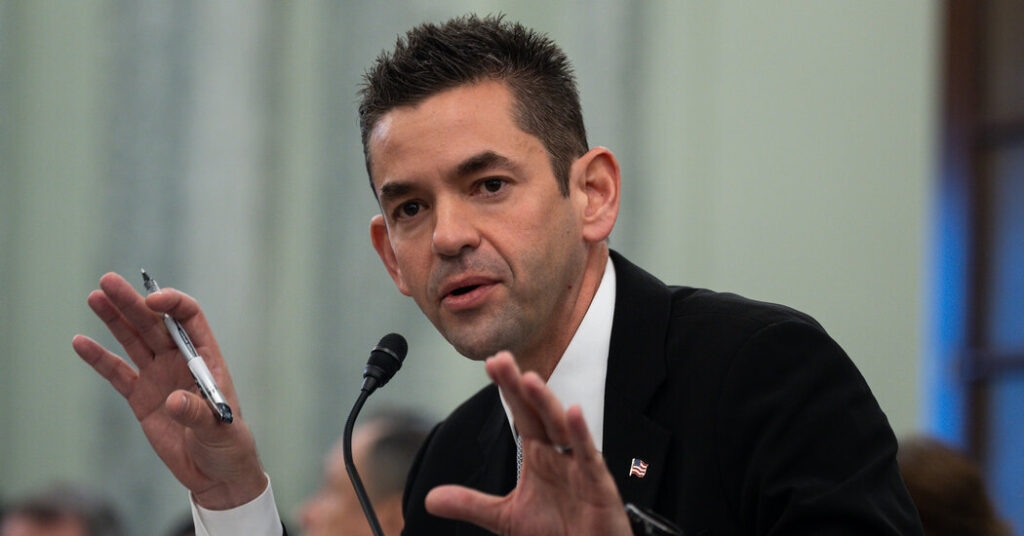
After 11 months of tumult and downsizing, NASA will have a permanent leader. The U.S. Senate confirmed Jared Isaacman, the billionaire entrepreneur who traveled to orbit twice on private space missions, to the post of administrator on Wednesday by a 67-30 vote.
As Mr. Isaacman assumes his post, some believe NASA has an opportunity for reinvention similar to a crossroads that the agency faced after the fall of the Berlin Wall in 1989 and the dissolution of the Soviet Union two years later. In that time period, the agency was also led by an administrator who was an executive bringing ideas from the private sector to the federal space agency, rather than a former NASA astronaut or a government insider.
He was Daniel Goldin, who was nominated by President George H.W. Bush and ended up also serving Presidents Bill Clinton and George W. Bush during his tenure of nearly a decade. The ups and downs of Mr. Goldin’s leadership could be instructive for Mr. Isaacman.
In May, Mr. Isaacman wrote a document called “Project Athena Strategic Plan,” which offered ideas about how he hoped to reorganize and reinvigorate NASA.
“NASA will return to focusing on achieving the near impossible — doing what no other agency, organization or company is capable of doing,” he wrote in the introduction.
Mr. Isaacman highlighted three objectives: human space exploration of the moon, Mars and deep space; unlocking a larger space economy; and becoming a “force multiplier” for science missions, tapping into partnerships with commercial companies and academia to bring down costs.
He has received broad support from the space community. “I think that puts NASA back on a good track,” said Todd Harrison, an analyst with the American Enterprise Institute, a libertarian think tank.
That sentiment was shared by Senator Marie Cantwell, Democrat of Washington. On Wednesday, she highlighted the importance of returning NASA astronauts to the moon as she called on senators to support his nomination.
“I am optimistic that Mr. Isaacman will bring a steady hand and clear vision to NASA,” she said. “I hope we can partner together, all of us, to achieve this incredible thing for the American people.”
But Mr. Isaacman could have started this agenda earlier in the year had he been confirmed to the NASA post in June. Then President Trump suddenly changed his mind and pulled the nomination just days before the Senate would have likely confirmed him. Mr. Trump changed his mind again in November and renominated Mr. Isaacman.
The NASA he will lead today is very different from the one he would have taken over in June. Nearly 4,000 NASA employees — about a fifth of the work force — have left or will leave soon, part of federal downsizing. And the agency is facing fierce global competition as China pledges that it will land astronauts on the moon by 2030.
To return astronauts to the moon in the Artemis III mission, NASA is relying on a lunar lander being developed by Elon Musk’s company SpaceX. But the vehicle is a variant of the Starship rocket and is still being developed. Sending it to the moon requires a whole series of launches to give the lunar lander enough propellant to leave Earth’s orbit. Moving millions of pounds of ultracold liquids between spacecraft in the absence of gravity is a rocket engineering feat never before achieved.
The complexity of Artemis III has led members of Congress and Sean Duffy, the secretary of transportation, who has been filling in as NASA’s acting administrator since July, to voice concerns about SpaceX’s delays and the increasing likelihood that China will beat NASA in this 21st-century space race.
Satisfying often competing priorities highlights the “bureaucratically fraught position” in which Mr. Isaacman will find himself, said Eric Romo, the president and chief operating officer of Impulse Space, a company that is developing orbital spacecraft.
During a panel discussion at the Deutsche Bank Global Space Summit in November, Mr. Romo cautioned that Mr. Isaacman would face constraints on how quickly he could change NASA.
“Congress basically tells them extremely clearly what to spend money on,” Mr. Romo said. “The White House has their own priorities.”
One example is the prescriptions of Mr. Trump’s tax and spending law that Congress passed over the summer. It includes provisions added by Senator Ted Cruz, Republican of Texas, that add billions of dollars for NASA. But those funds must be spent on big, expensive projects like the Space Launch System, a rocket built by traditional aerospace contractors.
By contrast, in the Athena document, Mr. Isaacman called for “working alongside industry to determine a more affordable, repeatable architecture that applies to the moon, Mars and deep space.”
As Mr. Isaacman contends with these pressures, some experts say he may look to Mr. Goldin’s experience in the 1990s.
NASA, then led by Richard Truly, a former astronaut, wanted a major budget increase for Mr. Bush’s plans to send astronauts back to the moon and then to Mars while continuing to work, without changes, on the Space Station Freedom, a project started under President Ronald Reagan that was years behind schedule and far over budget.
There was also the embarrassment of the Hubble Space Telescope, which was launched in 1990 with a mirror that produced fuzzy pictures.
“NASA was in a total crisis at that time,” said Mark Albrecht, who served as executive secretary of the National Space Council under President George H.W. Bush.
In early 1992, Mr. Truly announced he would resign.
In the search for a new NASA administrator, Mr. Albrecht remembered Mr. Goldin, a technology-savvy executive at TRW Inc. He led that company’s satellite program.
When Mr. Bush lost to Mr. Clinton in the election later that year, the Clinton administration kept Mr. Goldin.
He was able to recast the Freedom project into the International Space Station. Astronauts repaired the Hubble telescope in orbit, and it has been sending back sharp images of the cosmos ever since.
Mr. Goldin also pushed the philosophy of “faster, better, cheaper” — more missions with more modest goals and smaller price tags so that one failure would not be catastrophic.
The first of those lower-cost missions — Mars Pathfinder — successfully put the first rover, about the size of a breadbox, on the red planet in 1997.
Then, in 1999, two Mars missions — the Mars Climate Orbiter and the Mars Polar Lander — failed.
Still, those two missions together cost about half as much as an earlier failed Mars mission built in a more traditional way, and NASA was able to recover more quickly.
“Dan was the first to really think through, ‘How could you do a cadence of competitively bid science missions?’” said Lori Garver, who worked for Mr. Goldin at NASA headquarters from 1996 to 2001 and then became NASA’s deputy administrator during the Obama administration. “And we take that for granted today.”
Mr. Albrecht said, “My hope is that Jared is another Dan.”
Mr. Goldin declined an interview request to talk about NASA and Mr. Isaacman.
But last month he posted some thoughts and recollections on his X account about NASA.
He said he had three big goals when he started at the agency: building small, affordable satellites; making launch costs cheaper; and getting the government out of Earth orbit. These share similarities with Mr. Isaacman’s Athena plan.
“There’s so much more to do in space,” like mining near-Earth asteroids, Mr. Goldin wrote, adding, “We have a grasp of the basic science and technology for this. The question is: Do we have the desire?”
Kenneth Chang, a science reporter at The Times, covers NASA and the solar system, and research closer to Earth.
The post Trump’s NASA Pick Is Confirmed at Last to Lead Space Program in Peril appeared first on New York Times.