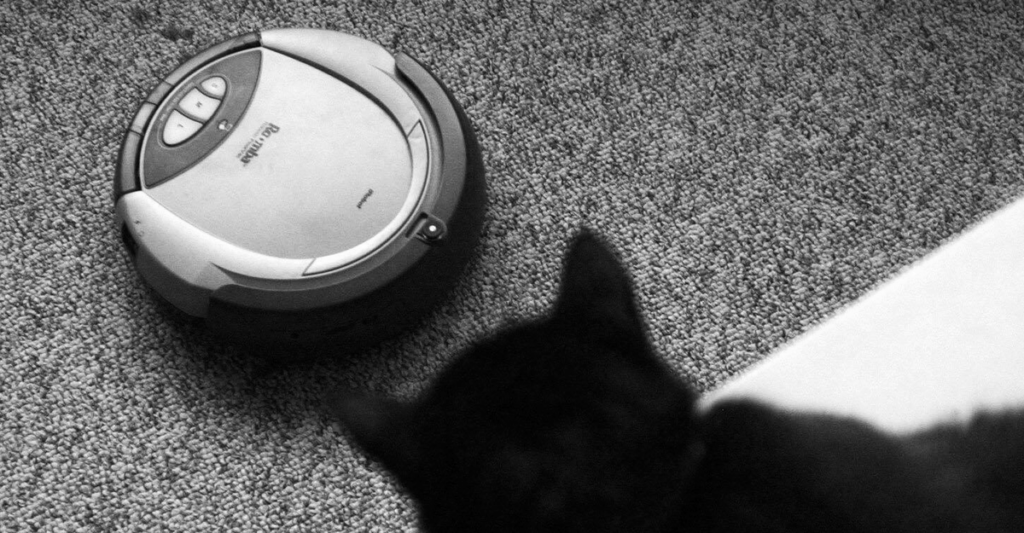
The home-vacuum robot began, like most things, with war. In August 1990, the same month and year Saddam Hussein invaded Kuwait, three MIT roboticists incorporated the company that would eventually become iRobot, the maker of the Roomba.
In its first decade, iRobot began to assemble a small-droid A-team for the theater of combat. The Ariel defused mines; the PackBot handled bomb disposal. (Later they would be joined by the Warrior, which breached obstacles; the camera-encrusted SUGV, which handled recon; and the palm-size FirstLook, which could be thrown through a window to investigate hazardous materials.) These machines weren’t weapons, but they facilitated weaponry’s consequences. At the turn of the millennium, iRobots might be seen on cable news kicking up Iraqi dust, investigating suspicious domestic packages, and probing the ruins of the World Trade Center.
From their armature, iRobot built Roomba in 2002—a domesticated robot that surveilled, detected, and removed materials from wood floors and carpets. Roomba created the U.S. market for home vacuum robots, and home robotics in general, insofar as a general home robotics was ever realized. Eventually, things went south. Competitors took over. A 2022 acquisition by Amazon failed on antitrust grounds, and this week iRobot filed for bankruptcy. Roombas will continue to meander across wool and laminate, but under the control of iRobot’s Chinese manufacturing partner.
Roombas never really worked, not well. They got stuck on the lips of rugs. They tumbled down stairs their sensors failed to see. Cluttered spaces—which is to say, homes and apartments—caused Roombas to struggle. They tripped over electrical cords, they failed to clean in corners, and they failed to pick up debris beyond fine dust. Because of all this, Roomba owners sometimes felt the need to tidy up in advance of robotic cleanings, or to add a round of human cleaning afterward. The high-tech vacuum could seem like a wayward pet.
The Roomba also shared some DNA with its military forebears. The device builds an internal map of the home it struggles to clean, and iRobot disclosed that these ghost maps could be shared with partners. In 2022, images leaked from Roomba test units outfitted with cameras, which showed real people in their homes, including one woman on the toilet. Depending on the whims of its new owner, the innocuous robot could become a spy. Some worry that Roombas will become a swarm of covert, foreign operatives.
Roomba’s affliction inverts the hopeful spirit that it and other robots of the early aughts once held. In 2001, Segway promised to reinvent cities with its electrified stand-up scooters. Sony’s AIBO, an expensive robot dog, was meant to offer both companionship and entertainment. LEGO Mindstorms promised to teach kids to program robots. But most such products either failed or drifted into unexpected niches. (The Segway lingers as a vehicle for sightseers and mall cops.) New ones have appeared—the costly Roomba-style lawn mowers I now see in my neighborhood, for example, or preposterous humanoid AI butlers such as the 1X Neo and the as-yet unreleased Tesla Optimus, which cost as much as a small car. By any reasonable standard, the dream of everyday robotics has largely failed.
[Read: A pocket guide to the robot revolution]
Why? Because software was easier. After 2004 or so, when the economy had recovered from the dot-com crash, consumer growth and corporate profit came from scaling low-cost, data-driven software services: Google, Facebook, LinkedIn, Salesforce, YouTube, Skype, even WordPress and Blackboard. Innovation in machinery was redirected toward personal-media and communication devices. Once the smartphone was invented, it produced another surge of data-driven software products.
For most consumers, robots also promised (and delivered) far less utility or joy than, say, a social network, which was much simpler to build and run. But the robots still had value in the contexts that begat them: warfare and espionage. iRobot continued selling military products, and spun off that business in 2016. Sony discontinued its original entertainment robots, and repurposed their technologies for other consumer products. Industry found applications, too: Larger-scale robots became commonplace in factories and warehouses, where the environments are standardized and automated labor can be overseen. And iPad-on-a-stick telepresence robots became popular in hospitals, where eventually they helped deliver last rites to COVID-19 patients in quarantine.
The humble Roomba is important as a symbol of everyday robotics’ promise and its failure. Whether in The Jetsons or Star Wars, the idea that cute, autonomous devices could live inside your home has persisted. It is time to abandon that dream for good. Robots are for battle, and robots are for spying, and robots are for places where humans will not or cannot be. They are not your friends, and they will never clean your floors.
The post The Roomba Was a Disappointment appeared first on The Atlantic.