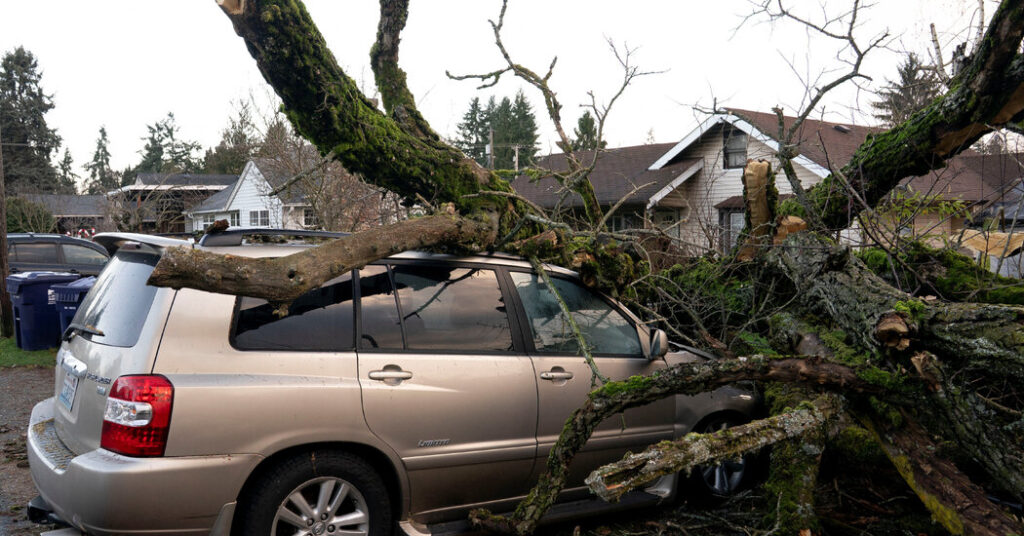
A burst of strong winds battered Oregon, Washington and British Columbia early Wednesday morning, leaving hundreds of thousands of people without power across a region where unusual amounts of rain in the last week have pushed rivers over their banks and forced tens of thousands of people to flee their homes.
The winds developed in the wake of yet another wet storm that moved through Tuesday.
A wind speed of 112 miles per hour was recorded on a peak near the Alpental ski resort in North Bend, Wash., while a gust of 70 m.p.h. was measured in Hope, British Columbia, in the Fraser Valley, where flooding has occurred in the last week.
While storms in December often bring winds to this corner of the world, Kayla Mazurkiewicz, a meteorologist with the National Weather Service in Seattle, said the gusts Wednesday were “definitely unusual.”
As of 11:30 a.m. local time, nearly 400,000 customers in Washington and Oregon were without power, according to poweroutage.us, a website that tracks utilities. In British Columbia, more than 72,000 customers were without power on Wednesday, according to poweroutage.com. Widespread outages stretched into Montana and Idaho, as the storm carried the high winds east.
In Montana, emergency officials urged people to avoid traveling through the afternoon, and they warned that wind gusts could reach as high as 90 m.p.h.
The Washington Emergency Management Division reported power outages “across large chunks of the state” Wednesday morning.
In Aberdeen, Wash., part of a building collapsed after high winds struck Tuesday evening, according to the city’s Police Department, which shared photos of the debris covering a sidewalk that was temporarily closed.
The Washington State Department of Transportation said that U.S. Highway 12 was closed in both directions from Packwood to Naches on Wednesday morning because of downed trees, white-out conditions and low visibility.
The agency said that Interstate 90 at the Snoqualmie Pass was open, but that power was out and cameras were down Wednesday morning. Water had also been reported on the roadway from rain the night before. Some school districts were closed on Wednesday because of the weather.
In Oregon, the state’s Department of Transportation shared photos of roadways such as Highway 126 with downed power lines and trees as crews worked to clear up the debris. The department also reported that high winds and heavy rain in the Willamette Valley in the northwest region of the state were causing hazardous road conditions.
Several rocks fell from the facade of the Hi-Tide Oceanfront Inn in Seaside, Ore., and damaged a truck, according to the city, which posted an image on Facebook. No one was injured, said Joshua Heineman, tourism director for the city. The city was urging residents not to call 911 or the Police Department for updates on power outages.
Schools there and in districts such as Astoria and Jewell were closed because of a lack of power, high wind conditions and roads that were dotted with debris and downed trees.
Brian Proctor, a meteorologist at Environment Canada, said this recent storm was part of a string of weather that has packed an extra punch, even for a region used to powerful systems moving through.
“These systems have been very active, very dynamic,” Mr. Proctor said.
Over the last week, rainfall totals across the east Fraser Valley in British Columbia have ranged from about six to 10 inches. In western Washington, totals have exceeded 16 inches in the Cascade Range, with over four to eight inches in the valleys spread between the mountains and Puget Sound. This water has poured into the rivers, pushing many of them to record levels and bringing devastating flooding.
More storms are on the way, with one arriving as soon as Thursday, Mr. Proctor said, but they are expected to be more typical cold systems, bringing more snow than rain to the mountains.
“We’re slowly transitioning out of this period,” he said.
Johnny Diaz contributed reporting.
Amy Graff is a Times reporter covering weather, wildfires and earthquakes.
The post Storm Knocks Out Power for Hundreds of Thousands in the Pacific Northwest appeared first on New York Times.