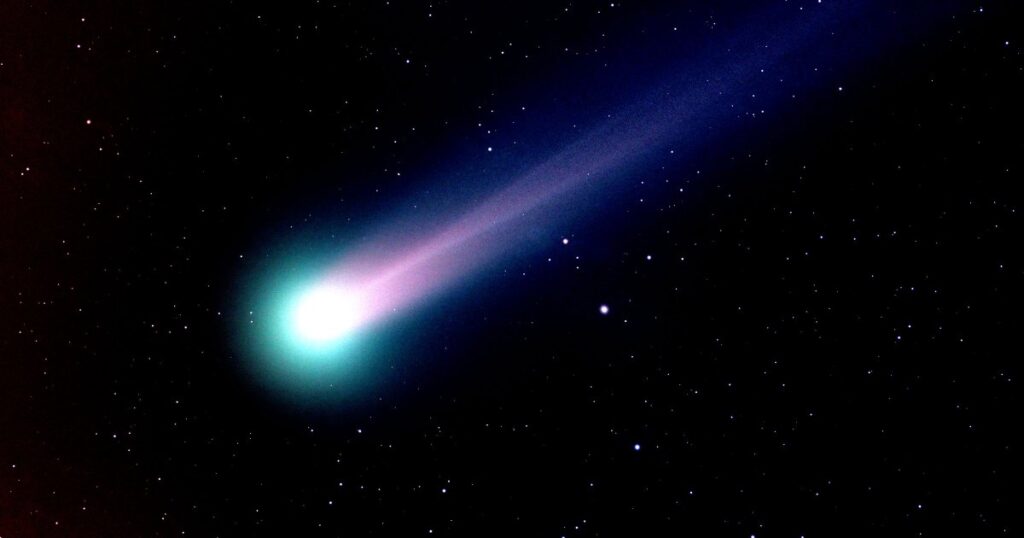
We’re mere days away from mysterious interstellar object 3I/ATLAS making its closest approach to Earth before it speeds back out of the solar system, never to be seen again.
The object, which scientists believe is a comet visiting from far away, is expected to come within just shy of twice the average distance between the Earth and the Sun. While that may sound like an enormous divide, astronomers are eager to point ground- and space-based telescopes at the extremely rare object during the best opportunity they’ll ever have to study it.
As we wait to hear more about those observations, Harvard astronomer Avi Loeb — who has long championed the far-fetched hypothesis that the object could be an alien spacecraft coming to visit — is continuing to closely track 3I/ATLAS, while taking note of what he calls its many “anomalies.”
The main thing that got his attention was that the object’s trajectory is almost exactly aligned with the solar system’s planets, in a striking coincidence. And that’s without getting into the object’s unusually large suspected size, its close approach of several solar system planets, its unexpectedly high concentration of carbon dioxide ice and gas, and a “Sunward jet” that he suggests could be a beam designed to “mitigate the risk from micrometeorites or rocks,” among several other “anomalies.”
Now, he’s pointing to a new letter published in the journal Astronomy & Astrophysics, in which a team of astronomers in Spain detailed the “detection of a wobbling high-altitude jet” in the interstellar comet that showed up in observations taken by the Two-meter Twin Telescope in Tenerife, Spain, between early July and September.
According to the findings, this Sun-facing “anti-tail” jet is “offset by less than eight degrees from the poles associated with the rotation axis of the nucleus,” as Loeb explained in his latest blog post, which means that “3I/ATLAS has a steady dayside and a steady nightside, which switch roles at perihelion,” or its closest approach to the Sun.
3I/ATLAS reached perihelion on October 29, coming within 126 million miles of the Sun.
Loeb argued that it’s extremely unlikely — a probability of just 0.5 percent, according to his calculations — that the object’s rotation axis would be aligned within just eight degrees with the direction of the Sun, giving it a smooth transition from dayside to nightside.
“If not for that special alignment, the anti-tail jet towards the Sun would have been oriented at a much larger angle relative to the rotation axis and would have shown a much larger wobble in position angle than the observed value of eight degrees,” he wrote.
“With a larger misalignment angle, it could have featured prominent gaps in activity as its base exits the dayside and enters the nightside of 3I/ATLAS,” Loeb explained.
3I/ATLAS’ Sunward anti-tail didn’t disappear after it reached its closest point to the Sun, adding to the mystery. To Loeb, this would imply that there’s a “new pocket of ice near the opposite pole of the rotation axis, that gives rise to a prominent new anti-tail jet after perihelion.”
“Of course, a technological spacecraft might have a reason for aligning the outflow of gas from its thrusters in the direction of the Sun,” he suggested, arguing that “we do not have high-resolution images of the jet direction near perihelion.”
Plenty of questions remain, and Loeb hopes that “upcoming spectroscopic observations of the material” inside 3I/ATLAS’ anti-tail will shed more light on the matter.
More on 3I/ATLAS: 3I/ATLAS Still Showing Strange Protrusion as It Approaches Earth
The post Scientists Say They’ve Found Another Anomaly About 3I/ATLAS appeared first on Futurism.