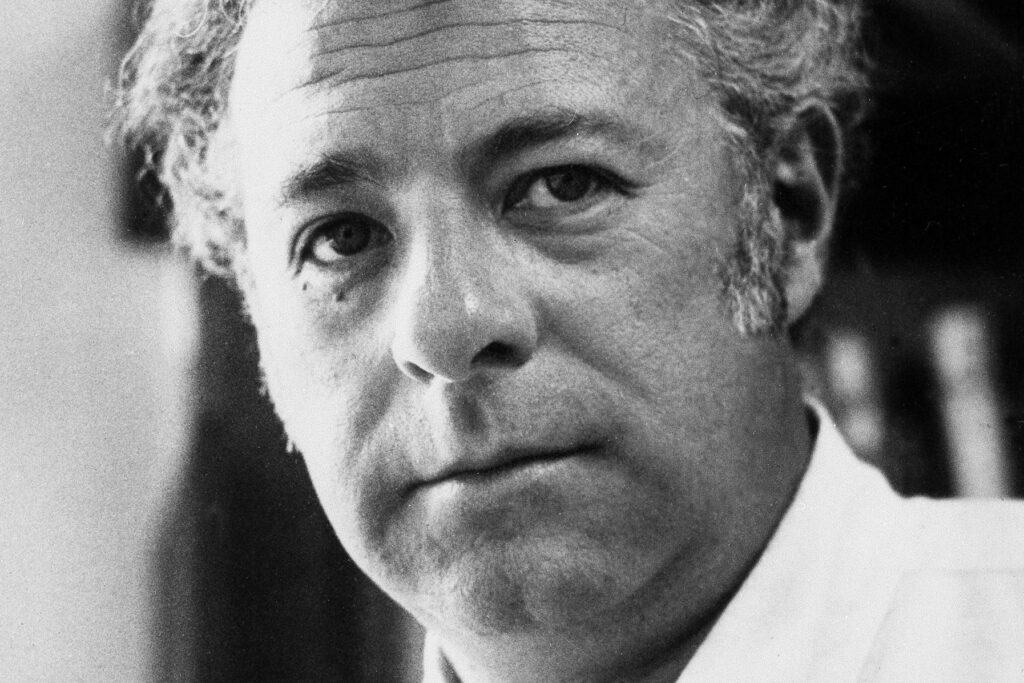
Norman Podhoretz, the disputatious Commentary magazine editor who rose from poverty in Brooklyn to the heights of American intellectual life in Manhattan, then veered from the left to the right to become a leading neoconservative voice on foreign policy, died Dec. 16. He was 95.
His death was confirmed by his son, John Podhoretz, in a statement published by Commentary that did not specify the cause of death. Mr. Podhoretz had been treated for spinal stenosis in recent years.
Sardonic, immodest and tirelessly prolific, Mr. Podhoretz wrote hundreds of essays and a dozen books, most notably “Making It” (1967), a candid account of his self-professed drive for money, power and fame. As the top editor at Commentary from 1960 to 1995, he also converted a once-liberal, Jewish-oriented monthly into a house organ of neoconservatism, the political movement that he spearheaded with his friend Irving Kristol, editor of the Public Interest policy journal.
Although its circulation was modest, peaking at about 60,000 in the 1960s, Commentary maintained an outsize influence for decades, energizing debates surrounding foreign policy, affirmative action, gender roles, sexuality, education and what became known as political correctness.
Two of its contributors, Daniel Patrick Moynihan and Jeane J. Kirkpatrick, were separately appointed U.S. ambassador to the United Nations, buoyed by essays they wrote for Commentary in the 1970s. In 1979, Washington Post columnist George F. Will called the magazine “America’s most consequential journal of ideas,” adding that Mr. Podhoretz was “a scourge of intellectual foolishness, his own emphatically included.”
Writing with vinegar, if not acid, Mr. Podhoretz excoriated liberals and conservatives, attacking the “disaster” of women’s liberation as well as Republicans whom he regarded as insufficiently hostile toward the Soviet Union. His early work, he told the New York Times in 2017, offered “something to offend everyone,” including in a 1963 essay, “My Negro Problem — And Ours,” which suggested that miscegenation, rather than integration, was the solution to America’s racial strife.
The son of Yiddish-speaking immigrants from Eastern Europe, Mr. Podhoretz reinvented himself several times over, evolving from street-tough gang member to clean-cut graduate of Columbia and Cambridge, from literary takedown artist to liberal political commentator, and from left-leaning peacenik to proponent of preemptive, unilateral warfare.
His political transformation mirrored that of Kristol and other New Deal Democrats who moved to the right in the 1960s, disillusioned by the countercultural and New Left movements and skeptical of President Lyndon B. Johnson’s Great Society programs. Also at play, he said, was his deepening attachment to Judaism, his frustration with the “anti-Semitism of the left,” and a sense that the United States was being blamed for too many of the world’s ills.
“The issue was America,” he told the Wall Street Journal in 2006. “I was repelled, almost nauseated, by the rise of anti-Americanism on the left. The hatred of this country seemed to me not only wrong, it was disgusting.” He struck a similar chord in recent years, telling the Journal in 2021 that “this ‘woke’ business — critical race theory, Black Lives Matter, all of it — is just pure anti-American hatred.”
Mr. Podhoretz championed an expansive use of American power, calling for a military buildup in lieu of détente with the Soviet Union, and “probably did more than anyone else to keep the survival of Israel and the plight of Soviet Jews at the forefront of public debate,” according to journalist Jacob Heilbrunn’s book “They Knew They Were Right: The Rise of the Neocons.”
Soon after the terrorist attacks of Sept. 11, 2001, he called for an invasion of Iraq to dislodge Saddam Hussein, arguing that the United States was engaged in nothing less than a world war against “Islamofascism.” In 2004, one year after launching the invasion, President George W. Bush awarded Mr. Podhoretz the Presidential Medal of Freedom, the nation’s highest civilian honor.
‘Making It’
Mr. Podhoretz was the patriarch of an influential neoconservative family that included his wife, writer and Commentary contributor Midge Decter; his son, Commentary editor John Podhoretz, a former speechwriter for presidents Ronald Reagan and George H.W. Bush; and his stepson-in-law Elliott Abrams, who held foreign policy positions under Reagan, George W. Bush and Donald Trump.
He was perhaps equally well known for his association with another tight-knit clan, a group of mostly Jewish and leftist New York intellectuals that included his mentor, Lionel Trilling, as well as Hannah Arendt, Irving Howe, Saul Bellow, Norman Mailer, Nathan Glazer and Daniel Bell.
Dubbed “the Family” by journalist Murray Kempton, they debated Marxist philosophy and modern literature at parties that sometimes erupted into fistfights — and largely severed ties with Mr. Podhoretz after the publication of “Making It.”
The memoir charted his professional ascent and realization that although he and his friends spoke of themselves and their work in lofty terms, they were driven by a desire for wealth and celebrity. “Ambition … seems to be replacing erotic lust as the prime dirty little secret of the well-educated American soul,” he wrote.
Mr. Podhoretz’s friends advised him not to publish the work, deeming it unflattering and undignified, as in one passage where he lamented “the prissily bred middle-class Jews” and other “snobs” in his college classes. Forging ahead anyway, he was met with a dismal reception.
“It is doubtful that any nonfiction book of the last 10 years has received so many vitriolic reviews,” journalist Merle Miller wrote in the Times. The New Leader called it “a career expressed as a matchless 360-page ejaculation,” although later critics were generally kinder, and the memoir was reissued by New York Review Books in 2017.
By all accounts, Mr. Podhoretz became a heavy drinker after the book was published. Searching for direction, he began working on a volume about the Beats (he considered them “know-nothing bohemians”), and recalled driving drunk from an artists’ colony in New York to a farmhouse he owned in Pennsylvania.
It was there, in 1970, that he experienced a religious awakening — he told a biographer, Thomas L. Jeffers, that he saw a vision in the sky and realized that “Judaism was true.” His drinking stopped, and his right-leaning views fermented. He began using Commentary to attack left-wing movements and the rival New York Review of Books.
Up from the slums
The younger of two children, Norman Podhoretz was born in Brooklyn on Jan. 16, 1930, and raised in the rough-and-tumble neighborhood of Brownsville. His father drove a horse-drawn milk truck, and his mother was a homemaker. Mr. Podhoretz often recalled that at the age of 5 or 6, a teacher caught him wandering the halls of his elementary school and asked where he was going.
“Op de stez,” he replied. The remark led to his placement in a remedial speech class, which Mr. Podhoretz credited with eradicating his Yiddish accent — and thus, he said, enabling his early success — and with tuning his ear to the intricacies of the English language.
He soon began writing obsessively on his family’s Smith-Corona typewriter, copying articles from newspapers before churning out his own poems and stories. “I was intoxicated by what seemed to me to be beautiful style,” he told a C-SPAN2 interviewer, recalling his fascination with the fairy tales of Andrew Lang and later the poetry of Walt Whitman.
At Boys High School in Bedford-Stuyvesant, Mr. Podhoretz wore a red satin jacket that identified him as a member of the Cherokees gang, and was mentored by a teacher who, while calling him a “filthy little slum child,” steered him toward modern poets like T.S. Eliot. He entered Columbia University at 16 on a full scholarship and studied Hebrew at the nearby Jewish Theological Seminary.
Mr. Podhoretz received bachelor’s degrees from both schools in 1950. Two years later, he received a third bachelor’s, from Cambridge. He later received a master’s degree in English there, but abandoned an academic career to focus on his writing.
“What I wanted was to see my name in print, to be praised, and above all to attract attention,” he wrote in “Making It.”
He found it with a 1953 review of Bellow’s novel “The Adventures of Augie March,” which Mr. Podhoretz deemed a failure for its lack of character development and overexuberant style. Mailer dubbed him the “hanging judge” of literary criticism.
After Army service, Mr. Podhoretz joined Commentary in 1955 as an assistant editor. Within a few years he had left the magazine, frustrated by its direction. He worked on several publishing ventures with his friend Jason Epstein before Commentary’s founding editor, Elliot Cohen, died by suicide in 1959.
The magazine’s owner, the American Jewish Committee, tapped Mr. Podhoretz as Cohen’s successor. Broadening Commentary’s focus, he excerpted Paul Goodman’s 1960 bestseller “Growing Up Absurd,” and in his early, left-leaning years as editor he ran essays by social theorists Herbert Marcuse and Norman O. Brown, as well as novelist Philip Roth.
After the liberal Sen. George S. McGovern (D-South Dakota) was crushed in the 1972 presidential election, Mr. Podhoretz and Decter helped form the Coalition for a Democratic Majority, a group of conservative and centrist Democrats that also included Kirkpatrick, Moynihan and Sen. Henry M. “Scoop” Jackson of Washington. His split from the party was cemented in 1980 with the election of Reagan, who called Mr. Podhoretz’s book “The Present Danger,” about the necessity of blocking the advance of Soviet influence, “vitally important.”
Mr. Podhoretz retired in 1995 to serve as Commentary’s editor at large. He also was a foreign policy adviser to Rudy Giuliani’s 2008 presidential campaign, making headlines when he called for the bombing of Iran to prevent the country from acquiring nuclear weapons.
By then, detractors said, he had transformed from a thoughtful commentator into a Manichaean ideologue, trumpeting a with-us-or-against-us worldview.
Reviewing Mr. Podhoretz’s 2007 volume “World War IV: The Long Struggle Against Islamofascism,” New York Times book critic Michiko Kakutani wrote that he “has served up a hectoring, often illogical screed based on cherry-picked facts and blustering assertions … a book that furiously hurls accusations of cowardice, anti-Americanism and sheer venality at any and all opponents of the Bush doctrine, be they on the right or the left.”
Mr. Podhoretz married Decter in 1956. She died in 2022. In addition to their son, John, they had a daughter, journalist Ruthie Blum. A stepdaughter, Rachel Decter Abrams, died in 2013. A complete list of survivors was not immediately available.
In addition to “Making It,” Mr. Podhoretz wrote memoirs including “Breaking Ranks” (1979), about his political “defection,” and “Ex-Friends” (1999), which offered exactly what it promised in its subtitle: a chronicle of the author’s “Falling Out With Allen Ginsberg, Lionel and Diana Trilling, Lillian Hellman, Hannah Arendt and Norman Mailer.”
Both books recalled the publication of “Making It” with some glee, describing the vanishing party invitations that followed in its wake, and the social rift that deepened in the aftermath of Mr. Podhoretz’s political conversion.
“There are two kinds of people in the world, those who want to be loved and those who want to be feared,” Mr. Podhoretz had told the Times in 1972. “I want to be loved, but I sometimes seem to go out of my way to make that difficult, if not impossible.”
The post Norman Podhoretz, neoconservative stalwart and Commentary editor, dies at 95 appeared first on Washington Post.