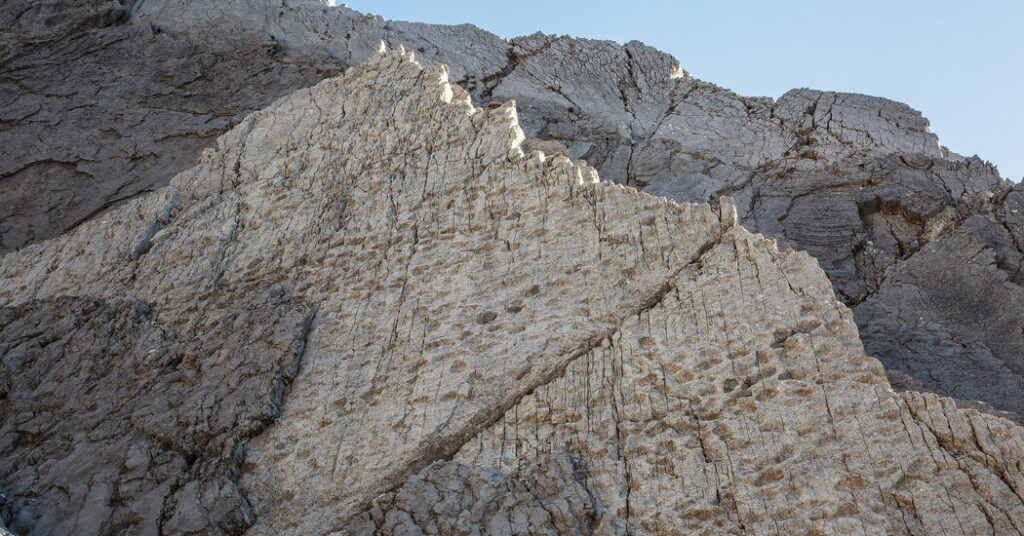
A nature photographer seeking shots of bearded vultures and red deer in the Italian Alps discovered a cache of dinosaur footprints that scientists are calling “remarkable.”
The finding in Stelvio National Park, near the Swiss border, that was unveiled Tuesday consists of thousands of fossilized footprints more than 200 million years old. The tracks, some of them stretching for hundreds of yards, are so well preserved that marks of toes and claws are visible.
While working on a project in the Italian region of Lombardy, in mid-September, the photographer, Elio Della Ferrera, spotted “something strange” through a telephoto lens. He had worked on paleontological projects and said he knew he was onto something.
Mr. Della Ferrera wanted a closer look. Fighting dense thickets of trees without trails to guide him, he hiked for two hours or so up steep slopes. It took “a lot of effort,” he said. “The last few hundred meters are really difficult to cover because they are vertical, and there is this crumbly layer on top of a hard bottom layer.”
“But I arrived right there, in front of these footprints.”
The tracks are thought to have been made by prosauropods, plant-eating dinosaurs with long necks from the late stages of the Triassic Period who are ancestors of the brontosaurus.
Mr. Della Ferrera believed he could well have seen and photographed the site before without realizing what it was. “I probably saw them in the past, and even took some photographs, but then I threw them away because at the time I was concentrated on taking beautiful pictures for competitions and other projects,” he said in an interview.
This time, he knew what he was looking at.
He said he estimated seeing about 2,400 prints on one vertical surface. “It is an incredible thing,” he said.
Cristiano Dal Sasso, a paleontologist at Milan’s Natural History Museum, said in an interview that he had never seen anything similar in 35 years. He described the discovery as “reality that surpasses fantasy.”
Not only had he never come across tracks in such numbers, but the tracks were parallel, “indicating group behavior, animals that walk together, which in the Triassic Period is rare,” he said, making the find even more important.
It was also the first time that tracks were found in the Italian region of Lombardy, which was once an environment comparable to present-day tropical areas and “very different from today,” Dr. Dal Sasso said. Only northern Italy was attached to the rest of Europe at the time; southern Italy remained underwater, and the tracks were found on what would have been a shoreline.
Dr. Dal Sasso said the team of experts he leads had only a few weeks to study the tracks up close before the weather turned. “The real research will begin next year,” he said. “This was a preliminary investigation.”
High up on a mountainside, with no trails, the footprints are hard to reach, which could be why they hadn’t been found before. Future study of the site may be primarily done with drones and remote sensing technologies. The site is not that far from Bormio, where Alpine skiing will take place at the Winter Olympics in February.
“It looks like a very impressive new site,” said Richard J. Butler, a professor of paleobiology at the University of Birmingham, who was not involved in the find. “Large dinosaur track sites from the Triassic Period, the oldest interval of dinosaur evolution, are relatively rare compared to later time periods, so it is a highly significant discovery.”
“What’s particularly remarkable is that this site, which must have been exposed for thousands of years, hasn’t been discovered previously, given that it is in Italy,” he said. “That must reflect how remote and difficult to access some of these mountain areas can be.”
The footprints were spotted on a nearly vertical surface, but the prosauropod was not a Triassic Spiderman. The land was flat when the prints were made, only to be pushed upward over millions of years as the Alps were formed.
Elisabetta Povoledo is a Times reporter based in Rome, covering Italy, the Vatican and the culture of the region. She has been a journalist for 35 years.
The post More Than 2,000 Dinosaur Footprints Are Found in the Italian Alps appeared first on New York Times.