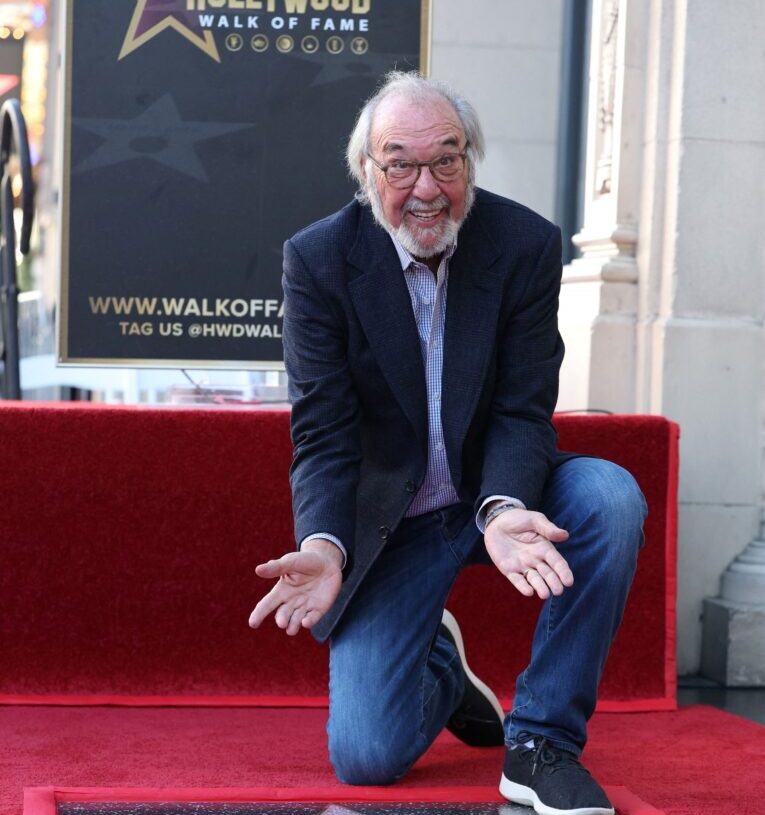
In a career spanning six decades, James L. Brooks has been instrumental in the creation of dozens of iconic television shows, “The Simpsons” and “The Mary Tyler Moore Show” among them, and movies including “Terms of Endearment,” “Broadcast News” and “As Good as it Gets.” His latest film, “Ella McCay,” stars Emma Mackey as an up-and-coming politician whose ambitions are threatened by scandal (The Post’s review called her “a try-hard you can’t help but reluctantly root for”). In a recent phone interview, Brooks spoke about everything from his idealistic early days in showbiz to the “slaughterhouse” mentality of making movies today.
This interview has been edited for length, clarity and to make the interviewer sound at least half as smart as the classic James L. Brooks heroine.
Ella McCay exists in a lineage of great women characters that you’ve created over the years. How is she the same as some of your heroines and how is she different, generationally or otherwise?
She has some sisterhood with Mary Tyler Moore, I think. Because, in the evolution of women in the United States this is, I think, where [Mary Richards, Moore’s character] would be now. Mary … was very smart, she was in news. She was not particularly self-confident; she did not have a sense of herself.
That shares some qualities with Holly Hunter’s character in “Broadcast News”: these women who are out there, doing the work, achieving. But there’s a little ambivalence there, or a little self-doubt.
Yeah, in Holly Hunter’s case … her secret cure was crying every day in private.
Right, whereas men just throw up.
Not this one.
You started as an usher at CBS, right? Which is a time-honored way in.
Yeah, and I was a copy boy in the newsroom when Edward R. Murrow was there. You’re looking at somebody who brought coffee to Edward R. Murrow.
Wow. What was that like? What was he like?
He was a walking god. You know that there’s a woman who wrote a 1,100-page book about him, if I have that right, and they asked her what the biggest surprise was in her decade of research. And she said, “that he deserved the legend.”
In the live television world, what did you learn about storytelling and entertainment values and audiences that served you well?
I learned how to hold a flashlight and direct people to their seats. The humiliation when you had to stand out in the snow in New York — they didn’t give you a coat, they gave you a cape. And I was a kid and I was wearing this awful cape. And I loathed the cape, but it was too cold without it.
So, you don’t necessarily think it taught you anything about writing or creating shows or narratives?
No. And not to go into sob stories or anything, but the ambition was to survive and the jobs that we’re talking about now usually went to college graduates and I wasn’t one. But my sister’s best friend was the assistant to the guy who hired agents. So that was this enormous break I got, just to be out there in my cape. And then I filled in at CBS News as a copy boy, because we pages were vacation replacements. And then the guy who I replaced as a vacation replacement didn’t come back from vacation. I never would have gotten that job unless it happened that way.
I don’t know about you, my head is just swimming with how fast everything has changed — in terms of the industry, but also just cinematic language. How does it feel to be you these days?
It feels like I have to be very grateful for the shot, you know, in this climate — to have your little idea and then see it through yourself and then have somebody let you make it. So, I think the new factor in actually making the movie was the appreciation of being able to make the movie.
Wow, yeah. And then even just technology, again, you’ve really traversed all these technologies: You start out in live television, go to 35 mm, you undergo the spectacle era, the superhero, CGI, special effects.
Yes, and it felt like breathing mountain air to me, the appreciation of getting to do it.
“Terms of Endearment,” “Broadcast News,” “As Good as it Gets” … I don’t need to name your own movies to you and what touchstones they became and still are, not just because they captured their era, but in many cases anticipated coming eras. Do you think movies have that cultural currency now?
I don’t know. I know that I’m so fascinated that Paddy Chayefsky twice stone cold saw the future and made “[The] Hospital,” and “Network.” That’s the most amazing thing to me, that he was a seer.
It’s true. Who would have thought that “All the President’s Men” would turn out to be the fantasy and “Network” would turn out to be reality? Paddy knew.
Yeah, the greatest screenwriter who ever lived, as far as I’m concerned. Words! Lots of words.
Well, I mean, look at what you did with “Broadcast News.” You anticipated infotainment and surface over substance.
It was sort of happening with broadcast news. I was in the newsroom when layoffs happened. I saw hearts break and so that gives you really a sense of mission.
Tell me about your process. Do you write every day?
I write every morning. Sometimes at night.
No matter what?
I sit there, no matter what.
You use the word trauma to describe Ella’s journey.
Yeah. I thought her trauma was really double-barreled because she’s made to feel abandoned and abandoning.
I read a great quote where you talked about your own childhood not being “roses and warm bread” — a quintessential Jim Brooks line. Might I add: beautiful, but tell me how that all percolated.
My father resembled the man in the movie. He was an alcoholic man and I say he clicked off all the deadly sins. He just went through them and my mother held us together financially, held us together in every way. I had the big sister protecting me; I had a Helen [McCay, played by Jamie Lee Curtis] and I had a mom. But boy, it was rocky.
I use the word, throwback, and I don’t want that to sound like a pejorative, but it just seems like the kind of movie they don’t make any more.
Oh yeah, that gets said a lot. And that was what I sat down to do. You know, it wasn’t a happenstance. It was [a movie] that I didn’t make before, it really goes back to, a salute to films that came before me.
I’m part of a group that gets together on Zoom every once in a while just to talk about how to save film culture — you know, film-going culture — and we all have a deep connection to that ritual and that convening.
Laughing alone and laughing with people is a different experience. The commitment to get up and go and spend the money and sit is different. The greatest boss anybody ever had, Grant Tinker [Moore’s husband and producer], said, “You realize on a Saturday night” — this is when Saturday night was explosive on CBS — “that you could fly over the United States, jump out of the plane and very likely land on somebody watching your show.” And that was true! That was thrilling.
I read somewhere that already there might be a new James L. Brooks project in gestation.
Uh, certainly in gestation, yeah. I’m looking forward to seeing if it works.
Are you kind of waiting to see how Ella [McCay] does? What’s your emotional state when a movie is coming out like this — especially now, because it does feel a little risky.
You feel like you’re a cow in line at the slaughterhouse.
You’re also James L. Brooks, so you have a lot of goodwill and a lot of capital, but I get what you’re saying. It’s a very strange, tenuous time.
Yeah, and again, [I’m a] lucky bastard to get to make it.
The post James L. Brooks on the path from Edward R. Murrow to ‘Ella McCay’ appeared first on Washington Post.