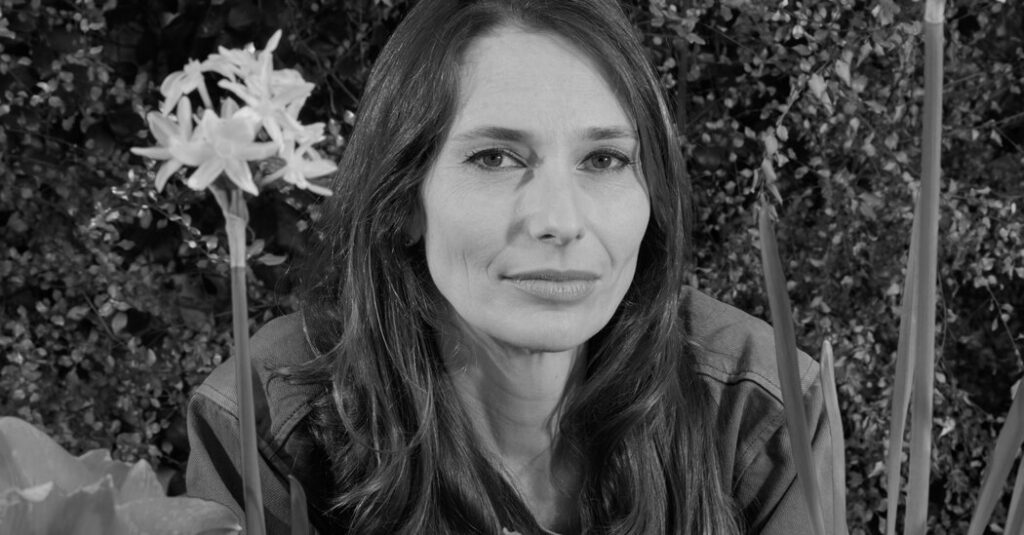
There’s no rest for the wicked, or for those who write about them. Ask Geneva Robertson-Dworet, a creator and showrunner of the Amazon series “Fallout.” Season 2, which debuted on Tuesday on Prime Video, was still a week away from premiering, and her mind was already gazing even further into the show’s postapocalyptic future.
“We’re full steam ahead on writing Season 3,” she said on a video call from her Los Angeles home last week. “My primary focus has moved off of Season 2, into ‘Where are we going next?’”
Based on the successful video game series, “Fallout” takes place 219 years after a cabal of American corporations and their billionaire owners decided to initiate nuclear war and consolidate their control of humanity. Survivors dwell in subterranean vaults constructed by those same capitalist fanatics. Or they scramble to stay alive in a wasteland littered with artifacts from that bombed-out civilization — an alternate future, in which the square, anti-commie optimism of the 1950s never ended — and overrun by horrifying mutants. (The humans are even worse.)
The show, whose executive producers include Jonathan Nolan and Lisa Joy (both creators of “Westworld”), stars Ella Purnell as Lucy, a bright-eyed vault-dweller raised to believe in the American Way, until surface dwellers invade and kidnap her father, Hank (Kyle MacLachlan). She braves the wasteland to find him, alternately helped and hindered by a former actor turned mutant gunslinger known as the Ghoul (Walton Goggins) and an accidental hero in a robot suit, named Maximus (Aaron Moten).
As viewers learn in Season 1, Hank was secretly one of the corporate flunkies responsible for the apocalypse (he was cryogenically frozen and thawed out; it’s that kind of show), and the three main characters all have their own scores to settle with him.
Season 1 of “Fallout” is mostly about their journey, but this season, the focus is on the destination: New Vegas, a largely intact mecca of casinos and carnality controlled by the billionaire Robert House (Justin Theroux). House was among those responsible for initiating the nuclear apocalypse.
“It’s like, he’s so rich he was able to take a whole city and make it his vault,” Robertson-Dworet explained. “It’s the ultimate American city, and also the ultimate hyper-capitalistic city. Taking moralistic, naïve Lucy, who only left the vault a few weeks ago, to the actual City of Sin just felt like a delicious idea.”
Robertson-Dworet talked about how she and the series’s other creator and showrunner, Graham Wagner, built their writers’ room, and about the challenges involved with giving sex appeal to an irradiated ghoul with no nose. (Wagner was unavailable for an interview.) These are edited excerpts from the conversation.
Until recently, video game adaptations didn’t have a successful track record. When you took this on, were you consciously working against those expectations?
Going in, I hadn’t actually played Fallout before, but my husband had, so I’d watched him play it many times. [Laughs.] Graham was very familiar with the games, and so was Jonah [Jonathan Nolan]. I’d worked on many I.P. projects before, so between Marvel, DC and all the other franchises I’ve worked on, you’re always very aware that you’re working with material that someone really loves — and that hopefully, as creators, we love as well. I would not take a project where I didn’t respect the source material, or where I’d try to change it. Then someone else should take the job!
Jonah directed the first three episodes and defined the visual look of the show; he decided we’d shoot on film, and that we’d do whatever we could practically. It’s not like you’re looking at some ludicrously C.G.I.-ish wonderland when you watch our show. It’s deeply cinematic.
As harrowing as the show’s depiction of the nuclear apocalypse has been, there’s plenty of over-the-top, “splatstick” violence that is played for laughs. Is that a difficult balancing act?
To me, the thing that makes the Fallout games unique is the tone. They’re filled with moral dilemmas and crises and real drama — and absurd comic characters, and a real sense of wit and irony. To whatever extent we do that, it’s because it’s in the games.
Graham and I specifically set out to build a writer’s room that was a mix of comedy writers, who’d worked almost solely on 30-minute comedy shows before, and 60-minute drama writers. When they got in the room, most of our writers were like, “I’ve never been in a room with a comedy writer before” or “I’ve never been in a room with a drama writer before.” That’s how bizarrely segregated the two genres are in our industry. We have Owen Ellickson, who comes from “The Office,” in a room with Dave Hill, who wrote for “Game of Thrones.” We’re blessed with these two very different tonal sensibilities.
We also cast specifically with an eye toward talented drama actors who could pivot into comedy on a dime. I’d worked with Walton Goggins before — he was the obvious choice for the Ghoul. That part was basically written for him. We looked at so many actors for the roles of Lucy and Maximus, but Ella Purnell and Aaron Moten were the ones who could make you cry and then nail a joke in the next line. That’s very hard to do.
Kyle MacLachlan is cut from that same cloth. I’m thinking of his multiple roles in “Twin Peaks: The Return,” which ranged from terrifying to hilarious.
Kyle’s an extraordinary actor, and an extraordinary person. He walks on set, and suddenly everyone is happy and giggling.
His character emerges as a major antagonist this season.
Hank is not someone who sits on the sidelines and lets a terrible world continue. Anyone can see that there are very serious problems with the wasteland, and that maybe it needs solutions. It’s a heroic intention. And he has a point! Things are not good. Someone needs to do something. People need to try to make it better. It’s just that he goes a little too far with trying to create a moral society.
When we learn his company helped drop the bombs itself, it hits viscerally. Why did you make that choice?
What we were trying to grapple with is a corporation whose stock price goes up when there’s a war and people are terrified. They’d have financial motivation to stoke the fears of war further and further, which might actually cause the bomb to drop. Look around and see what’s happening with A.I., or new technologies in the military space. It feels like everyone’s on this hamster wheel because it’s increasing the number of zeros in their bank accounts, the world be damned. That’s why this felt so interesting and frightening to me. The world might end because a few people needed to get rich.
On a lighter note — I think — can we talk about the sex appeal of the Ghoul?
Ah! Yeah, it’s very intentional. Vincent Van Dyke, our prosthetics creator and absolutely the best in the business, his life is creating creatures whose outer forms are infused with their inner characters. He created our Ghoul for us, and we had a lot of conversations about how he had to be sexy. For example, some of the ghouls in the games have hair, but partial hair was not sexy. [Laughs.] He had to be fully bald.
The post How the ‘Fallout’ Writers Gave Sex Appeal to a Ghoul With No Nose appeared first on New York Times.