As Greenpeace and the pipeline company Energy Transfer have fought a series of bruising court battles — including one that could bankrupt Greenpeace in the United States — a little-known organization filed what’s known as a “friend-of-the-court” brief with the North Dakota Supreme Court.
The organization, Grow America’s Infrastructure Now, or GAIN, urged the court in its November brief to prevent Greenpeace from filing a lawsuit against Energy Transfer in another country. GAIN argued that Greenpeace was trying to “relitigate” its case after suffering a startling defeat in a trial in Mandan, N.D., this year, when a jury held three Greenpeace entities liable for some $670,000 in damages over their role in protests against the Dakota Access Pipeline nearly a decade ago.
GAIN describes itself as a nonprofit trade group supporting projects like pipelines and power plants.But behind the scenes, Energy Transfer was funding GAIN, according to a 2023 court deposition from Vicki Granado, a spokeswoman for the company. Ms. Granado said that Energy Transfer was providing GAIN around $100,000 a month “to run the coalition.”
It is one of several facts pointing to greater coordination between GAIN and Energy Transfer than was previously known, as documented by FieldNotes, an oil and gas watchdog group. The deposition was previously discussed in a podcast about the case by Alleen Brown.
And those links point to a growing problem. Friend-of-the-court briefs, or amicus briefs, are increasingly being used as a litigation tactic rather than for their intended purpose, said Renee Knake Jefferson, a law professor at the University of Houston. The filings are supposed to offer “additional concerns the court should consider,” but often one party is “going behind the cloak of the amicus brief to continue its own advocacy,” Ms. Jefferson said.
GAIN’s spokesman, Craig Stevens, who is also a partner at the Washington, D.C., consulting firm DCI Group, did not respond to repeated queries about the relationship between GAIN and Energy Transfer, nor did Ms. Granado.
Elsewhere in her 2023 deposition, Ms. Granado said she did not know if GAIN had other funders and added that the group was independent. “We don’t review what they post, what they don’t post, what they put out,” she said.
Ms. Granado’s deposition also showed that Energy Transfer helped to found its predecessor organization, MAIN, which was created by DCI Group. The firm has often been accused of using what are sometimes called “Astroturfing” tactics to disguise corporate lobbying as grass roots action.
“Did Energy Transfer ask DCI or approve DCI setting it up?” a Greenpeace lawyer asked Ms. Granado in the 2023 deposition, referring to MAIN. “We did,” she said.
Daniel Simons, senior legal counsel for strategic defense at Greenpeace International, told The New York Times that “Energy Transfer is deploying its public relations puppets like GAIN and rallying its fossil fuel allies to amplify its inflammatory rhetoric.”
Allison Orr Larsen, a professor at William & Mary Law School who has written about the growing use of amicus briefs at the U.S. Supreme Court, said the rules around disclosing who is funding them are “pretty anemic” on the federal level.
The same issue persists on the state level, including in North Dakota. The state requires whoever is filing the brief to disclose their identity and interest in the case and whether a party in the case or a third party was involved in drafting or funding the brief.
Keith Swisher, a professor at the University of Arizona James E. Rogers College of Law, who reviewed the GAIN brief at The Times’s request, said that the revelations in the deposition underscored how porous disclosure rules are. Even if litigants largely funded an organization, they would have to disclose only the money used for that organization’s amicus brief.
“It’s unclear from what we know whether this violated the disclosure rule, but what does seem clear is that the disclosure rules are too lax and need improvement,” he said.
The North Dakota Supreme Court was scheduled to hear arguments about Energy Transfer’s request for an anti-suit injunction on Thursday. The trial judge in Mandan, James D. Gion, scheduled a hearing on finalizing a verdict for the same day. Greenpeace has said it may have to shut down U.S. operations if the judgment in that case stands.
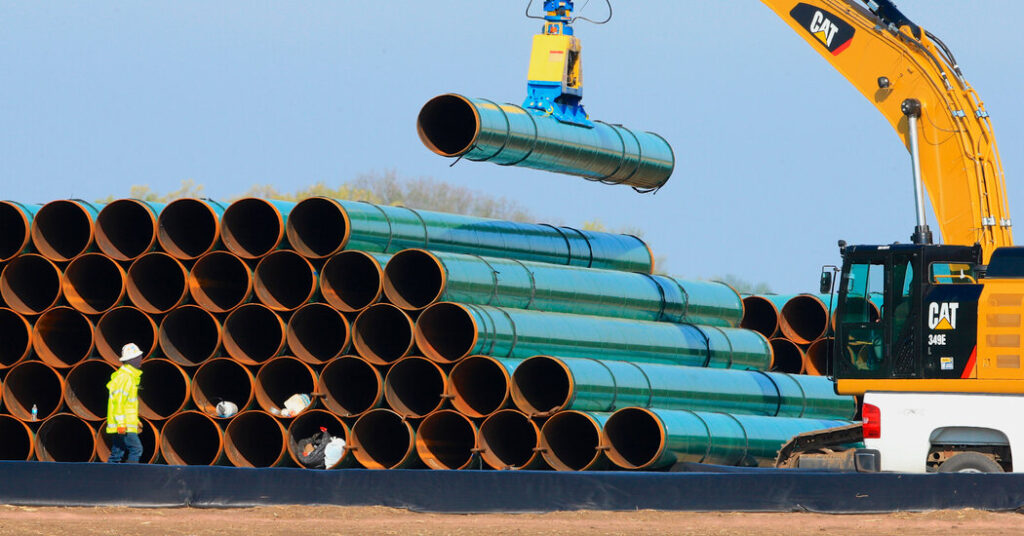
The courtroom battle began when Energy Transfer sued Greenpeace over its role in the protests against the construction of the Dakota Access Pipeline south of Bismarck, N.D. The company accused the advocacy group of playing a key role in organizing the protests, which it denied.
But a jury found three Greenpeace entities liable for nearly $670 million, an amount later reduced by Judge Gion to roughly $345 million. Greenpeace International filed its own lawsuit in Amsterdam, where it is based, accusing Energy Transfer of pursuing a SLAPP suit, or Strategic Litigation Against Public Participation, a term for lawsuits by powerful actors that are designed to stifle critics. Many states have provisions blocking such lawsuits, but not North Dakota. The Amsterdam complaint cites a novel European Union anti-SLAPP directive, as well as Dutch law.
Energy Transfer is seeking to block that lawsuit by getting North Dakota to grant an international anti-suit injunction, which would be an extraordinary move. Judge Gion declined the same request this year.
“This court’s intervention is needed to prevent a foreign entity (Greenpeace) from inviting a foreign tribunal to sit in judgment over North Dakota’s judiciary,” Energy Transfer said in its petition. It accused Greenpeace of trying to do an “end-run” in hopes of barring enforcement of the judgment.
Energy Transfer is led by Kelcy Warren, a Texas billionaire and donor to President Trump who has spoken publicly about his desire to confront environmental protesters.
It’s not clear whether Energy Transfer is still funding GAIN, or who GAIN’s other funders are. The group reported less than $50,000 in revenue for the past three years, an amount that’s far less than what was described in the deposition.
David Hunter, professor emeritus at American University Washington College of Law and a former Greenpeace board member, reviewed the filings and said it reminded him of tactics used by the tobacco and energy industries during debates about smoking and climate change. “They’re deeply embedded in the strategy, and that’s what is the most troublesome thing about not disclosing that to the court as part of the amicus brief, because it doesn’t allow the court to determine how much weight to give to this other supposedly independent voice,” he said of GAIN.
This reflects a growing controversy in the legal world around what some call “dark money” in the briefing process, particularly as more groups are filing amicus briefs. Most courts have to approve a party’s filing of an amicus brief, which is supposed to be a friend of the court, not a friend of the litigant, Ms. Larsen said.
Senator Sheldon Whitehouse, Democrat of Rhode Island and an outspoken critic of the energy industry, has been one of the loudest voices calling for stricter rules on amicus briefs. He said in a statement that there had been a “a coordinated, fossil-fuel-backed network that floods court proceedings with flotillas of amicus briefs without disclosing the billionaire and special-interest dark money behind them.”
Karen Zraick covers legal affairs for the Climate desk and the courtroom clashes playing out over climate and environmental policy.
The post Greenpeace’s Fight With Pipeline Giant Exposes a Legal Loophole appeared first on New York Times.