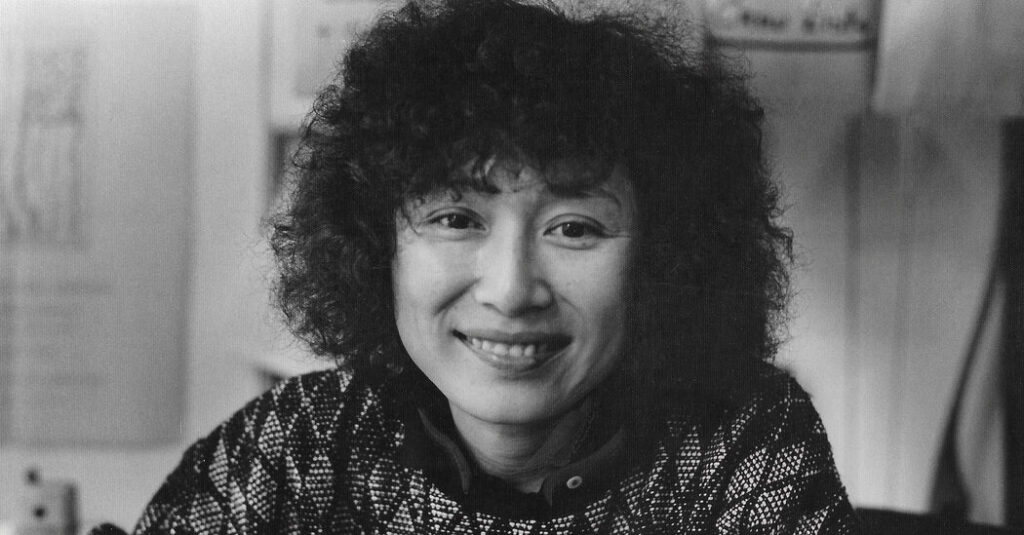
Christine Choy, a bold filmmaker whose influential documentaries, including the Oscar-nominated “Who Killed Vincent Chin?,” probed social-justice issues involving Asian Americans and other marginalized people, died on Dec. 7 in the Bronx. She was 76.
Her death, at a hospital, was confirmed by her son, Fleeta Siegel, who said the cause was cancer. She lived in Lower Manhattan.
A faculty member of New York University’s Tisch School of the Arts since 1988, Ms. Choy made dozens of short and feature-length films exploring historical and contemporary events in which race, identity and privilege emerged — and sometimes merged — as themes.
“Who Killed Vincent Chin?” (1987), about a high-profile hate crime, was co-directed with Renee Tajima-Peña. The film, which aired on public-television stations, received a Peabody Award and became a staple of cinema studies courses. In 2021, the film was inducted into the Library of Congress’s National Film Registry for its cultural significance.
The directors spent years detailing the aftermath of a crime that took place one night in 1982, when two white Motor City autoworkers fatally beat 27-year-old Vincent Chin with a baseball bat in front of a McDonald’s restaurant. Mr. Chin, a Chinese American draftsman for an engineering firm, had been celebrating his coming marriage with a bachelor party at a nearby bar.
The attackers, Ronald Ebens and his stepson, Michael Nitz, admitted to the killing, saying they had been drunk. They said racial animus was not a factor, even though they apparently thought that Mr. Chin was Japanese and had cursed at him at the bar that evening, blaming him for car-industry layoffs.
Initially charged with second-degree murder, the men pleaded “no contest” to a reduced charge of manslaughter and were sentenced to three years’ probation and fined $3,000, with no jail time — a ruling that helped galvanize the Asian American civil rights movement. A federal civil rights investigation followed, but the outcome was not a happy one for Mr. Chin’s family.
Ms. Choy captured the Asian American community’s outrage by cutting between interviews with Mr. Ebens, who dismissed the murder, comparing it to a bar brawl, and footage of Mr. Chin’s grieving mother, Lily.
Vincent Canby of The New York Times wrote that the film “so successfully analyzed this sudden, sad, fatal confrontation that almost everything except the Big Mac becomes implicated in the events.”
Genevieve Yue, an associate professor of culture and media at the New School in Manhattan, wrote in an email: “What makes ‘Who Killed Vincent Chin?’ so extraordinary is that it is a story told from within the community — not just Asian Americans, but the multiracial, working-class Detroiters who were suffering the effects of the downturn in the auto industry in the 1970s. The film maintains this complex worldview without ever losing sight of the people involved, least of all Vincent Chin himself.”
Professor Yue added that the film gave rare “cinematic form to anti-Asian racism in the United States” and was one of the first documentaries made by nonwhite female directors to be funded by the Corporation for Public Broadcasting.
Later generations of filmmakers, among them the acclaimed documentarian Jesse Moss, took inspiration from the movie, writing that it had landed with the “force of a thunder clap.”
“It was urgently, angrily political, but compassionate and complex, and meticulously constructed,” Mr. Moss wrote. “I had never seen anything like it.”
Ms. Choy stayed within the bounds of traditional documentary form, peeling back layers of truth without losing sight of the fundamental societal indictment that she sought to bring. “The film is not built on logic but on emotion,” she told The Times. “Once you respond to the emotion, we hope you’ll find the logic. It doesn’t work the other way around.”
Chai Ming Huei was born in Shanghai on Sept. 17, 1949 — the year of the Communist revolution — to a Chinese mother, Ai Ja Cho, who worked for an American company, and a Korean father, Kun Woo Choy, a traveling salesman. Her father soon left for Korea, and the family was reunited in Seoul after several years.
In a country mired in poverty after the Korean War, Ms. Choy struggled with a new language and discrimination because of her Chinese background. She said she became a Catholic because the church sponsored Koreans in their efforts to emigrate to the United States. At 14, Christine (as she soon became known) moved to New York with $65 in her pocket to attend her Korean Catholic school’s sister school.
One of her few pleasures in Korea, she said, was going to see the American Technicolor movies bursting with stars like Sandra Dee. As she later told students who made a documentary about her: “Everybody’s blonde. Everybody’s in love. Everybody parties all the time. Everybody dresses to kill.”
“And then I got to this country,” she added, referring to a United States very unlike the one in the movies. “I said, ‘What happened?’”
She attended Washington University in St. Louis and Columbia University, studying architecture and urban planning. At the same time, she immersed herself in the growing anti-Vietnam War movement, concluding, as she later put it, “I was living in the belly of an imperial country.”
After seeing a documentary film about Vietnam, she turned to filmmaking in the early 1970s, intrigued by its use of composition and light, and joined Newsreel, an anti-establishment collective of filmmakers in New York.
Shortly thereafter, the company fractured over an ideological dispute, and Ms. Choy teamed up with a few members to form a new production company, naming it Third World Newsreel. One of her colleagues was Susan Robeson, a granddaughter of the singer and left-wing activist Paul Robeson.
Among the company’s first efforts, with her as co-director, were “Teach Our Children” (1972), a short chronicling the 1971 Attica prison rebellion; “From Spikes to Spindles” (1976), about the plight of garment workers in New York’s Chinatown; and “Inside Women Inside” (1978), about a women’s prison. The last, Ms. Choy recalled, was one of her favorite works, because it captured feelings of injustice and shame among the inmates — feelings that she had once experienced, she said, after being arrested for leafleting in front of a New Jersey department store.
“Mississippi Triangle” (1984), another Third World production, explored the interlocking histories of the Chinese, white and Black communities in the Mississippi Delta and the resentments that simmered among them. To achieve a granular level intimacy, Ms. Choy and her co-directors, Worth Long and Allan Siegel (whom she married in 1979), deployed three camera crews, embedding each in the community that corresponded with its director’s own race.
The result was what the LA Weekly critic Helen Knode called a “superb” documentary that challenged the Black-white binary of Southern history and captured the “swampy, hot country rhythms” of the Delta and the “ugly knots” of racial tension congealing beneath the surface.
Among Ms. Choy’s subsequent films — which she again often co-directed — were “Homes Apart: Korea” (1991), about the human toll to families divided by the 38th Parallel, separating North from South Korea; “Best Hotel on Skid Row” (1990), which is narrated by the poet Charles Bukowski; “Sa-I-Gu” (1993), which recounted the 1992 Los Angeles riots through the eyes of women in the city’s Korean American community; and “In the Name of the Emperor” (1995), which addressed sex crimes and other atrocities perpetrated by Japanese soldiers against Chinese civilians in the 1930s massacre known as the Rape of Nanking.
Up to and even after the success of “Vincent Chin,” there were years of lean living and difficulties in raising money to make her films. Two of her N.Y.U. students, Ben Klein and Violet Columbus, turned the camera on her in 2022 for “The Exiles,” a documentary that chronicled her attempt to finish a film about the 1989 Tiananmen Square massacre in Beijing — a project she abandoned when money dried up.
“The Exiles” won the Sundance Grand Jury Prize for best documentary, buoyed by what the film critic David Ehrlich of IndieWire called Ms. Choy’s mix of the “revolutionary zeal of a teenage Marxist with the diva-like magnetism of Mariah Carey.”
In other interviews, Ms. Choy told stories of booking a round-trip flight to Canada just to buy duty-free cigarettes and how, in her younger years, she was on familiar terms with members of the Black Panther Party as well as the radical group Weather Underground. She recalled knowing the parents of Tupac Shakur, both of them Panthers: “I used to babysit him — can you believe it?”
Her marriage to Mr. Siegel ended in divorce. In addition to her son Fleeta, she is survived by a daughter, Ku-Ling Yurman; another son, Tatanka Tan; a sister, Cathy Chai Esposito; and five grandchildren.
Among her colleagues and acolytes, Ms. Choy was known as a charismatic presence in front of the camera as well as behind it. Writing about “The Exiles,” Jason Bailey of The Times described her as “a foul-mouthed, chain-smoking, no nonsense local legend.”
As she continued teaching and directing, Ms. Choy described her filmmaking philosophy to Interview magazine in 1991, saying: “Feel it! Feel! Feel feelings. Sadness, happiness, regrets. If you can feel how you live, you’re able to understand what others are feeling.”
The post Christine Choy, Documentarian of Asian American Life, Dies at 76 appeared first on New York Times.