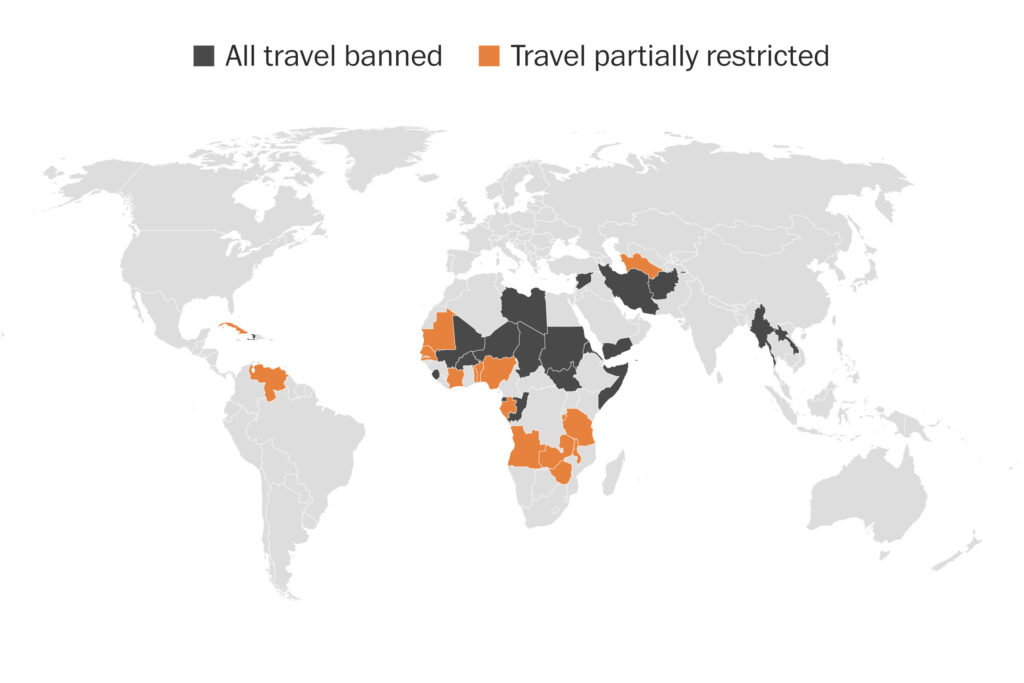
The Trump administration has increased the number of countries whose citizens face a full or partial travel ban on entry to the United States from 19 to 39, a significant expansion of the order announced this year.
The announcement of the policy change, shared Tuesday on the White House website and set to go into effect on Jan. 1, 2026, bans citizens from five additional countries, including South Sudan and Syria, and partially restricts the entry of people from 15 more countries, including Nigeria. Citizens of Laos and Sierra Leone previously faced a partial ban on entry into the United States under President Donald Trump’s June travel ban. They now face a complete ban.
The expansion of the travel ban is part of the Trump administration’s effort to aggressively crack down on immigration after an Afghan immigrant shot and killed two National Guard troops in Washington, D.C., last month. In the weeks since the deadly shooting, the Trump administration paused immigration applications from 19 countries it deems high-risk, halted asylum cases processed by U.S. Citizenship and Immigration Services and suspended all immigration-related requests from Afghan nationals.
“It is the policy of the United States to protect its citizens from foreign nationals who intend to commit terrorist attacks, threaten our national security and public safety, incite hate crimes, or otherwise exploit the immigration laws for malevolent purposes,” reads the announcement on the White House website, signed by Trump.
Many of the countries under full travel bans or other restrictions have previously faced scrutiny from the Trump administration.
In June, the State Department ordered the governments of 36 countries to meet new benchmarks and requirements within 60 days or face restrictions on entry into the United States, according to an agency memo previously reviewed by The Washington Post.
Of the 36 listed countries, 19 face new restrictions: Angola, Antigua and Barbuda, Benin, Burkina Faso, Dominica, Gabon, Gambia, Ivory Coast, Malawi, Mauritania, Niger, Nigeria, Senegal, South Sudan, Syria, Tanzania, Tonga, Zambia and Zimbabwe. Mali is the only newly restricted country that did not appear in the June State Department order.
According to the June memo, if a country was willing to accept third-country deportees — people deported from the U.S. to a place where they are not citizens — that would mitigate the administration’s concerns about that country. However, under Tuesday’s order, travelers from South Sudan — which accepted eight noncitizens in July — are barred from entering the U.S.
In August, the Trump administration ordered Malawian and Zambian travelers headed for the U.S. to post large, reimbursable bonds of up to $15,000 to deter visa overstaying. While neither nation was high on the list of countries whose citizens overstayed, experts said the deposits amounted to a form of travel ban. Under the expanded Tuesday order, Malawian and Zambian travelers now face a partial ban on entry into the U.S.
Of the 20 countries facing new travel restrictions, 16 are in Africa. All 39 countries on the travel ban list are majority non-White, while nearly half are Muslim-majority countries. All but three affected nations are classified by the World Bank as having low- to middle-income economies.
The post All the countries affected by Trump’s expanded travel ban appeared first on Washington Post.