Now that the U.S. has seized a Venezuelan oil tanker and President Donald Trump has declared an oil blockade, the results could “devastate” Venezuela’s struggling economy and put further pressure on President Nicolás Maduro and possible regime change, according to geopolitical and energy analysts.
The big question is how far the U.S. will take the sanctioned oil tanker blockade—Trump’s social media announcement was scant on details—and for how long, because it is unlikely Maduro would willingly step down in the near future, said Francisco Monaldi, director of the Latin America Energy Program at Rice University’s Baker Institute for Public Policy.
“This could be devastating. We’re talking about an economy where more than 80%—perhaps north of 90%—of the foreign exchange revenues for the government comes from oil. The oil is absolutely dominant,” Monaldi said, noting that Venezuela’s only other meaningful exports are modest mining and seafood industries.
The questionably legal effort—a blockade is historically an “act of war”—could result in “hyperinflation” within Venezuela, a further weakening of its currency, an economic recession, and a fuel shortage for its citizenry, he said.
Venezuela is home to the world’s largest proven oil reserves, but the country produces less than 1% of global oil production. Venezuela’s volumes have plunged from 3.2 million barrels daily in 2000 down to less than 1 million barrels today under the authoritarian socialist regimes of Maduro and his predecessor, Hugo Chávez, from a combination of mismanagement, underinvestment, and escalating U.S. sanctions.
Citing national security concerns over drug trafficking, the U.S. has bombed many boats from Venezuela—again under questionable legal authority—killing more than 80 people thus far, according to the U.S. military. Last week, the U.S. escalated the conflict by seizing the sanctioned oil tanker Skipper for allegedly making repeated, illegal shipments of Venezuelan and Iranian oil.
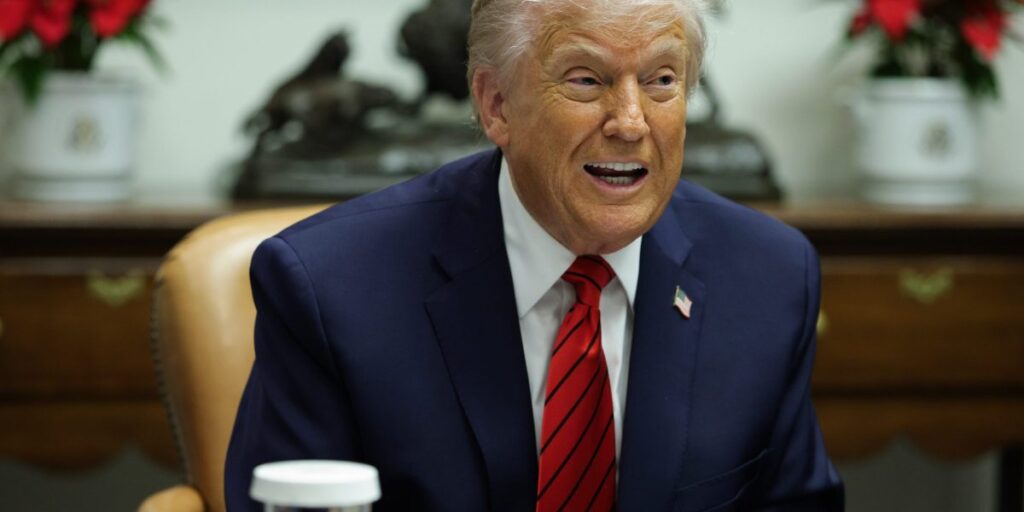
Trump went further late on Dec. 16, posting on social media that he is “ordering A TOTAL AND COMPLETE BLOCKADE OF ALL SANCTIONED OIL TANKERS going into, and out of, Venezuela.”
“Venezuela is completely surrounded by the largest Armada ever assembled in the History of South America,” Trump stated. “It will only get bigger, and the shock to them will be like nothing they have ever seen before—Until such time as they return to the United States of America all of the Oil, Land, and other Assets that they previously stole from us.”
Trump is presumably referencing the 2007 expropriation of Venezuela’s oil assets from foreign companies, including Exxon Mobil and ConocoPhillips, under Chavez.
The U.S. State and Defense departments declined comment, and the White House did not immediately respond to multiple requests for comment.
Regardless, it shouldn’t take too long to figure out how this will play out.
“In a blockade, it’s very easy to identify an oil vessel,” Monaldi said. “We will see how they move from the rhetoric of the present to the actual implementation of policy.”
Logistical questions abound
Trump’s statement specifically cited “sanctioned” oil tankers, but last week’s seizure triggered the turnaround of most vessels away from Venezuela—with a few exceptions—even those that are not facing sanctions. The brave few that did not change course from Venezuela weren’t seized.
So, the big questions now are whether the U.S. will only seize sanctioned tankers and whether the White House will add new sanctions to crude oil vessels that dock in Venezuela, Monaldi said.
“If not, it wouldn’t be a true blockade at all because there are plenty of vessels in the dark fleet,” Monaldi said. “But, if you sanction them while they’re loading the oil, then it is a blockade.”
The dark or shadow fleet is a clandestine network of older oil tankers working with sanctioned nations, such as Iran and Russia, that conceal their oil trips by disabling tracking, using fake identities, and other tactics. The oil tanker Skipper was a part of the dark fleet; it was formally sanctioned three years ago.
The bottom line is it is expensive for the U.S. to seize tankers, including the logistics of transporting the tanker to Galveston, Texas, which is what happened to the Skipper. And new sanctions also take time and a lot of paperwork.
“We are already seeing a tremendous impact just because of the one seizure. We’re seeing vessels turning around that were coming to Venezuela,” Monaldi said. “If all that was happening with just one seizure and the signal they might do more, I would imagine this is going to be a very heavy deterrence. The discounts are going to get so high.”
Because of the preexisting sanctions on Venezuelan oil, about 80% of its exports go to China under heavy discounts.
Monaldi estimates the blockade could easily cut Venezuela’s oil exports in half, placing even greater discounts on the remaining exports. A little more than 15% of Venezuela’s exports go to the U.S. because of Chevron’s special license to operate in the country and partner with state oil company PDVSA.
“Is it possible that Maduro says to Chevron, ‘I’m not allowing you to take any more oil. Why would I allow you to get paid if I cannot benefit?’” Monaldi asked.
In a statement, Chevron spokesman Bill Turenne said, “Chevron’s operations in Venezuela continue without disruption and in full compliance with laws and regulations applicable to its business, as well as the sanctions frameworks provided for by the U.S. government.”
If Venezuela’s oil exports are halved or reduced even further, the country would quickly run out of oil storage and be forced to reduce its own oil production. Eventually turning those oil flows back on takes time and money—often about a year, Monaldi said.
Maduro likely would prioritize domestic refining and fuel production with the remaining supplies, he said, but fuel shortages could still become a factor, further inflaming the Venezuelan populace.
“Even when people get worried about gasoline scarcity, then gasoline scarcity appears because people rush to fill their tanks,” Monaldi said.
But Maduro will cling to power as long as he is able. And it is even possible he sees the blockade as a sign of weakness from Trump, Monaldi added.
“This could also signal to Maduro that [Trump] is not willing to go the military route.”
The post A U.S. oil blockade on Venezuela could ‘devastate’ its economy and further pressure Maduro. But how far is Trump willing to take it? appeared first on Fortune.