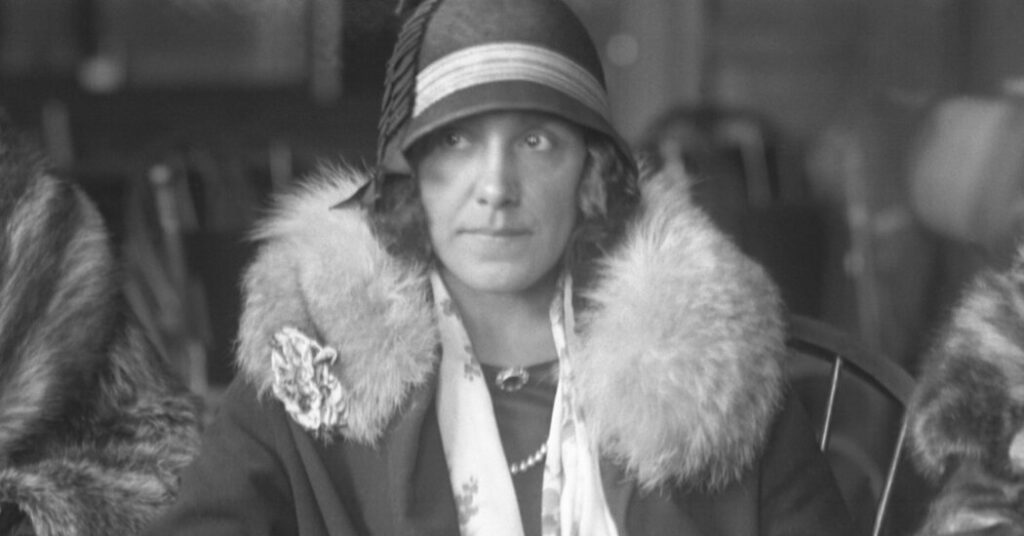
On Sunday, Jan. 22, 1922, a slender 18-year-old man approached the front desk of the Hotel Marie Antoinette, at the corner of West 66th and Broadway, and reserved a room with a bath. After he signed the register “Mr. & Mrs. James Smith,” he went upstairs with the young woman accompanying him: a petite 22-year-old with olive skin, brown eyes and bobbed black hair. For the next two weeks they ate ham-and-pickle sandwiches at midnight, shared secrets and sorrows and loved each other fully and freely — until a lawyer sent by the young man’s father discovered them.
The young man was not James Smith. He was Leonard Kip Rhinelander, often known as Kip, scion of one of New York’s oldest dynasties. The Rhinelanders arrived in America in 1686, began buying land and eventually became second only to the Astors as owners of New York City real estate. By the 1920s, their holdings were worth nearly $100 million, or $1.6 billion in today’s money. The Rhinelanders were known for guarding their bloodline as fiercely as their wealth.
The young woman was Alice Jones, the daughter of two former servants on an English estate who emigrated to America in 1891. She lived with her parents in a modest alley house in New Rochelle and worked as a housemaid and laundress.
The lawyer immediately separated Leonard and Alice. Soon Leonard’s father, Philip Rhinelander, determined to avert a potential mésalliance, sent him far away. But during what would become a two-year exile, Leonard and Alice exchanged more than 700 letters pledging their love and loyalty and secretly became engaged. Once Leonard turned 21, he hurried back to New Rochelle, and on Oct. 14, 1924, he and Alice married without his father’s knowledge and began living quietly and happily as Mr. and Mrs. Leonard Rhinelander. Their quiet happiness lasted one month — until Nov. 13, 1924, when an article appeared on the front page of New Rochelle’s local paper.
The headline read: “Rhinelanders’ Son Marries Daughter of a Colored Man.”
Alice knew nothing about the article until Leonard returned from work that evening, trailed by reporters and photographers. Her initial shock turned quickly to defiance. “Well, we are not colored,” she told a reporter. “There is no colored blood in us.” Though her father’s skin was brown, he had never identified as Black. “I want the world to know that my father and mother came from English stock for generations back.”
Later that night, as they stood side by side on her parents’ front porch, Leonard threatened to sue the newspaper for libel, and Alice vowed they wouldn’t let anyone break up their marriage. “We’re happy,” she said, “and we’re going to be happy.”
But the next day a full-page photograph of Alice appeared on the front page of The Daily News under the headline “HIS COLORED BRIDE.” In the first of hundreds of articles it would publish about what became known as the Rhinelander case, the paper declared that news of the marriage had exploded like “a bombshell tossed into the aristocratic ranks of New York and Newport bluebloods.” The Daily Mirror, its tabloid competitor, ran an even more shocking front page headline: “RHINELANDER WEDS NEGRESS.”
Crowds of reporters, photographers and curiosity-seekers massed outside the Jones home while Leonard and Alice hid inside. After a week of being virtual prisoners, they hesitantly agreed to allow a Rhinelander lawyer named Leon Jacobs, who handled Leonard’s inheritance when he turned 21, help them escape. On Nov. 20, Leonard left the Jones house with Jacobs, who promised to return for Alice the next day and reunite her with Leonard someplace where the press couldn’t find them. Alice received a telephone call from Leonard that night — and then all communication ceased. The Daily Mirror reported he had been kidnapped by a “family agent.”
When Jacobs finally returned six days later, it was not to reunite Alice with Leonard but to inform her that Leonard had charged her with “racial fraud” and filed for an annulment. Alice immediately suspected Leonard had been pressured, a belief that was validated by a note she received from him that same day. “Honey bunch, old scout!” he had written. “I hope you will win this case. Get the best lawyer.” Her lawyer warned that fighting the suit in court would be daunting, but Alice told reporters: “I will never give him up. I love him dearly, and he loves me dearly.”
Nearly a year later, when Rhinelander v. Rhinelander opened in a packed White Plains courtroom, Alice and Leonard became the unwilling lead characters in a sensational legal drama that would ultimately become one of the Jazz Age’s most notorious media spectacles. Day after day for four weeks, their lives and love affair were dissected and scrutinized, their most intimate expressions of affection and desire exposed both in the courtroom and in newspapers all over the nation. Day after day, Alice silently endured an onslaught of racist and dehumanizing rhetoric.
After the trial ended, Rhinelander v. Rhinelander slipped from the spotlight, just another tabloid scandal in an era rife with them. But 100 years later, the Rhinelander case offers an indelible portrait of a love destroyed by American racism, in all of its absurdity and savagery. Leonard and Alice Rhinelander were an American Romeo and Juliet, and for the crime of loving each other, they paid an extraordinary price.
When the esteemed Westchester County lawyer Isaac Mills stood to deliver his opening statement on the first day of the trial, he declared to the jury — and the several hundred Black and white spectators crowded into the courtroom benches — that Leonard fully believed Alice was white when he married her, and continued to believe that even after the headlines screamed otherwise. But once Leon Jacobs showed him Alice’s birth certificate, he could no longer believe that — because the doctor who certified Alice’s birth in 1899 had marked her race as “Black.”
Leonard deserved an annulment, Mills said, because Alice had deceived him about her true racial identity.
If Alice and Leonard had married in one of the 29 states that outlawed interracial marriage at the time, the presentation of Alice’s birth certificate to a judge would have invalidated their union. In New York, however, interracial marriage was legal, and divorce was typically permitted only in cases of adultery — which left an annulment on the basis of racial fraud as Leonard’s only state-sanctioned means of dissolving the marriage. Precedents for such annulments existed throughout the country — and in Westchester County itself, where six years earlier, a white woman filed for an annulment after noticing a patch of curly black hair protruding from her mother-in-law’s hairpiece one day. Her husband’s birth record couldn’t be located, but his brother’s showed that he had been classified as Black. A judge ruled she had unwittingly married a Black man and granted an annulment. That judge, Justice John Morschauser, was now presiding over the Rhinelander trial.
A white spouse who claimed to have been tricked into marrying a nonwhite person was almost always seen to have legal grounds to seek an annulment — a reflection of the widespread opposition to interracial marriage, even in states where it was legal. That opposition was a rare instance of “almost complete agreement among colored and white people,” W.E.B. Du Bois noted in a 1920 article for the N.A.A.C.P. publication The Crisis. Though the N.A.A.C.P. strongly advised against interracial marriage on the basis of the inherent social challenges, it regularly beat back attempts to outlaw it in order to defend individual freedom and challenge the belief that Black people were inferior to white people.
That was exactly what the leaders of the American eugenics movement claimed. From the movement’s headquarters at Cold Spring Harbor Laboratory on Long Island, its leaders — some of whom were among the nation’s most respected scientists — warned that racial mixing, which they called miscegenation, would lead to the annihilation of the nation’s “white civilization.” Eugenics has since been denounced as a racist pseudoscience, but in 1925 it was considered a legitimate field of study, and it had enormous influence. A year before the Rhinelander trial opened, eugenicists, along with leaders of the Ku Klux Klan, helped pass the Johnson-Reed Act, the most restrictive and racist immigration legislation in the nation’s history, and Virginia’s Racial Integrity Act, the most restrictive anti-miscegenation legislation in American history. And in July 1925, just months before Isaac Mills pleaded for the jury to release Leonard from “the undying disgrace of an alliance with colored blood,” John Scopes stood trial in Tennessee for teaching evolution from a best-selling biology textbook that stated as fact that there were five human races, with the “highest type” being “the civilized white inhabitants of Europe and America.” Mills’s rhetoric was hyperbolic, but his sentiments were not.
That first day, Alice glanced at Leonard across the courtroom, but he didn’t meet her gaze. When court adjourned, they left separately, Alice surrounded by her family, Leonard escorted by his bodyguard and Jacobs. He had no one else in court to support him; earlier that year his father had disinherited him and forbade him to have contact with anyone in the Rhinelander family. To the reporters who sought her out during the year leading up to the trial, Alice continually voiced her fervent wish to reunite with Leonard. But Leonard’s thoughts and feelings were a mystery. He had been in seclusion since Jacobs separated him from Alice, and his bodyguard kept reporters at a distance throughout the trial. Reporters wondered: Did he still love Alice? Did he want to remain married to her? Or did he believe the things his lawyer said in his opening statement? No one knew.
The next morning, Alice’s lead counsel, Lee Davis, delivered the trial’s first twist: He admitted that Alice had “colored blood.” The courtroom crowd buzzed. Reporters raced to get word to their editors. And Alice hid her face in the collar of her coat and wept. Davis’s concession shifted the trial’s main focus from Alice’s racial identity to Leonard’s knowledge of it. But the concession was also a direct contradiction of who she believed herself to be.
Her parents, Elizabeth and George, were born in England in the mid-1800s. Her mother’s parents and her father’s mother were white. But her father’s father was a native of a British colony — India or perhaps the West Indies. He died when George was a baby, and that was all that was known about him.
Mills sent an investigator to England twice to search for George’s birth record. It was money wasted. Even if the investigator had located the birth record, it wouldn’t have provided any clarification of his racial identity, because race wasn’t listed on vital records in England. Elizabeth later testified that George was treated like every other servant on the English estate where they worked. His skin color was a nonissue until they sailed to America in 1891.
At that time, the Joneses had never met a Black person; they had no connection to Africa, slavery or the experiences of Black Americans. So even as they discovered that George would often be identified as Black, they rejected that identity and to every extent possible forged a life as exceptions to America’s racial rules. They bought a home in a white neighborhood; sent Alice and her sisters to nearly all-white public schools; and attended a well-to-do Episcopal church whose members were white. Like most white people at the time, the Joneses avoided social contact with Black people. When Alice’s older sister, Emily, married a Black man against their wishes, they exiled her for two years, allowing her back into the family only after their granddaughter was born — with light skin and auburn hair.
When Alice told Leonard she wasn’t Black, she wasn’t lying. As she told a reporter, she had “never thought of herself as a Colored girl, always thought of herself as a white girl.” In her family’s understanding, her father’s brown skin didn’t mean he was Black; he was English — just like her mother.
New York had no legally defined racial categories. So even though race was a standard entry on the state’s vital records, racial determination was utterly nonstandard. In some years, census enumerators identified Alice and her family as white; in other years, Black or Mulatto. When Alice’s sister Emily married a Black man, she was classified as Black on her marriage record. When Alice’s sister Grace married an Italian-American man, she was classified as white.
The inconsistency of racial classification was not just a local matter. This was starkly evident in two landmark Supreme Court cases in which the justices directly contradicted themselves as they sought to define — and limit — whiteness. In the 1922 case Ozawa v. United States, a Japanese immigrant argued that because his skin was pale, he fit the definition of “white person” and therefore was entitled to citizenship under the nation’s naturalization policy. But the justices denied his claim, ruling that skin color was not a legitimate determination of whiteness. A “white person,” they held, was “a person of the Caucasian race.” Just a few months later, in the 1923 case United States v. Bhagat Singh Thind, the court revoked the citizenship of an Indian man after ruling that although he was a member of the Caucasian race, his physical characteristics were such that he did not meet the common man’s understanding of “white person.” Everywhere in America, decisions about racial identity were so arbitrary as to be absurd — and yet they carried life-changing consequences.
On the day Alice and Leonard took their vows at the New Rochelle City Hall, the clerk identified her race on the marriage certificate as “white.” If the doctor who filled out Alice’s birth certificate had seen her the same way, she and Leonard would be living in their own little home just like “two loving birds,” as Alice had once written — not pitted against each other in a courtroom.
From his first moments on the witness stand, Leonard struggled to speak. He had stuttered since childhood, and his lawyer, Mills, claimed that this speech impediment had stunted his mental and social development. Although Leonard disputed that claim during cross-examination, Mills persisted in referring to him as “mentally backward” and painting him as the helpless victim of Alice’s seduction. According to Mills, Alice’s letters had transformed Leonard into “an utter slave” who was so infatuated that he “did not know black from white or anything.” Over Davis’s repeated objections, Mills proceeded to read 98 of Alice’s letters to Leonard aloud.
In many of them, Alice recounted memories of their stolen weeks at the Hotel Marie Antoinette: when Leonard bathed her; when she made him happy with her “little hand” and “warm lips”; and when they first made love. “Wasn’t us both in heaven,” she wrote. It was one of the happiest times of her life, she told him. “As long as I live, I shall never forget it.”
As Mills read her words aloud, Alice hunched in her seat and stared at the floor. Leonard sat stoically on the stand. And the overflow crowd in the hall banged on the locked courtroom doors and eventually tried to break through them to witness the drama for themselves.
Newspapers all over the country provided extensive coverage of the trial each day, and many printed excerpts or the full text of Alice’s letters, which subjected her to vitriolic scorn for violating the rules of civilized womanhood by engaging in sex outside marriage — and, worse, taking pleasure in it. In response to criticism that they were printing “smut,” editors declared the public was more interested in the Rhinelander case than in any other news topic at the time. “Its drama has been bigger than any court story I have ever known,” one editor said.
During cross-examination, Davis accused Leonard of exploiting Alice’s letters for his own benefit. By then, Leonard’s efforts to speak had become a kind of torture for him and for everyone in the courtroom. He sweated profusely and gulped down glass after glass of water. Under Davis’s grilling, he finally broke down and admitted that Jacobs had stolen Alice’s letters from his room. Leonard considered the letters sacred, and had tried to prevent Mills from using them in court. But he couldn’t.
“It wasn’t in your power to control your own lawsuit?” Davis asked. “Is that your answer?”
“Yes,” Leonard said. It was the first evidence during the trial of what Alice had believed all along: that it was the Rhinelander family and lawyers who were behind the annulment suit, not Leonard. Jacobs, frustrated by Leonard’s performance on the stand, was later overheard muttering, “The little fool still loves her, and he is tearing up his case because of it.”
Leonard’s letters to Alice revealed the depth of that love. He wrote of the “living fire” that only she possessed, confessed that his heart was also broken the night they were separated and promised that as soon as he turned 21 he would marry her and never leave her. Like Alice, his memories of their sojourn at the Hotel Marie Antoinette sustained him through his profound loneliness.
“You did nothing that was indecent?” Davis asked suddenly on the fourth day of cross-examination. When Leonard said he hadn’t, Davis withdrew one of Leonard’s letters from his jacket pocket, showed it to him, then took it back without submitting it into evidence. Davis had done this once before in the trial. But this time, he asked for a meeting in the judge’s chambers. Twenty-five minutes later, Justice Morschauser abruptly halted the trial.
The next day Justice Morschauser adjourned the trial again after Mills asked for time to craft a response to what he deemed an “emergency.” Many reporters predicted that once Philip Rhinelander was advised of the contents of what had been dubbed “the mystery letters,” he would drop the annulment suit rather than allow them to be read in court. Alice and her family evidently believed the same. They posed for photographs, showing what one reporter called “the victory smile.”
They were wrong. When court reconvened, Mills raised his fists in the air and declared in a voice vibrating with fury: “My answer to his threat, Your Honor, is that I defy him and dare him to do his worst. We proceed with this trial. Mr. Rhinelander, take the stand.”
Justice Morschauser’s voice was stern and urgent as he ordered all young people and women, aside from three female reporters, out of the courtroom. Alice and her family left willingly, but court officers had to drag out several white women who refused to budge from their seats. Once the doors were closed, the room was half-full and more quiet than it had been in weeks.
The first mystery letter contained a passage in which Leonard described becoming sexually excited while reading Alice’s recollections of their time at the Marie Antoinette. “Something that belonged to me acted the way it usual did whenever I am with you darling,” he wrote. “Oh! sweetheart, many, many nights when I lay in bed and think about my darling girl it acts the very same way and longs for your warm body to crawl upon me, take it in your soft, smooth hands, and then work it up very slowly between your opened legs!!!”
“Did you love this girl?” Davis asked.
“I did, yes.”
When Davis berated him for writing “the vilest kind of smut,” Leonard did not apologize.
“I had no other outlet to relieve my emotions except by my letters,” Leonard said. “In them I put my very heart and soul. At least, I have a clear conscience that I gave my word of honor to Alice of being true.”
In the second letter, he had written, “Do you remember, honeybunch, how I used to put my head between your legs?” He went on: “When my lips and tongue were making you so happy you used to say to me, ‘Oh, Len, oh! Len.’ You were in heaven, dear.” Oral sex was a criminal offense at the time. One reporter declared the second letter to be “the most unspeakable document that was ever introduced into a court record.” Leonard’s delight in providing sexual gratification to Alice earned him universal condemnation in the press as aberrant, abnormal and perverted. In his closing summation, Mills would note that the act was done “at her request”; he claimed that Leonard bore no responsibility for his actions because Alice had dragged him into “degradation.” Few people seemed sympathetic to that line of reasoning — especially since Leonard steadfastly refused to admit his behavior was unnatural or immoral.
Davis continued to hammer Leonard. “You were willing to marry the girl that did these things with you in the Hotel Marie Antoinette,” he said. “But you were unwilling to marry one who had the slightest taint of colored blood?”
Leonard had not wanted to bring the annulment suit, not at first. He had loved Alice and, as his lawyer said, very likely still did. But once his family, his lawyers and his nation convinced him she was not a white woman, he could no longer allow himself to live with her.
“As to the color,” Leonard told Davis, “I drew the line.”
In order to win the case, though, Davis had to convince the jurors that Leonard actually did know Alice wasn’t white before they married. The strongest evidence of that, Davis believed, was Alice’s body itself — which is why he had spent days convincing her to submit to a “color examination.”
During 19th-century racial-identity trials, those who claimed to have been wrongly enslaved submitted their bodies for inspection by judges and juries in the desperate hope of proving they were white, and thus deserving of freedom. Alice underwent a surreal inversion of this dehumanizing ordeal: She partially disrobed in front of 12 white men to show she wasn’t white — and that Leonard, seeing what the jurors saw, had to have known that.
No reporters or photographers were in the room during the color examination. The court stenographer offers the only eyewitness account: “The Court, Mr. Mills, Mr. Davis, Mr. Swinburne, the jury, the plaintiff, the defendant, her mother, Mrs. George Jones, and the stenographer left the courtroom and entered the jury room. The defendant and Mrs. Jones then withdrew to the lavatory adjoining the jury room and, after a short time, again entered the jury room. The defendant, who was weeping, had on her underwear and a long coat. At Mr. Davis’s direction she let down the coat, so that the upper portion of her body, as far down as the breast, was exposed. She then, again at Mr. Davis’s direction, covered the upper part of her body and showed to the jury her bare legs, up as far as the knees.”
“The price she paid was a high one,” wrote a reporter for the Black newspaper The New York Amsterdam News. “Few women of any race would have paid so dear a price.”
After 15 minutes, it was over. Alice clutched her coat to her chest as her mother and sister half-carried her to a room down the hall. Leonard, the jurors and the lawyers returned to the courtroom, where Davis asked one more question.
“Your wife’s body is the same shade as it was when you saw her in the Marie Antoinette with all of her clothing removed?”
“Yes,” Leonard replied.
“That is all,” Davis said.
During closing arguments, Mills urged the jurors to imagine Leonard as their own son. “There isn’t a father among you who would not rather see his son in his casket than to see him wedded to a mulatto woman,” he said. Davis counseled jurors that a verdict for Alice meant they were clearing her of fraud — not endorsing interracial marriage. “I don’t know that I believe in mixing the blood,” he said, and agreed with Mills that Alice and Leonard should never again live as husband and wife.
The jury retired just before noon on Friday, Dec. 4. Twelve hours later they emerged with a verdict, which was sealed and placed in a safe until court convened the following morning. But late that night, reporters knocked on the front door of the Jones home and delivered the good news: Alice had won.
Several jurors later reported that long after 11 of them had voted in favor of Alice, one held out, adamant that Leonard wouldn’t have married Alice if he had known she was a “Negress.” When the others told him Alice was actually “a woman of color,” the man said he didn’t understand the difference. In an upending of the one-drop rule, a juror asked the man if he would consider a quart of water with a small glass of whiskey added to it to be “whiskey.” He said no and promptly joined the others to clear Alice of racial fraud and deny Leonard an annulment.
A reporter for The Afro-American in Baltimore observed that the jurors’ distinction between “Negro” and “Colored” had brought something new to American jurisprudence. But the jurors’ decision-making was as arbitrary as in every case in which racial classification was performed in America. It was not so different from the Supreme Court justices who a few years earlier had invented such contradictory definitions of “white person.”
The nation’s leading Black newspapers hailed the jurors for rising above race prejudice to deliver justice, then accurately predicted a backlash. Two months after the trial, a New York state senator announced he was considering introducing a bill to make interracial marriage between white and Black people a felony in the state. A year later, anti-miscegenation laws were proposed in eight states outside the South, including two — Connecticut and New Jersey — that had never seen such laws. The N.A.A.C.P. ensured none of these bills came close to passing.
After the trial ended, Alice reasserted her English identity and vowed to prove she was white. She sacrificed that identity during the trial only because she believed it would help her save her marriage. In a legal sense, it did. But it did not lead to the reunion she desperately hoped for.
The day the verdict was announced, Leonard began another exile, living under an assumed name in various locations while his lawyers appealed the decision. After New York’s highest court upheld the marriage in March 1927, Leonard established residency in Nevada and filed for divorce.
This time, Alice didn’t fight for the marriage. In 1930, she signed an agreement entitling her to a $31,500 lump sum (a value of about $600,000 today), and a $3,600 yearly lifetime annuity (the equivalent of $68,000 today). In return, she ceded all rights to the Rhinelander fortune and promised never again to use the Rhinelander name.
Six years later, on Feb. 20, 1936, Leonard died of pneumonia at the age of 32. After his divorce from Alice, his father had allowed him to return to New York, and they had been living together in a modest house in Long Beach, fewer than 30 miles from her, when he died. Leonard was no longer guarded or restrained. At any time he could have driven into the alley in New Rochelle, knocked on Alice’s door and taken her back to the Hotel Marie Antoinette — or anywhere they could be alone. That he never did suggests what he said in court on Nov. 23, 1925, was his final word: He had drawn a line. “Our love for each other cannot be broken,” he had once written to Alice. But when he was forced to choose between American racism and his wife, he broke his vow to her.
That did not stop Alice from keeping her vow to him. After Leonard’s death, she told a reporter, “I never loved anybody but Leonard, and I never will love anybody else.” She kept a portrait of him on her piano until her death on Sept. 13, 1989, at the age of 90. She hadn’t been able to save their marriage in her lifetime, but she ensured that after her death it would endure, at least in the cemetery where she is buried. Inscribed on the headstone that marks her grave is the name she chose for eternity: Alice J. Rhinelander.
The post A Revelation Tore Apart Her Fairy-Tale Marriage, and Shocked the Nation appeared first on New York Times.