Early on Sunday, more than 13 hours after they had scrambled to safety in basements and dorm rooms, Brown University students received reassuring news.
The police had detained someone — a person of interest, they called him — in connection with the campus shooting that killed two students and wounded nine others on Saturday afternoon. A shelter-in-place order could finally be lifted.
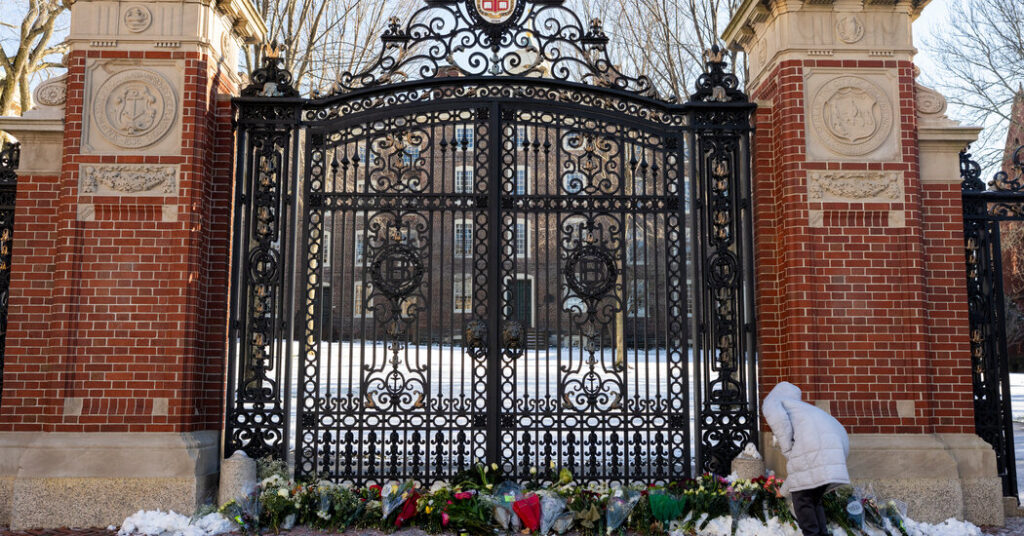
As grief-stricken students embraced in dining halls and made plans to travel home for the holidays, a sense of mournful calm took hold on the campus in Providence, R.I. That evening, at a public vigil for the victims, people spoke about healing their community.
Then, a few hours before midnight, prosecutors received an analysis of a key piece of crime scene evidence. It indicated that the young man being held at the Providence police station was not linked to the attack.
At a hastily arranged news conference that began just after 11 p.m., Rhode Island officials announced that the manhunt was back on.
“Sometimes you head in one direction, and then you have to regroup and go in another,” Peter Neronha, the attorney general of Rhode Island, told his state. “And that’s exactly what has happened.”
Saturday
It was finals season at Brown, and Barus and Holley engineering building was buzzing with students taking exams or squeezing in last-minute study sessions. The building’s exterior doors were unlocked. Inside a cavernous first-floor classroom, one of those study sessions was wrapping up just after 4 p.m.
Just as a teaching assistant for an introductory economics class, Joseph Oduro, was dismissing his students, a masked man barged in and started shooting. Mr. Oduro heard the gunman shout something, but he could not make out exactly what it was.
Some students ran out. Others hid. Spencer Yang, a first-year student, was shot in the leg and ducked behind a chair, where he comforted a classmate whose injuries looked even more dire.
The first 911 calls about the shooting reached the police at 4:05 p.m. Within minutes, officers and rescue crews were racing toward the scene. The gunman had already escaped onto the streets of Providence.
A few blocks away, Mayor Brett Smiley was at home watching a Providence College basketball game on TV when a passing police car caught his eye.
His phone rang almost at that moment. It was the deputy police chief, who said: “Mayor, we have reports of a shooter at Brown University.”
Students on the campus began to warn each other online.
“Why are people running away from B&H?” someone posted anonymously at 4:06 p.m. on a channel for Brown students on the social media app Sidechat.
Four minutes later, another person posted: “STAY AWAY FROM THAYER STREET NEAR MACMILLAN 2 PEOPLE JUST GOT SHOT IM BEING DEAD SERIOUS.”
The university sent out its first emergency alert at 4:22 p.m. There was a shooter, it said. Everyone needed to shelter in place. Lock doors, silence phones, hide until further notice.
The reality of the threat began to sink in on campus. “Call your parents,” one member of the Brown community posted on Sidechat at 4:24, and “tell them you love them.”
About 30 minutes after the university’s first alert, Brown sent another saying “one suspect in custody.” The alert advised students to “stay hidden.” Minutes later, the university backtracked: No one was in custody. A person who was detained briefly turned out not to be the gunman, officials said later.
Peter Neronha, the attorney general of Rhode Island, was at a wedding reception when he got a call about the attack. By around 5 p.m., he and others from his office were arriving at a command post that had been set up inside Brown’s applied mathematics building, next door to Barus and Holley.
Investigators began looking for witnesses and processing evidence from the shooting scene. Some of that evidence was sent outside the state for expedited testing.
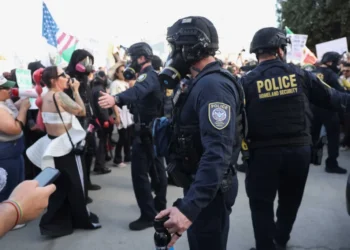
Law enforcement officers, some 400 of them, descended on the campus and surrounding neighborhood. The authorities blocked roads. Waiting ambulances crowded the streets nearby. Helicopters circled overhead. Officers in body armor carrying rifles and shotguns walked the sidewalks and shined lights into parked cars, looking for the shooter.
Officers began room-by-room searches across the campus, marching some students out with their hands in the air.
At 6:33 p.m., the university posted a letter online. Two people had died in the attack.
Reporters were called to a news conference, but the local authorities had limited information to share. They had not recovered a gun. They described the assailant in only the vaguest terms: a male dressed in black.
“This is a day that we hoped never would come to our community,” Christina Paxson, Brown’s president, wrote in a message to campus at 7:38 p.m.
As the search continued, President Trump called Gov. Dan McKee of Rhode Island at 9:04 p.m. and promised federal support, according to the governor’s office.
At 11:07 p.m., the Providence police released a potentially key piece of evidence: video of a “person of interest” in the shooting, seen walking away from the scene.
The person appeared to be a man, a bit heavyset. His back was to the camera. He seemed to be in no great hurry. His face was not visible.
Sunday
As Saturday night became Sunday morning, police officers continued a methodical search of the campus.
About 20 minutes’ drive away, at a hotel off Interstate 95 in Coventry, R.I., investigators thought they might have broken the case wide open. Working off a lead generated by the Providence police, the F.B.I. used cellular location technology to pinpoint the phone of a possible suspect.
Federal agents and local officers burst into the hotel before dawn and took that man into custody. A person familiar with the investigation, who spoke on the condition of anonymity to discuss the early stages of the case, said that when agents searched that room, they found two firearms.
At about 3 a.m., Mayor Smiley went to bed. An hour later, a police official called him with news of the person in custody. The mayor did not go back to sleep.
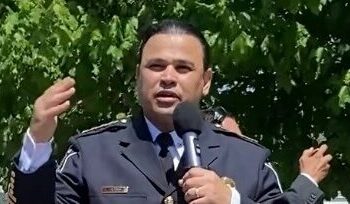
Brown announced at 5:42 a.m. that the shelter-in-place order had been lifted, and shortly after 7 a.m., Col. Oscar Perez, the Providence police chief, said at a news conference that officers were not looking for anyone else.
As students began to emerge from hiding, Brown canceled the remaining week of its fall semester. No more classes, papers or exams. “For the moment, we encourage everyone to focus on their own safety and well-being,” Francis J. Doyle III, the provost, wrote in a letter.
That afternoon, Mayor Smiley described meeting at a hospital with a wounded student, who told him that memories of an active-shooter drill in high school had been helpful in the crisis. The conditions of the nine wounded students were reported to be stable or improving.
Across town, detectives and prosecutors were working to collect evidence, to see if there was a case to be made against the man in their custody. Mr. Neronha, the attorney general, said that officers applied to state judges for search warrants, taking time to make sure their work could withstand scrutiny at any future trial.
As darkness fell on Sunday evening and light snow swirled, several hundred people gathered for a vigil at Lippitt Memorial Park, about two miles from the site of the shooting. The event, initially meant to celebrate Christmas and Hanukkah, was repurposed as a venue for communal grief.
“I think my job in the days to come is to help our community heal, to process the trauma that they’ve been through,” Mayor Smiley said while he was there.
After the vigil, he stopped at a synagogue and then went home. He would not be there long. Around 7 or 8 p.m., he got a call about the evidence, and went to the city’s public safety building to learn more.
Sometime before 11 p.m., the man detained by the police was released.
Monday
As Rhode Island woke up to news that the manhunt had resumed, Brown students were learning the identifies of their slain classmates: Ella Cook, 19, a talented pianist from Alabama, and MukhammadAziz Umurzokov, 18, an aspiring surgeon from Virginia.
Police departments in the state stepped up patrols outside schools. The University of Rhode Island abruptly called off the day’s in-person final exams. Providence residents opened their doors to find police officers asking if they had any security camera footage or doorbell videos.
Talib Reddick, the president of Brown’s Undergraduate Council of Students, left campus before sunrise on Monday to catch an early flight home. He had heard from other students who were stunned that all day Sunday, people had been “out and about on campus and they didn’t have the actual shooter.”
Prosecutors held a formal briefing at 8 a.m. to work out the next steps in the investigation, and then F.B.I. agents fanned out, searching in the snow for evidence.
By Monday night, officials had released new photos and videos of the person who they believe carried out the attack, describing him as a male, around 5 feet 8 inches tall, with a stocky build. The images showed a man walking on the streets of Providence in the hours before the shooting, wearing dark clothing and a medical mask over his face. The F.B.I. offered a reward of up to $50,000 for information leading to the arrest and conviction of the shooter.
Investigators said they were making progress, and officials signaled optimism that they would eventually solve the case.
Mr. Neronha spoke in an interview on Monday about the person who had briefly been detained. He said there had been “a quantum of evidence pointing in that person’s direction,” and that “once he became a person of interest, you needed to run it to ground.” .
The attorney general declined to say exactly what had convinced prosecutors that they had the wrong man, lest he tip off the actual killer to the nature of the evidence.
“He has been cleared,” Mr. Neronha told the state later Monday. “He is not a person of interest any longer. The investigation is now focused in another direction.”
As another day ended, the gunman remained on the loose.
Thomas Gibbons-Neff, Katherine Rosman, Stephanie Saul, Devlin Barrett, and Jenna Russell contributed reporting. Georgia Gee contributed research. Bethlehem Feleke contributed video production.
Mitch Smith is a Chicago-based national correspondent for The Times, covering the Midwest and Great Plains.
The post Wrong Turns and Long Nights: Inside the Search for the Brown University Attacker appeared first on New York Times.