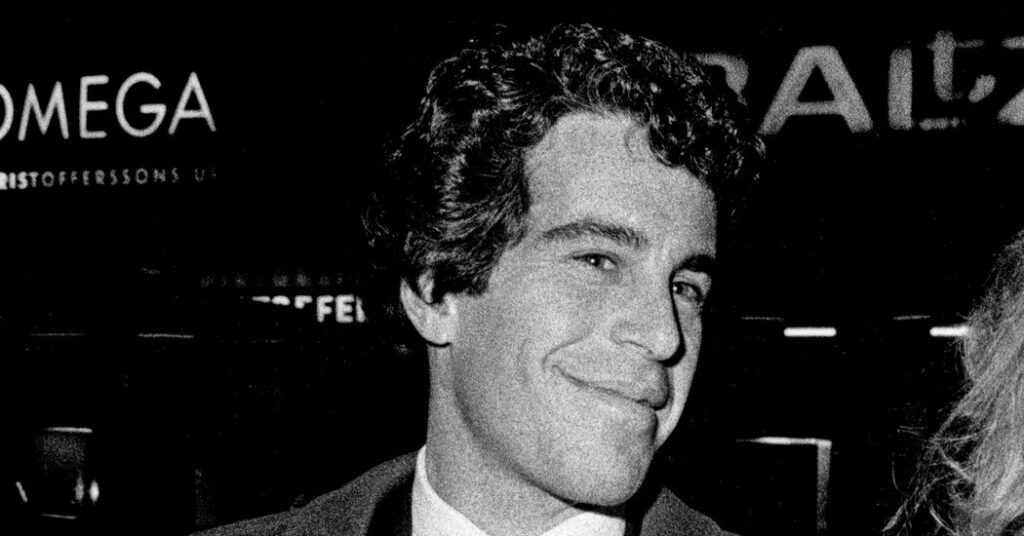
One unsolved riddle around Jeffrey Epstein is how a college dropout from a working-class Brooklyn family amassed hundreds of millions of dollars and held sway in the most rarefied circles of American finance, politics and society.
We spent months trying to cut through myths and falsehoods to fill in the gaps in Epstein’s origin story and determine how he made his fortune. We pored over private archives; reviewed previously unpublished interviews; sifted through diaries, letters, emails and photo albums; combed through thousands of pages of records; and spoke to dozens of Epstein’s colleagues, friends, acquaintances and business and sexual victims.
Here are six takeaways from our investigation.
Epstein’s start on Wall Street came through a series of lucky breaks.
Epstein was about to lose his teaching job at Manhattan’s prestigious Dalton School when he was invited by a student’s parent to an event at an art gallery, according to a document prepared by his lawyers and a recording of Epstein that we obtained. At the gallery, he met another Dalton parent, who connected him to Ace Greenberg, the future chief executive of Bear Stearns. This earliest part of Epstein’s rise has not previously been reported.
Greenberg took him under his wing and even seated Epstein next to his 20-year-old daughter at a dinner party, in what the daughter told us was probably a setup. Soon, Epstein was caught committing a series of flagrant offenses — falsely claiming he had graduated from college, abusing his expense account and giving a girlfriend privileged access to investment deals — which we are reporting in full for the first time. Yet the firm repeatedly gave him second chances.
Bear Stearns provided Epstein with prestige, business and women for decades.
We learned that after Epstein left the firm, one of his former managers kept introducing him to clients and young women. The manager sent multiple young female assistants to Epstein’s apartment, sometimes leading to hookups and romantic relationships. One, Patricia Schmidt, told us that she was being used as leverage by both the manager and Epstein. Another was Suzanne Ircha, who later became close friends with Melania Trump. Neither Schmidt nor Ircha’s relationship with Epstein has previously been reported.
For decades, Epstein continued to use his tenure at Bear Stearns, as well as his close relationship with Greenberg and other top executives, to bolster his legitimacy with potential clients and government officials.
Epstein made his first small fortune by scamming investors.
After leaving Bear Stearns, Epstein continued his pattern of lying and cheating, according to unpublished interview transcripts that we obtained. One of his early mentors, the British defense contractor Douglas Leese, split with Epstein after accusing him of abusing his expense account. Another, a businessman named Michael Stroll, accused Epstein of absconding with most of his $450,000 investment in a deal that never appeared to materialize.
.css-1mxer6r{max-width:600px;width:calc(100% – 40px);margin:1.5rem auto 1.75rem;height:auto;margin-left:auto;margin-right:auto;font-family:nyt-franklin;color:var(–color-content-secondary,#363636);border-top:1px solid var(–color-stroke-quaternary,#DFDFDF);border-bottom:1px solid var(–color-stroke-quaternary,#DFDFDF);padding-top:20px;padding-bottom:20px;}@media only screen and (min-width:1024px){.css-1mxer6r{width:600px;}}.css-1medn6k{font-family:nyt-franklin,helvetica,arial,sans-serif;font-weight:500;font-size:1.0625rem;line-height:1.5rem;}@media only screen and (max-width:480px){.css-1medn6k{font-size:1rem;line-height:1.375rem;}}.css-1f84s5v{font-weight:700;font-size:1.0625rem;}@media only screen and (max-width:480px){.css-1f84s5v{font-size:1rem;}}.css-1f84s5v a{color:var(–color-signal-editorial,#326891);-webkit-text-decoration:underline;text-decoration:underline;}.css-1f84s5v a:hover{-webkit-text-decoration:none;text-decoration:none;}.css-1hvpcve{font-size:17px;font-weight:300;line-height:25px;}.css-1hvpcve em{font-style:italic;}.css-1hvpcve strong{font-weight:bold;}.css-1hvpcve a{font-weight:500;color:var(–color-content-secondary,#363636);}.css-214jt4{margin-top:15px;margin-bottom:9px;}@media only screen and (max-width:480px){.css-214jt4{font-size:14px;margin-top:15px;margin-bottom:10px;}}.css-214jt4 a{color:var(–color-signal-editorial,#326891);-webkit-text-decoration:underline;text-decoration:underline;font-weight:500;font-size:16px;}@media only screen and (max-width:480px){.css-214jt4 a{font-size:13px;}}.css-214jt4 a:hover{-webkit-text-decoration:none;text-decoration:none;}.css-1mxer6r{max-width:600px;width:calc(100% – 40px);margin:1.5rem auto 1.75rem;height:auto;margin-left:auto;margin-right:auto;font-family:nyt-franklin;color:var(–color-content-secondary,#363636);border-top:1px solid var(–color-stroke-quaternary,#DFDFDF);border-bottom:1px solid var(–color-stroke-quaternary,#DFDFDF);padding-top:20px;padding-bottom:20px;}@media only screen and (min-width:1024px){.css-1mxer6r{width:600px;}}.css-1medn6k{font-family:nyt-franklin,helvetica,arial,sans-serif;font-weight:500;font-size:1.0625rem;line-height:1.5rem;}@media only screen and (max-width:480px){.css-1medn6k{font-size:1rem;line-height:1.375rem;}}.css-1f84s5v{font-weight:700;font-size:1.0625rem;}@media only screen and (max-width:480px){.css-1f84s5v{font-size:1rem;}}.css-1f84s5v a{color:var(–color-signal-editorial,#326891);-webkit-text-decoration:underline;text-decoration:underline;}.css-1f84s5v a:hover{-webkit-text-decoration:none;text-decoration:none;}.css-1hvpcve{font-size:17px;font-weight:300;line-height:25px;}.css-1hvpcve em{font-style:italic;}.css-1hvpcve strong{font-weight:bold;}.css-1hvpcve a{font-weight:500;color:var(–color-content-secondary,#363636);}.css-214jt4{margin-top:15px;margin-bottom:9px;}@media only screen and (max-width:480px){.css-214jt4{font-size:14px;margin-top:15px;margin-bottom:10px;}}.css-214jt4 a{color:var(–color-signal-editorial,#326891);-webkit-text-decoration:underline;text-decoration:underline;font-weight:500;font-size:16px;}@media only screen and (max-width:480px){.css-214jt4 a{font-size:13px;}}.css-214jt4 a:hover{-webkit-text-decoration:none;text-decoration:none;}
Got a confidential news tip? The New York Times would like to hear from readers who want to share messages and materials with our journalists.
See how to send a secure message at nytimes.com/tips
We learned that Epstein soon embarked on what appeared to be schemes to manipulate the stock prices of publicly traded companies. And he solicited money from outside investors, including the chief executive of Simon & Schuster, and then disappeared with their money. Epstein’s ability to walk away with impunity let him keep amassing enough wealth to impress larger financial targets to come.
Epstein’s first big breakthrough came from tracking down money in the Cayman Islands.
Epstein liked to tell people he was a financial “bounty hunter.” We found only one example of this being true — but it was a big one. In the early 1980s, the brokerage firm Drysdale Securities imploded, and many wealthy families lost millions. Epstein happened to be dating Ana Obregón, a Spanish socialite and actress, and soon he was hired by the Obregóns and other Spanish families to find their missing money.
To help in the hunt, Epstein turned to a friend and former federal prosecutor named Bob Gold. Gold told us that he and Epstein spent more than a year searching for the money before Epstein concluded that the funds were hidden in a Canadian bank’s branch in the Cayman Islands — a story that has not previously been told in full. Epstein was richly rewarded for having found the money, a windfall that, combined with the Stroll scam, made him a millionaire.
Epstein exaggerated his association with David Rockefeller as a crucial calling card.
Few Americans were better connected in the 1990s than David Rockefeller, the heir to the industrial fortune. We found that Epstein managed to insinuate himself into Rockefeller’s world by having his foundation donate tens of thousands of dollars to Rockefeller University and the Trilateral Commission. On at least one occasion that has not been previously reported, Epstein hosted Rockefeller at his Manhattan mansion for a small group discussion about estate planning, an attendee told us.
Epstein also claimed that he managed money for the Rockefeller family, which appears to have been a lie; a person who helped manage the family’s wealth told us that Epstein didn’t even pitch Rockefeller on any investments. Nonetheless, we found that Epstein used the Rockefeller name to impress powerful people and institutions.
The billionaire Les Wexner was a source of much more than money.
Les Wexner, the billionaire behind such brands as the Limited and Victoria’s Secret, was probably Epstein’s biggest benefactor, but he also offered another kind of currency: credibility and credentials.
In the late ’80s, Epstein used his association with Wexner to develop relationships with men like Ken Lipper, a prominent hedge-fund manager; we discovered that Epstein then falsely claimed on a regulatory filing that he worked for a Lipper hedge fund. He used Wexner’s money to rescue the lawyer Alan Dershowitz from a failed investment; Dershowitz went on to become one of Epstein’s chief defenders.
The post What to Know About the Origins of Jeffrey Epstein’s Wealth appeared first on New York Times.