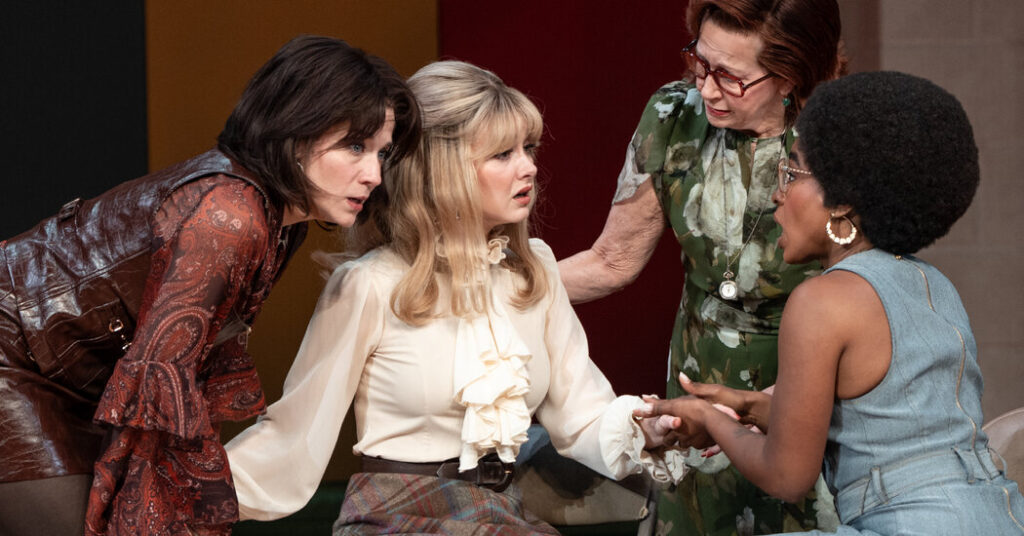
Six women of various ages sit, awkwardly, on metal folding chairs placed in a semicircle on the dimly lit basketball court of a local rec center. They are completely naked, clearly uncomfortable, and talking haltingly about what they like and don’t like about their bodies.
“I hate my nostrils,” says one.
“I do love my brain,” says another.
“It’s the scar from my, from my C section. Both of my C sections.”
“I love my tits.”
This back-and-forth takes place in a key scene in the new Broadway play “Liberation,” which I recently saw with my mother and twin sister. I imagine some audience members considered it an extreme example of the confessional consciousness-raising groups that convened in the 1970s during the women’s liberation movement. But the three of us recognized the gathering as very real: My mother had been a participant.
Letty Cottin Pogrebin, a writer and pioneer of the movement, was part of the team that founded Ms. magazine with Gloria Steinem. During the playwright Bess Wohl’s research for “Liberation,” she interviewed Letty about her consciousness-raising (C.R.) group and topics like equal pay and sexual harassment. My mother also sent Wohl a copy of her Ms. article from 1973 describing the group’s nude convening.
“The women talk about physical vulnerability,” Letty wrote, “about revealing their bodies for the first time to a man, about seeing other women’s bodies, about skin color and texture and about flesh that is no longer young.”
Those details, along with many others — including a powerful sense that they were changing the world — made it into “Liberation,” which opened on Broadway this fall to enthusiastic reviews after an Off Broadway debut in February.
Directed by Whitney White, the play explores the promise and failings of feminism through the eyes of the group’s leader, Lizzie, a young 1970s journalist played by Susannah Flood, who also portrays Lizzie’s adult daughter and serves as the contemporary narrator.
The play’s subject matter has proved timely in a moment when tradwife content has prompted debate on social media and when divisiveness over abortion rights has intensified after the Supreme Court’s 2022 overturning of Roe v. Wade.
Watching “Liberation” with my mom and my sister, Abigail Pogrebin, an author, evoked memories of our mother’s evolution as an activist — her participation in protest marches and political organizing and her personal revelations.
My mother said she felt pride in the achievements of her cohort, represented by the characters onstage — including women of different racial backgrounds and sexual orientation, who had additional battles to fight. But she also saw in the play the slow pace of progress, given that women still earn 83.6 percent as much as men.
People have often asked me what it was like to grow up as the daughter of a women’s movement progenitor, and I’ve always said that it’s all I ever knew. It was the air we breathed, the water we swam in. My sister, our younger brother David and I took for granted that we could each play with dolls or trains, wear pink or blue and grow up to be whatever we wanted to be.
After the performance of “Liberation,” my sister, mother and I sat down with Wohl and her mother, Lisa Cronin Wohl — a writer and Ms. contributor — to talk about what the play brought up for each of us and how it dovetailed with our lives.
I started by asking my mother why, when I looked over at her during the curtain call, she was crying.
“It was seeing my whole life,” she said, still choked up. “I just felt so buoyed by the part of that final monologue in which she really captured who we were and what we did and what we felt we were doing, and also what we feel has been lost and unraveled.”
In that monologue, the mother character says:
… knowing that the things we said and did, the conversations we
had, are still here? That they’re not over. Well, I guess that’s the
solution. It’s the problem. And the solution.
“There were so many characters in this play who are my people, my friends, my C.R. group,” Letty added. “People have died, and they struggled and they left a mark. But it’s kind of like a footprint in the sand. And the ocean comes and takes it away.”
My sister, Abby, said “Liberation” summoned what it was like to grow up in our household: How our mom pushed us in the double stroller as she marched in street demonstrations; how we played with other Ms. kids in the office’s “tot lot,” testing out the non-gender-specific toys sent for editors’ assessment; how we coveted the mini Milky Way bars my mom kept stashed in her desk drawer (which Steinem, an unrepentant candy fan, regularly sampled).
The characters in the play “felt familiar to me,” Abby said, “in a way that was almost cellular.”
My sister and I were both especially affected by what the narrator’s mother says to her daughter about the trade-offs of parenting as well as some disappointment in her adult daughter’s complacency:
It was a huge problem for us, the having you, the raising you, and the way you took so much for granted and let so much slide — not just the political progress but the community — the solidarity — I don’t know where that is now.
The play also pointed up the degree to which the term “feminist” has become freighted. My mother always taught us it simply meant giving men and women equal treatment and opportunity. For our daughters’ generation, the label has grown more complicated, and some young women reject it.
For Abby, the play also echoed her own 2011 oral history about Ms. for New York Magazine, retracing the limitations that used to define a woman’s life, such as the inability to get a credit card in her own name.
“We couldn’t get a loan at the bank, we couldn’t buy a home,” Margie says in “Liberation,” adding that “at my high school, girls used to play basketball on half the court because everyone thought we couldn’t run the full way across.”
Wohl, 50, said that speaking with my mother had unlocked something important.
“I think it was Gloria who called you and said, ‘It’ll never be over’ after Reagan was elected,” Wohl added, an apparent reference to Ronald Reagan’s open opposition to the Equal Rights Amendment. “And that line — ‘It’ll never be over’ — I just remember you saying that.”
Regarding the naked C.R. group: “I know Mom did that,” Abby said dryly, “and I don’t really want to imagine it.”
Wohl credited her mother’s influence on the script as well, how “she was willing to have all of the hard, honest conversations with me.
“She didn’t flinch when I told her that I would be sharing really personal, raw things,” Wohl added. “She kept telling me to just go for it, don’t hold anything back.”
“Liberation” also grapples with ambivalence about marriage, suggesting that freedom can sometimes be at odds with partnership. “It’s almost impossible to have both,” one character says.
Cronin Wohl said that because she had been “reluctant to get married,” she related to the lines spoken by Margie about the imbalance intrinsic to traditional marriage:
Take it from me, whatever you do, do not become a wife. Because no matter what they say, the expectations and the rules are not equal. They just are not equal. And they never will be.
Abby said she had trouble relating to that tension in the play — the idea “that getting married was a capitulation to sign on to an oppressive institution” — because our parents’ modeled a teamwork and mutual respect that Abby has managed to find with her own husband.
“I didn’t grow up with a sense that it was somehow losing something to find a partner,” she said, “or that it was anti-feminist to get married.”
The play also deals with the movement’s racial divides. In one scene, Celeste (Kristolyn Lloyd), an intellectual and the only Black member of the predominantly white group, is confronted by Joanne (Kayla Davion) — another Black woman who briefly wanders into the group’s meeting — about whether the white members will ever consider Celeste an equal participant.
JOANNE: They’ll go climb the ladder, go write their novels, while they make it big — who’s going to be cleaning their houses?
CELESTE: Not me.
JOANNE: (Over her.) Who’s going to be watching their children. Their rise depends on keeping us down —
CELESTE: That’s why we’re pushing for universal child care, unionizing domestic workers, welfare reform —
JOANNE: Uh-huh. You call me when you get all of that.
Letty noted the honesty of this exchange in “dealing with the real schisms of push-pull within the women’s movement.
“If they were part of us, they were critiqued by their own,” she added of early Black feminists. “And if they were not part of us, they had to make their own movement. They made their own movement. But we were then bifurcated, weakened. We were just pulled apart.”
I asked everyone how they came away thinking about activism — whether public resistance is worth the personal risk and whether they could imagine taking to the streets now.
In the play, Celeste questions whether “protesting changes anything,” given entrenched patriarchy and potential backlash. “I don’t know if you can just ask people to walk out on their jobs, their families,” she says.
Letty sighed. “I guess I’m really feeling exhaustion, having to do everything all over again,” she said. “Although I recognize that the world is different from when we all started the struggle, I never dreamed that we could possibly lose a constitutional right.
“We got very lazy about our organizing to protect reproductive freedom,” she added. “We didn’t realize it wasn’t rock-solid.”
I personally felt nostalgic for the play’s spirit of sisterhood, the strength and support that Wohl’s women derive from one another. While I have fortifying female friendships, gathering a group of women in a room on a regular basis — talking about our lives — is rare.
I asked Wohl whether she considered her play political — a call to action, an effort to catalyze change.
“Seeing young women come and learn about the time of Letty and my mom, it’s a consciousness-raising for them,” she said. “The play is not meant to shove a point of view down anyone’s throat — I actually think that’s not good theater.
“But bringing people in community and having this exchange of energy that’s so alive and bringing back these stories from a time when regular people got together and did things to move the world forward,” she continued, “to me, that is a political act.”
Robin Pogrebin, who has been a reporter for The Times for 30 years, covers arts and culture.
The post Watching ‘Liberation’ With a Women’s Movement Pioneer, My Mom appeared first on New York Times.