The U.S.-European plan to secure Ukraine against future Russian attacks once the current war ends calls for a more robust Ukrainian military, the deployment of European forces inside that country to deter another invasion and increased use of American intelligence, according to officials familiar with drafts of two security documents that detail the proposal.
American and European diplomats meeting with Ukraine’s leaders over the past two days in Berlin have mostly signed off on the security guarantees, the officials said publicly and privately. The security documents are designed to serve as the cornerstone of a broader agreement aimed at reaching a cease-fire to end the nearly four-year-old conflict. They are also intended to persuade Ukraine to concede territory in a peace deal and give up on formal inclusion in NATO.
“We are seeing real and concrete progress,” Ursula von der Leyen, president of the European Commission, said Tuesday. “That progress is made possible thanks to the alignment between Ukraine, Europe and the United States.”
Still, a broad cease-fire appears to remain out of reach for the moment, in part because Russia is not a party to these negotiations. Any agreement to end the fighting would require significant concessions from either President Volodymyr Zelensky of Ukraine or President Vladimir V. Putin of Russia. While Mr. Zelensky has concerns about the American proposals, especially on territorial concessions, Mr. Putin has indicated no flexibility at all in his demands.
A Russian deputy foreign minister, Sergei A. Ryabkov, said on Tuesday that his government remains firm on demanding that Ukraine hand over the part of its Donbas region that Russia has not conquered and that it will not accept the presence of NATO-country troops in Ukraine.
U.S. officials said Monday that the territorial issue remains a roadblock but expressed confidence, despite Mr. Putin’s public comments, that he would eventually accept the presence of European forces in Ukraine not operating under the banner of NATO. They, like others interviewed for this article, spoke on condition of anonymity to freely discuss ongoing talks.
For the first time in months, European officials said they were working well with American negotiators and President Trump.
But some European leaders hinted at lingering concerns that all the diplomatic work with the Americans could be irrelevant if the fundamental disputes between Russia and Ukraine cannot be resolved.
“It sounded very promising, compared to the previous declarations, that the Americans are ready to give guarantees — but it would be an exaggeration if I said that we know everything about the concrete details,” said Donald Tusk, the prime minister of Poland.
American and European officials said the security documents were hammered out during more than eight hours of intense discussions with Mr. Zelensky and other Ukraine aides in Berlin on Sunday and Monday. Top leaders and national security officials from about a dozen European countries took part, including France, Germany, Italy and Britain.
One of the two documents lays out broad principles. They amount to what two American officials and several European diplomats said was a commitment similar to NATO’s Article 5 guarantee, in which all member nations pledge to come to the aid of any nation that is attacked.
The second part of the agreement, which American officials described as a “mil-to-mil operating document,” or military-to-military, provides more granular detail. It explains how American and European forces would work with Ukraine’s military to ensure that Russia does not once again attempt to seize Ukrainian territory in the years to come.
Neither document has been made public. People familiar with them said the operating document includes numerous, specific directives designed to reassure Ukraine in various scenarios of possible Russian incursion. One American official, who spoke to reporters on the condition of anonymity, said that the document was “very specific” about how to deter further incursions and punish Russia if they occur.
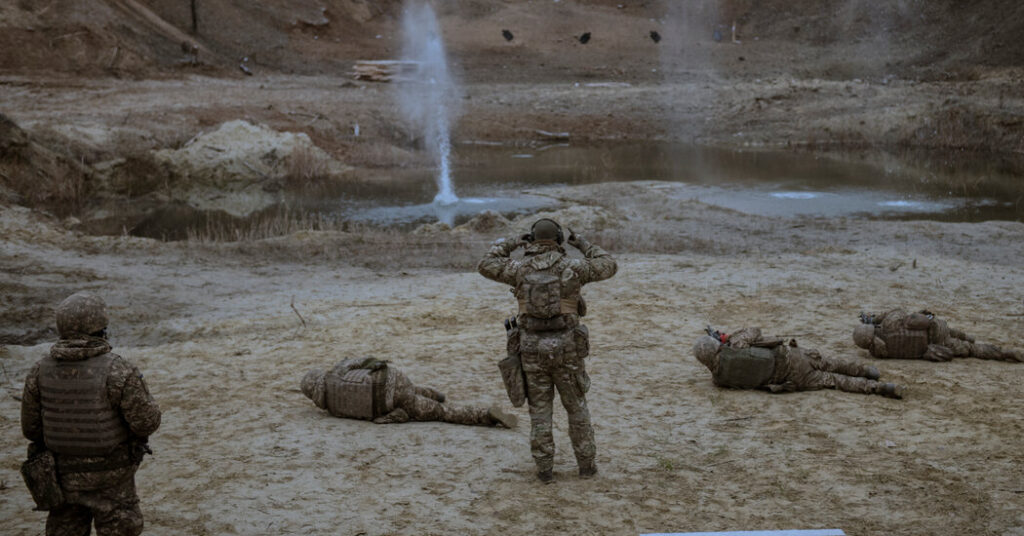
The first priority is a plan to bring the size of Ukraine’s military to a “peacetime level” of 800,000 troops, with up-to-date training and equipment, to serve as a strong deterrent against Russia. It has grown its army to nearly 900,000 during the war. By comparison, Germany’s army has about 180,000 armed troops.
Building such a force would require “sustained and significant support” for Ukraine, a joint statement by the leaders of 10 European nations and the top officials at the European Union said. One European diplomat said without specifying that the document lists “very concrete” details about military hardware that Ukraine needs.
The document also lays out details about a Europe-led military force to assist Ukraine by operating inside the country to secure the skies and seas. Officials declined to provide specifics about which countries would station troops in Ukraine, but Mr. Zelensky said Tuesday that several have pledged privately to do so. Those troops are expected to be based in western Ukraine, away from any cease-fire line, to serve as another level of deterrence against any future Russian aggression.
“Each country already understands its role or its volume of supplies,” Mr. Zelensky said during a news conference with Prime Minister Dick Schoof of the Netherlands in The Hague. “Some are ready to provide only intelligence, others are ready to provide troops in Ukraine — boots on the ground. We have this in the document.”
French and British diplomats are managing the proposal to deploy European forces in Ukraine as part of a group of about 30 countries they call the “Coalition of the Willing.” The European diplomat described the pledges in the security document as a menu from which their respective governments could choose the level of support.
Mr. Trump has repeatedly ruled out sending American troops to Ukraine. Instead, the operational document provides detail about how the United States would use its vast intelligence systems to help monitor the cease-fire and detect Russian activity aimed at re-entering the rest of Ukraine, officials said. The Americans would also help verify Russian compliance and make sure that minor skirmishes between Russia and Ukraine do not spiral into a new war.
It also details how the United States would help detect Russian attempts to create “false flag” operations that might give Moscow a pretense to resume hostilities. Officials have said for years that is a common Russian tactic.
Monday’s statement from the European leaders said the United States would lead a “cease-fire monitoring and verification mechanism with international participation to provide early warning of any future attack.” It was not clear whether or how American forces would intervene to defend European troops in Ukraine should they be attacked.
One of Mr. Zelensky’s chief concerns has been the fear that future security guarantees would fail, much like the 1994 agreement known as the Budapest Memorandum on Security Assurances. In that case, Ukraine, Russia, the United States and Britain provided “security assurances” to Ukraine in case of invasion, in return for Ukraine giving up the nuclear weapons it inherited in the breakup of the Soviet Union. Russia violated the agreement in 2014 and again in 2022, but the signatories took little military action to defend Kyiv.
American and European officials said the new security guarantee would be legally binding, subject to each country’s procedures. U.S. officials said that Mr. Trump had agreed to submit the security guarantees to the Senate, where treaties are typically ratified, though they did not make clear whether they would formally submit the guarantees as a treaty.
Mr. Zelensky said early Tuesday that the documents would be finalized in the coming days and that he expected American officials to then convey it to Russia and meet with Ukrainian negotiators after that, perhaps this weekend.
Maria Varenikova contributed reporting.
Michael D. Shear is a senior Times correspondent covering British politics and culture, and diplomacy around the world.
The post Ukraine Plan Calls For Enhanced Military, With U.S. and European Backup appeared first on New York Times.