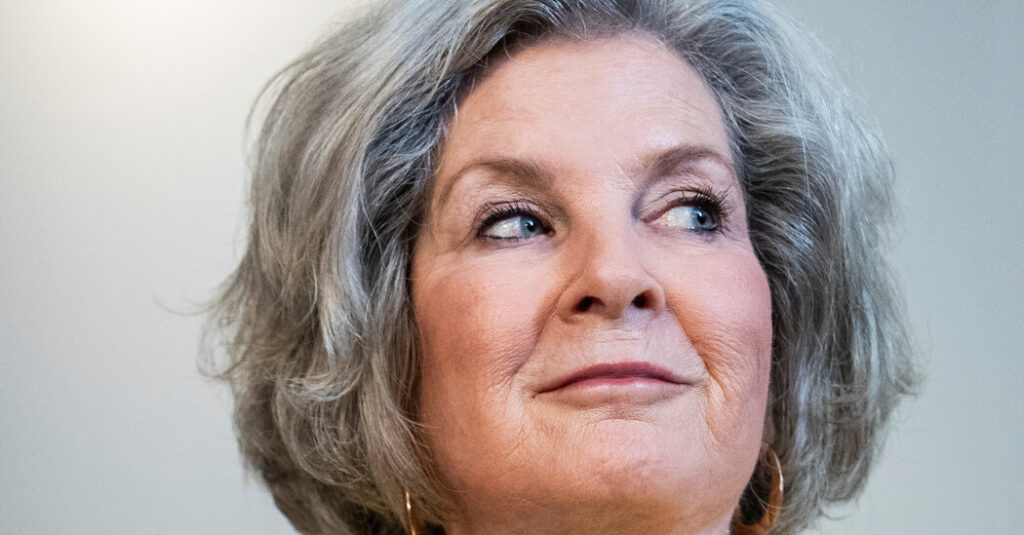
President Trump’s chief of staff said she tried to get him to end his “score settling” against political enemies after 90 days in office, but acknowledged that the administration’s still ongoing push for prosecutions has been fueled in part by the president’s desire for retribution.
Susie Wiles, the White House chief of staff, told an interviewer that she forged a “loose agreement” with Mr. Trump to stop focusing after three months on punishing antagonists, an effort that evidently did not succeed. While she insisted that Mr. Trump is not constantly thinking about retribution, she said that “when there’s an opportunity, he will go for it.”
Ms. Wiles made the comments in a series of extraordinarily unguarded interviews over the first year of Mr. Trump’s second term with the author Chris Whipple that are being published Tuesday and Wednesday by Vanity Fair. Not only did she confirm that Mr. Trump is using criminal prosecution to retaliate against adversaries, she also acknowledged that he was not telling the truth when he accused former President Bill Clinton of visiting the private island of the sexual predator Jeffrey Epstein.
Over the course of 11 interviews, Ms. Wiles offered pungent assessments of the president and his team: Mr. Trump “has an alcoholic’s personality.” Vice President JD Vance has “been a conspiracy theorist for a decade” and his conversion from Trump critic to ally was based not on principle but was “sort of political” because he was running for Senate. Elon Musk is “an avowed ketamine” user and “an odd, odd duck,” whose actions were not always “rational” and left her “aghast.” Russell T. Vought, the budget director, is “a right-wing absolute zealot.” And Attorney General Pam Bondi “completely whiffed” in handling the Epstein files.
Ms. Wiles described her own reservations about certain policies in real time to Mr. Whipple, author of a well-regarded book on White House chiefs of staff, even as debates raged inside the administration. She said she urged Mr. Trump not to pardon the most violent rioters from Jan. 6, 2021, which he did anyway. She unsuccessfully tried to get him to delay his major tariffs because of a “huge disagreement” among his advisers. And she said the administration needed to “look harder” at deportations to prevent mistakes.
But she did not complain about being overruled and at various points said she “got on board” with the eventual decisions. “There have been a couple of times where I’ve been outvoted,” she said. “And if there’s a tie, he wins.”
The off-script comments felt reminiscent of a similar episode in President Ronald Reagan’s first term when his budget director, David A. Stockman, likewise gave a series of interviews to what was then called The Atlantic Monthly with candid observations that caused a huge stir.
While Mr. Stockman kept his interviews secret from the White House (and nearly got fired), the broader Trump team cooperated with Vanity Fair. Mr. Vance and Secretary of State Marco Rubio gave interviews and along with top aides like Stephen Miller and Karoline Leavitt posed for glamour photographs by Christopher Anderson.
Ms. Wiles, a low-key Florida political strategist who ran Mr. Trump’s successful comeback campaign last year, has been the president’s most important aide this term, credited with running a more disciplined operation than he had in his chaotic first term. He has embraced her so much that he referred to her during a rally last week as “Susie Trump.”
But the White House under Ms. Wiles is chaotic too, just in a different way. Unlike John F. Kelly, the president’s longest serving chief of staff in his first term, who saw his job as trying to prevent what he considered radical, unwise or even illegal actions, Ms. Wiles does not view her role as constraining Mr. Trump. Instead, she makes clear that her mission is to facilitate his desires even if she sometimes thinks he is going too far.
She attributes her ability to work for Mr. Trump to growing up with an alcoholic father, the sportscaster Pat Summerall. “High-functioning alcoholics or alcoholics in general, their personalities are exaggerated when they drink,” she said. “And so I’m a little bit of an expert in big personalities.” While Mr. Trump does not drink, she said he has “an alcoholic’s personality” and operates with “a view that there’s nothing he can’t do. Nothing, zero, nothing.”
In a sign of how much her job revolves around the president’s big-personality, stream-of-consciousness public comments, she keeps a free-standing video monitor next to the fireplace in her West Wing office with a live feed of Mr. Trump’s social media posts.
The president’s fixation on payback against his enemies offers a case study. Ms. Wiles confided in Mr. Whipple in March that she had told Mr. Trump that his presidency was not supposed to be a retribution tour.
“We have a loose agreement that the score settling will end before the first 90 days are over,” she said then. When that did not happen by August, she told Mr. Whipple that “I don’t think he’s on a retribution tour” but said that he was aiming at people who did “bad things” in coming after him. “In some cases, it may look like retribution,” she said. “And there may be an element of that from time to time. Who would blame him? Not me.”
Among the targets, she acknowledged, was Letitia James, the New York attorney general, who won a civil court verdict against Mr. Trump for business fraud with a penalty of nearly $500 million. “Well, that might be the one retribution,” Ms. Wiles said. Did she advise Mr. Trump to back off? “Not on her. She had a half a billion dollars of his money.” (An appeals court later threw out the penalty as excessive but left the verdict intact.)
As for Mr. James B. Comey, the F.B.I. director who was fired by Mr. Trump while leading an investigation into Russian interference in the 2016 election, Ms. Wiles said, “I mean, people could think it does look vindictive. I can’t tell you why you shouldn’t think that.” She added: “I don’t think he wakes up thinking about retribution. But when there’s an opportunity, he will go for it.”
The Trump administration has brought indictments against Ms. James and Mr. Comey, but both were dismissed by a federal judge. The administration has vowed to keep trying, but two grand juries have since refused to re-indict Ms. James and another judge issued a ruling that will make it harder to pursue Mr. Comey.
Reached for comment on Monday evening, Ms. Wiles played down Mr. Trump’s personal motivations in the actions against his enemies. “It’s not that he thinks they wronged him, although they did,” she told The New York Times. “He thinks that they wronged, and they should not be able to do to somebody else what they did to him and the way that you could cure that, at least potentially, is to expose what was done.”
She added that she wanted to get that over with early in the term. “You don’t want it to get in the way of the real agenda,” she said. “And so, loosely, let’s get it all going within 90 days. Which we did. Now, the justice system works slowly and so even if it was initiated in 90 days, it could be a long time before it’s done.”
In the interviews published by Vanity Fair, Ms. Wiles faulted Ms. Bondi, one of her closest friends in the administration, for her early handling of the Epstein files, an issue that has been a cause célèbre for Mr. Trump’s right-wing base.
“I think she completely whiffed on appreciating that that was the very targeted group that cared about this,” Ms. Wiles said. “First, she gave them binders full of nothingness. And then she said that the witness list, or the client list, was on her desk. There is no client list, and it sure as hell wasn’t on her desk.” Mr. Vance, by contrast, understood the sensitivity because he himself was “a conspiracy theorist,” she said.
Ms. Wiles said she has read the Epstein documents and acknowledged that Mr. Trump’s name is in them. “We know he’s in the file,” she said. “And he’s not in the file doing anything awful.”
But neither, apparently, is Mr. Clinton. Asked about Mr. Trump’s claims going back years that Mr. Clinton had visited the Epstein island, Ms. Wiles said, “There is no evidence.” Asked if there was anything incriminating about Mr. Clinton in the files, as Mr. Trump has suggested, she said, “The president was wrong about that.”
She added that it was Deputy Attorney General Todd Blanche’s idea to go interview Mr. Epstein’s convicted associate, Ghislaine Maxwell, in prison and that the president did not know that she would be transferred to a minimum-security prison camp. “The president was ticked,” she said. “The president was mighty unhappy. I don’t know why they moved her. Neither does the president.”
Ms. Wiles described frustration with Mr. Musk, the billionaire who early in the year was empowered to eviscerate federal agencies and fire employees en masse with almost no process. “He’s an odd, odd duck, as I think geniuses are. You know, it’s not helpful, but he is his own person.” When he shared a post saying that Stalin, Mao and Hitler didn’t murder millions, their public sector workers did, Ms. Wiles said, “I think that’s when he’s microdosing.” Asked what she meant, she said, “he’s an avowed ketamine” user.
Mr. Musk has acknowledged trying ketamine “a few years ago,” but denied reports of more recent use. In the interview with The Times on Monday, Ms. Wiles took issue with the quote attributed to her about his drug use. “That’s ridiculous,” she said. “I wouldn’t have said it and I wouldn’t know.” But Mr. Whipple played a tape for The Times in which she could be heard saying it.
Mr. Musk’s demolition of the U.S. Agency for International Development including its lifesaving aid to impoverished people around the globe upset Ms. Wiles. “I was initially aghast,” she told Mr. Whipple. “Because I think anybody that pays attention to government and has ever paid attention to U.S.A.I.D. believed, as I did, that they do very good work.”
Mr. Musk’s approach was “not the way I would do it.” She said she called Mr. Musk on the carpet. “You can’t just lock people out of their offices,” she recalled telling him. She said that Mr. Musk was a disrupter. “But no rational person could think the U.S.A.I.D. process was a good one. Nobody.”
She offered no objection to Mr. Trump’s saber rattling against Venezuela and bombing of boats carrying alleged drug traffickers, suggesting that regime change against President Nicolás Maduro was Mr. Trump’s real goal. “He wants to keep on blowing boats up until Maduro cries uncle,” she said. “And people way smarter than me on that say that he will.”
She acknowledged that Mr. Trump, who lately has talked about mounting “land strikes” in Venezuela or elsewhere in the region, would need congressional authorization for that. “If he were to authorize some activity on land, then you’d have to, then it’s war, then Congress,” she said.
Ms. Wiles expressed misgivings about how the roundup of immigrants has been carried out at times. “I will concede that we’ve got to look harder at our process for deportation,” she said. Criminals should be deported, she added. “But if there is a question, I think our process has to lean toward a double-check.” When two mothers were arrested and deported with their children after voluntarily attending routine immigration meetings, she said, “I can’t understand how you make that mistake, but somebody did.”
She acknowledged sharp internal divisions over Mr. Trump’s announcement of major tariffs last spring. “There was a huge disagreement over whether” tariffs were “a good idea,” she said. “We told Donald Trump, ‘Hey, let’s not talk about tariffs today. Let’s wait until we have the team in complete unity and then we’ll do it.’” But he announced them anyway and “it’s been more painful than I expected.”
Ms. Wiles confirmed that she wants Mr. Trump to talk more about the economy and less about Saudi Arabia. She denied that he would use the military to influence the midterm elections and ruled out him running again in 2028. His comments about seeking an unconstitutional third term are “100 percent” about “driving people crazy.”
As for the potential successors, Mr. Vance and Mr. Rubio, she distinguished how each of them came around to supporting Mr. Trump after initially opposing him. “Marco was not the sort of person that would violate his principles,” she said. “He just won’t. And so he had to get there.” As for Mr. Vance, “his conversion came when he was running for the Senate. And I think his conversion was a little bit more, sort of political.”
Mr. Rubio told Mr. Whipple what he has said publicly, that “if JD Vance runs for president, he’s going to be our nominee and I’ll be one of the first people to support him.”
Still, the underlying tension came through when Mr. Vance posed for the magazine’s photographer. “I’ll give you $100 for every person you make look really shitty compared to me,” Mr. Vance joked. “And $1,000 if it’s Marco.”
Peter Baker is the chief White House correspondent for The Times. He is covering his sixth presidency and sometimes writes analytical pieces that place presidents and their administrations in a larger context and historical framework.
The post Trump’s Top Aide Acknowledges ‘Score Settling’ Behind Prosecutions appeared first on New York Times.