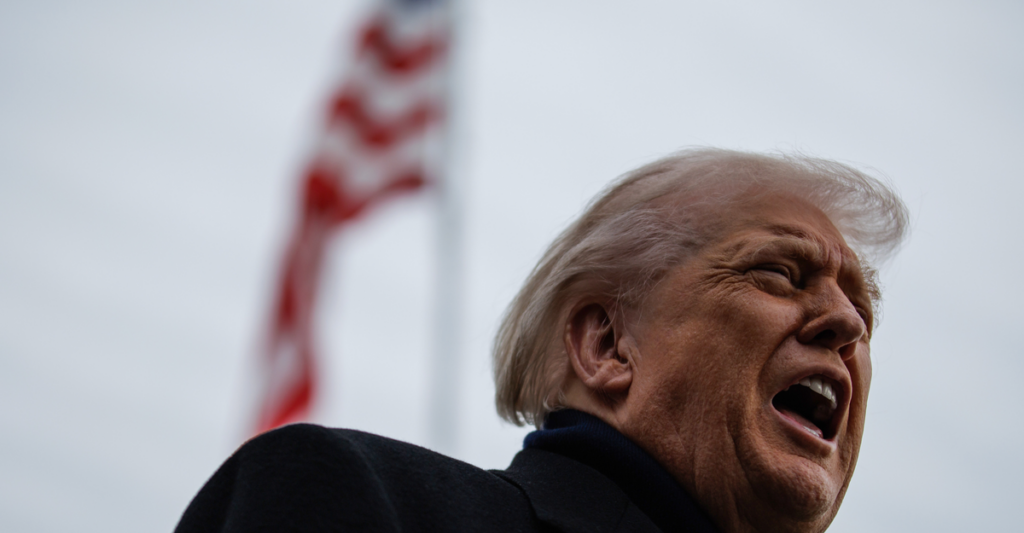
The actor and director Rob Reiner and his wife, the producer and photographer Michele Singer Reiner, were found stabbed to death in their home on Sunday. Yesterday, their son Nick, who has spoken about his bouts of drug addiction and homelessness, was arrested on suspicion of murder. With that news, a terrible event became doubly tragic. Reiner was beloved by almost everyone who knew him. On social media, friends described him as generous, kind, funny, and a caring soul. The One Tree Hill actress Sophia Bush called him an “almost indescribably wonderful man.” But none of that mattered to Donald Trump, who tore into the murdered Hollywood star. On Truth Social, President Trump described Reiner as “a tortured and struggling, but once very talented movie director and comedy star.” He added, without a shred of evidence, that Reiner’s death was “reportedly due to the anger he caused others through his massive, unyielding, and incurable affliction with a mind crippling disease known as TRUMP DERANGEMENT SYNDROME.” And just to be sure he was clear, Trump continued: “He was known to have driven people CRAZY by his raging obsession of President Donald J. Trump.”
[Read: Trump blames Rob Reiner for his own murder]
A few hours later, standing in the Oval Office, Trump was asked about the backlash to his comments. Instead of apologizing, he ramped up his attacks. “Well, I wasn’t a fan of his at all,” he said. “He was a deranged person, as far as Trump is concerned. He said—he knew it was false; in fact, it’s the exact opposite—that I was a friend of Russia, controlled by Russia. You know, it was the Russia hoax. He was one of the people behind it. I think he hurt himself, career-wise. He became like a deranged person. Trump Derangement Syndrome. So I was not a fan of Rob Reiner at all, in any way, shape, or form. I thought he was very bad for our country.”
None of this should be surprising. In 2015, Trump, a draft dodger, said that Republican Senator John McCain, a decorated Navy pilot who was a prisoner of war in Vietnam for more than five years, was “not a war hero.” Trump said McCain was only considered a hero “because he was captured,” adding, “I like people that weren’t captured.” He kept criticizing McCain even after the Arizona senator died. And during a political rally in 2019, he suggested that the late John Dingell, a Democrat who was the longest-serving member of Congress in American history, was looking up from hell. (Trump held a grudge against Dingell’s widow, Debbie, who succeeded her husband in the House.) He has made hundreds, maybe even thousands, of similar comments over the past decade. But if anything, Trump’s barbarity is getting worse, not better. As he ages, his inferno of hate intensifies.
At this stage, more than 10 years after Trump first descended a gold-rimmed escalator into the political scene, there is a temptation to dismiss his comments because they have become commonplace. Don’t let Trump live rent-free in your head, some on the right advise. Don’t waste time chasing his foolish and cruel comments, some of his critics warn. It’s oxygen to him. His defenders insist he’s the P. T. Barnum of American politics, a brilliant self-promoter and showman, and that it’s a mistake to pay too much attention to his words.
[Read: A decade of golden-escalator politics]
In fact, it’s a mistake to ignore them. Trump’s malignant narcissism is the most essential thing to understand about him.
Heraclitus taught that character is destiny. In Trump’s case, his sociopathy is destiny. His narcissism; his lack of conscience, remorse, or empathy; his pathological lying and grandiosity; his sense of entitlement, impulsivity, and aggression; his cruelty, predatory behavior, and sadism—these are the forces that drive him. If we don’t understand that, we understand almost nothing of importance about him. And beware: When a man with Trump’s personality feels caged in, when he feels besieged and abandoned and begins to lose control of events, he becomes more desperate and more dangerous.
Trump’s personal flaws have seeped into the MAGA movement he leads, which now controls the Republican Party. Megyn Kelly, the former Fox News anchor who, after she flamed out at NBC, has remade herself into a podcaster and ingratiated herself into MAGA world, offers a useful case study of how this works in practice.
Last month, Kelly spoke with the journalist Mark Halperin about American military strikes in the Caribbean, targeting boats that the Trump administration alleges carry “narco-terrorists” coming from Venezuela. She claimed the boats were carrying fentanyl, even though fentanyl does not come through the Caribbean. And then she weighed in on reports that two people who were clinging to the wreckage of an initial boat strike waved their arms toward the drone before they were killed in a follow-up strike. “I really do kind of not only want to see them killed in the water, whether they’re on the boat or in the water, but I’d really like to see them suffer,” she said. “I would like Trump and Hegseth to make it last a long time so they lose a limb and bleed out.”
That is sadism delivered from a $10 million mansion with a custom-built studio that includes a chic bar cart and is painted in the signature red of Kelly’s production company, Devil May Care Media.
Trump sets the pace, and his apparatchiks follow. Many of them have gained power and made money dumping toxic sewage into our civic water supply. But their devotion comes at a personal cost. Those who relish cruelty, who take special delight in dehumanizing others, are engaging in self-harm of a certain kind. “When we desecrate the divinity of others,” the author Brené Brown wrote, “we desecrate our own, and we betray our humanity.”
“Those who are kind benefit themselves,” the author of Proverbs put it, “but the cruel bring ruin on themselves.”
When he was asked about the killing of Charlie Kirk earlier this year, Reiner seemed genuinely aghast. His first response to learning of the murder, Reiner said, was “absolute horror.” It was beyond belief, he said. “That should never happen to anybody. I don’t care what your political beliefs are—that’s not acceptable. That’s not a solution to solving problems.”
Reiner was particularly moved by Erika Kirk’s eulogy for her husband. “I’m Jewish, but I believe in the teachings of Jesus and I believe in ‘do unto others’ and I believe in forgiveness,” he said. “And what she said, to me, was beautiful. She forgave his assassin, and I think that is admirable.”
[Read: Rob Reiner was a quiet titan of storytelling]
Reiner showed empathy and compassion for a murdered political opponent, Charlie Kirk, and extended grace and praise to Kirk’s widow. Donald Trump, conversely, showed a level of viciousness toward Reiner in death that we rarely see in anyone, and have never before seen in an American president. And yet Trump is president mainly because of the early and undying support he has received from white evangelical Christians and fundamentalists, not all of them but most of them. They stand with him to this very day, to this very hour, to this very second—not on his every utterance but on the moral arc of his presidency.
Many of the people who claim to follow Jesus are instruments of a merciless leader and a merciless movement. They have chosen their political loyalties over their faith, even while using the latter to validate the former. There is something morally twisted and discrediting in this.
One of the most elevating features of Christianity is the concept—and it is not only a Christian concept—of imago Dei. It is the belief that human beings are created in the image of God and valued because we are loved by God. Every person has inherent dignity and worth. Out of that conviction should arise compassion and empathy, including a solidarity with the poor and weak and wounded. It is the way of Jesus—and the way of Jesus, and the person of Jesus, has won our hearts.
Friederich Nietzsche “thought that if a culture was clutching calcified truths, one needed to sound them out relentlessly,” the historian Jennifer Ratner-Rosenhagen has written. Nietzsche identified himself as a “philosopher with a hammer,” spending his career “tapping that hammer against Western ideals turned hollow idols.” He challenged the notion of eternal truth, of absolute morality, and of God, whom he declared dead.
But “from time to time,” Ratner-Rosenhagen wrote, “Nietzsche put down his hammer as he tried to imagine a world after moral absolutes. Even he wondered what would happen once every article of faith had been shed and every claim to universal truth exposed as a human construct.”
It is a supreme irony that so many American Christians have now picked up the hammer that Nietzsche put down, as if to finish the work he began.
The post Trump’s Inferno of Hate Is Intensifying appeared first on The Atlantic.