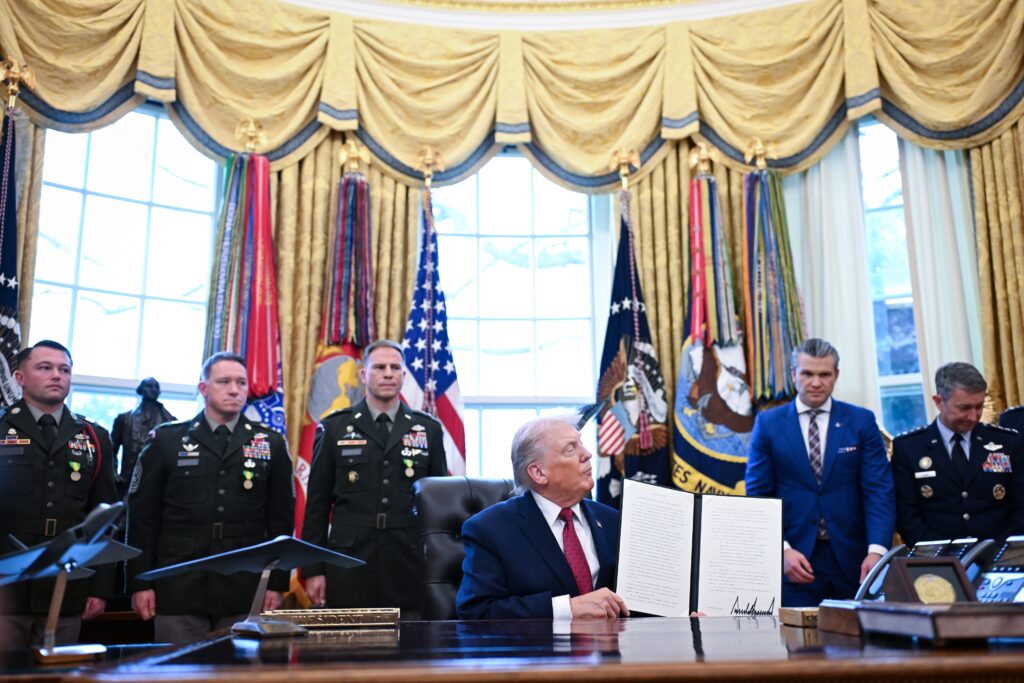
President Donald Trump’s declaration this week that illicit fentanyl is a weapon of mass destruction illustrates an escalation of the administration’s campaign against drugs, describing the synthetic opioid as “closer to a chemical weapon than a narcotic” that is fueling lawlessness in the Western Hemisphere.
But some policy and health experts say it is a stretch to call an addictive drug a weapon of mass destruction. They say the move may have little practical impact on curbing drug supply, addiction and overdose deaths.
The U.S. government defines a weapon of mass destruction as a chemical, biological or radioactive agent or any explosive or gas designed to injure or kill a large number of people. The designation heightens the coordination of resources with federal agencies to counter the threats.
Trump’s decision marks the latest example of how he has prioritized drug enforcement as a national security matter. The Biden administration also considered such a designation, which has drawn support from some Democrats.
During the past decade, illicit fentanyl made in clandestine labs by Mexican criminal cartels — with precursor chemicals sourced in China — has fueled an unprecedented rise in overdose deaths and addiction in the United States. The Trump administration has cited the deadly drug crisis in enacting tariffs on China and Mexico, labeling criminal groups terrorist organizations and launching military strikes on suspected smuggling drug boats in the Caribbean and Eastern Pacific.
Experts in national security and transnational crime say such heavy-handed measures could harm global alliances needed to combat traffickers.
“There are many deaths associated with cigarettes and cars,” said Jonathan P. Caulkins, a Carnegie Mellon University professor who researches the criminal drug trade. “The mere fact that there are many deaths doesn’t mean fentanyl is a weapon.”
The backdrop
Trump, in a Monday Oval Office news conference, justified the measure by claiming that “two to three hundred thousand” people die yearly of fentanyl, an inflated statistic.
Synthetic opioids such as fentanyl killed roughly 75,000 people in the U.S. in 2022, when overall drug deaths peaked at about 110,000, according to state data compiled by the Centers for Disease Control and Prevention. In 2024, about 81,000 people died of overdoses, including 48,000 from fentanyl and similar synthetic opioids.
Reasons for the abrupt decline include public health measures such as greater access to overdose reversal medications, increased addiction treatment, law enforcement crackdowns on suppliers and significant changes to the regional illicit drug supplies, researchers and government officials say.
Both President Joe Bidenand Trump secured agreements with China to crack down on companies that sell precursor chemicals to Mexican criminal groups.
In a statement, a White House spokeswoman noted that hundreds of thousands of Americans have died from fentanyl overdoses “and trying to dismiss this important action because drug deaths have ‘declined,’ is despicable.”
“Any one American dying is one too many, and the families of those who have sadly lost a loved one to this drug would say the same,” spokeswoman Abigail Jackson said. “President Trump is committed to combatting the scourge of illicit fentanyl through as many avenues as possible, including correctly designating as a Weapon of Mass Destruction.”
What the order may accomplish
Trump’s executive order declares fentanyl and the chemicals used in its production as a weapon of mass destruction, while directing the Justice Department to pursue criminal investigations and prosecutions into fentanyl trafficking groups. It also orders the Defense Department to determine whether military resources are needed to help federal law enforcement in combating the threat.
Statesand the federal government have beefed up penalties and investigations into traffickers in recent years.
“It isn’t like we don’t have plenty of law enforcement, interdiction and prosecutorial tools at our disposal to dismantle drug trafficking organization,” said Leo Beletsky, a professor of law and health sciences at Northeastern University, who called the order the “latest episode in drug policy theatrics.”
The designation could also provide additional justification for legally controversial military strikes on drug boats, according to legal scholars. The boats have typically carried cocaine, not fentanyl, according to the administration. The Trump administration has targeted vessels off the coast of Venezuela and threatened action against a regime that profits off of drug trafficking, even though most fentanyl comes into the U.S. by land from Mexico. The Trump administration has contemplated military strikes against cartels in Mexico, which analysts warn could hurt anti-narcotics cooperation between the countries.
Rebecca Ingber, a law professor at Yeshiva University’s Cardozo School of Law and a former State Department attorney across multiple administrations, said Monday’s declaration is the latest effort by the administration to “force the crime of selling or transporting drugs into a wartime frame.”
Ingber said she questioned whether “the administration’s view is that the sale or transport of drugs is itself a military attack on the United States, and if so, is it their view that they could use force anywhere, in any state’s territory, to stop it, including inside the United States?”
The White House, in its statement, did not address questions about the potential use of more military resources to target drug traffickers.
Steve Yates, a senior research fellow at the conservative Heritage Foundation, said the weapons of mass destruction designation would most likely be a tool to help the U.S. target financial institutions abroad, particularly in China, that deal with rogue actors dealing in precursor chemicals.
Yates, whose daughter died of fentanyl in 2023, said the designation could serve as a powerful deterrent and pressure governments to crack down. “The hope is to get more serious follow-through and collaboration with all foreign governments, because obviously they are ones with the most blood on their hands,” Yates said.
Not a new idea
Lawmakers from both parties and families of fentanyl victims have long sought the designation.
Parents of fentanyl victims who visited the Oval Office this month for the signing of a bill reauthorizing funding for addiction treatment mentioned the idea to Trump and “he loved it,” said Gregory Swan, co-founder of Fentanyl Fathers who was at the meeting. He said he and many of his fellow parents believe their children were poisoned by drug dealers and are not overdose victims.
“The government is agreeing with these parents, that their children’s murders need to be avenged,” Swan said. “They’re not playing nice in the sandbox anymore.”
In 2022, a bipartisan group of 18 attorneys general urged the Biden administration to designate fentanyl as a weapon of mass destruction, arguing that waiting for a rogue state or terrorist group to use it as a weapon “seems to be the same type of reasoning” that led to the attacks of Sept. 11, 2001.
They pointed to the 2002 incident in which Russian military force deployed a gas believed to have been fentanyl-based during the rescue of hostages taken by Chechen rebels at a Moscow theater. More than 100 hostages died.
“The attack in Russia is the only example of fentanyl being used as a weapon of war,” Regina LaBelle, director of the Addiction and Public Policy Initiative at the Georgetown University Law Center and a former drug policy official in the Biden White House, wrote with co-authors in 2022. “Devising an entire strategy on one incident isn’t good policymaking.”
Perceptions of fentanyl
Public health experts say the designation may also exaggerate fears about fentanyl, which in its legal form is a painkiller typically used after surgeries and for other acute care. The weapon of mass destruction designation does not target the legitimate painkiller.
Ryan Marino, a professor of medicine at Case Western Reserve University School of Medicine, said patients who are already skeptical of fentanyl as a legitimate pain medication will balk at its use because they believe it is a true weapon of mass destruction.
“It’s not a risk to people who aren’t using drugs,” said Marino, an emergency room physician. “Fentanyl is one of the safest and easiest-to-dose pain medications.”
The post Trump declared fentanyl a weapon of mass destruction. What does it mean? appeared first on Washington Post.