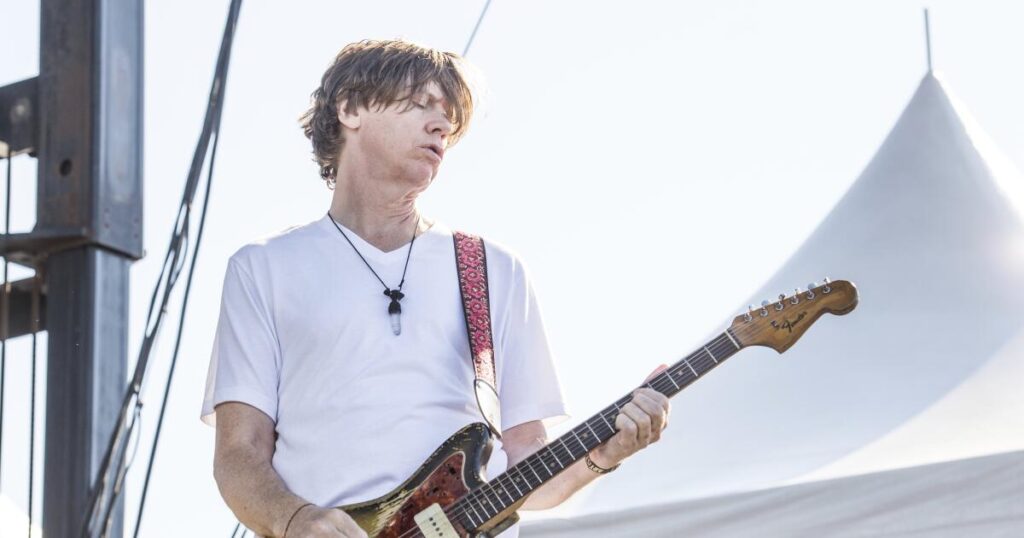
Thurston Moore is obsessed with jazz.
Not the mellow, easy-listening variety that serves as background music in elevators and waiting rooms.
No, Moore goes for the hard stuff: wailing saxophones, arrhythmic bass lines, drums that follow beats so out of time they might as well come from the deepest reaches of space. Call it broadcasts from Planet Jazz.
We’re talking free jazz, an experiment in improvisational music that captivated the world’s greatest jazz musicians in the second half of the 20th century: Albert Ayler, Derek Bailey, Ornette Coleman — and so forth.
For the last six years, Moore has been pouring this passion into a new book: “Now Jazz Now: 100 Essential Free Jazz and Improvisation Recordings 1960-80,” co-written by Byron Coley and Mats Gustafsson and published by Ecstatic Peace Library, the publishing imprint he runs with Eva Moore. The book also features words from Neneh Cherry and Joe McPhee.
The irony is abundant. The former singer, songwriter and guitarist of Sonic Youth, an experimental rock band with one foot in New York’s no wave moment and another in the indie rock explosion of the early 1990s, is devoted to a subgenre of music that isn’t exactly known for loud electric guitars.
It’s also a departure from the autobiographical writing in Moore’s memoir “Sonic Life” published in 2023, or the work he does as a writing instructor at the Jack Kerouac School of Disembodied Poetics at Naropa University in Boulder, Colo.
Nevertheless, the book covers what he and his co-authors consider the 100 greatest records by artists both legendary and obscure. “Now Jazz Now” is more than a collection of greatest hits, it’s the chronicling of a decades-long obsession with free jazz between “three record geeks who are really into collecting,” Moore said via Zoom from his home in London last month.
In a sense, the book began back in the ’80s when Coley, Gustafsson and Moore started collecting these strange recorded documents in experimental sound at a time when these records were hard to find and even harder to research.
“We knew that it was obscure,” Moore said. “We weren’t interested in it for the sake of obscurity. We were very interested in it for the sake of the music and the personalities involved. And as we got deeper into it, it was all about getting every copy we could find.”
When Moore describes those days, he sounds like someone traveling back in time to a distant land: “Before the internet, before Discogs, before eBay, before anything. It was all very mythical,” Moore said.
As a young musician, Moore was interested in jazz but couldn’t really make sense of it, so he turned to his friend Byron Cole for help. Cole had worked at Rhino Records in California and when he returned to the East Coast he was named the jazz editor of ‘80s hardcore zine Forced Exposure. Moore believed this was a radical statement in its own right considering the scene wasn’t exactly known for nuance and sophistication.
“I asked him to make me a cassette for tour so I could try to decode what was going on here,” Moore recalled. “He made me 20 and it was every major statement of modern jazz. I spent an entire tour with headphones on, listening to and falling in love with this music.”
The musician who once spent hours poring over hardcore zines to track down the latest 7-inch records from bands popping up around the country like outbreaks in an epidemic now turned his mania toward jazz.
“I started collecting the records on tour,” Moore said. “I was going into every record store. looking for Sun Ra records. At the time, they were a dime a dozen. … Even in the early ’90s, in certain college town record stores, they were like a buck each.” Today, some of those original pressings go for thousands of dollars.
Rounding out the trio is Gustafsson, a bona fide jazz musician, a wizard with a saxophone with deep feeling and unbridled enthusiasm. Here he is describing a collaboration between Eric Dolphy and Ron Carter: “It is free. It is beautiful. It is funny even! It freaks me out! Give me my brain back!”
“We each have a distinct writing style,” Moore acknowledged, but “we also wanted to make sure that our data was correct. So we’re being very anal and geeky about which session came at which time and which players were at which session. It becomes almost like a James Elroy novel with all these characters.”
The audience for these records were passionate but small, so by necessity the recordings were often do-it-yourself affairs. “It reminded me a lot of what interested me about punk rock early on,” Moore said, “that it was music made outside of the permissions of the corporate record world. … That, to me, was really interesting. It was an artist-run scene.”
Then there’s the music itself, which was beyond avant-garde. Cutting edge was the starting point. When Moore talks about these artists and their music, it’s like he’s describing a religious experience: “It’s like a sonic boom from the first groove,” Moore said of Peter Brötzmann’s “Machine Gun.” It’s just this saxophone blaring through what sounds like a distorted snare head. It’s so radical. It’s a great piece of noise music, but it’s free jazz, and it’s not even following the structures of what you know to be proper jazz behavior. It’s something else entirely.”
Or, as Coley quips, “‘Machine Gun’ is often the first record I play for punk listeners looking to open their holes a bit.”
The authors are so passionate about the project that the hardest part wasn’t writing the book but deciding what to leave out.
“We had about 500 more records that we had to parse off the list,” Moore admitted. “We had a lot of debates and arguments about which records were going to be in the book and shunting certain ones aside and so we created a contenders list, which we’ll probably put up on a dedicated site online. ‘If you like these 100 records, and once you’ve processed them, here’s 500 more that you should really, really listen to!’”
Naturally, some of the ideas Moore was listening to on these records and seeing in clubs on the Lower East Side began to shape his own understanding of improvised music. “When I realized how incredibly liberating and beautiful that was, it was all over for me. I started playing much more differently after that. My guitar playing really changed. It allowed me to feel confident in expressing myself in a way that had absolutely no shackle to it.”
Does this mean that Moore has traded in his axe for a sax?
Hardly. Moore is still writing songs, making records, and playing shows. Last year he released a new solo album — “Flow Critical Lucidity” — and dropped a new single just last summer. He will be performing at Big Ears Festival in Knoxville, Tenn., on March 28, 2026.
“I’m a songwriter. I like writing songs. I like writing experimental pop songs,” Moore said. “I go out with my band and I play typical band gigs, but I prefer being in a basement with a free jazz drummer any day of the week.”
Ruland is the author of “Corporate Rock Sucks: The Rise and Fall of SST Records.” His new novel, “Mightier than the Sword,” will be published next year by Rare Bird.
The post Thurston Moore documents his obsession with free jazz in a new book appeared first on Los Angeles Times.