For months, European countries have struggled to agree on a bold proposal to finance Ukraine and its war effort.
Now, as the United States is racing ahead to try to end the war started by Russia nearly four years ago, European leaders are working feverishly to finalize that funding plan. They hope it will help ensure that they have a seat at the table as negotiations intensify — and that Ukraine is in as strong a position as possible to make a deal.
It is also the European Union’s chance, diplomats and analysts have said, to forcefully disprove President Trump’s depiction of the 27-nation bloc as weak and indecisive.
On Thursday, that resolve will be put to the test when European leaders meet to decide if they can agree on a plan to use Russia’s own assets, frozen in Europe, to back a loan that would help Ukraine fund the war and its government for the next two years.
But with just days to go, obstacles to an agreement remain, as Belgium in particular expresses persistent doubts. Given that, what was meant to be a show of strength could still turn into a display of disunity and weakness at a diplomatically pivotal moment.
“Is Europe willing to do what it takes? It is very much a moment for Europe to stand up and be counted,” said Jacob Funk Kirkegaard, a senior fellow at Bruegel, an economic think tank in Brussels. “This is a point of maximum danger.”
The importance of Thursday’s meeting could not be more clear. It will come during a flurry of diplomacy that started on Sunday when President Volodymyr Zelensky of Ukraine met with President Trump’s negotiators in Berlin. The aim of that meeting, and follow-up negotiations, was to come up with a peace proposal that closes the gap between Mr. Trump’s recent plan and a counterproposal by Ukraine that would claw back some of what Kyiv and its European allies considered giveaways to President Vladimir V. Putin of Russia.
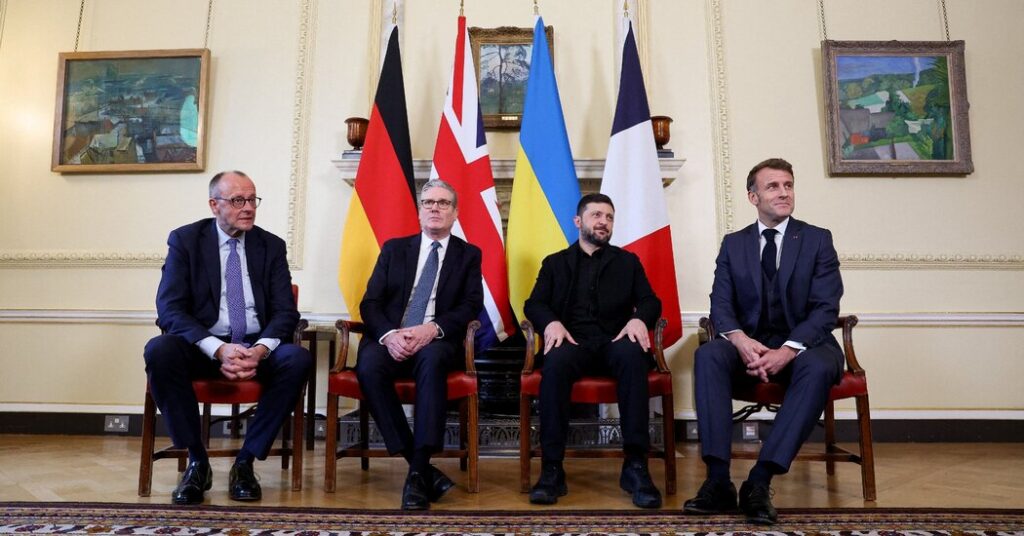
After months of struggling to gain a voice in negotiations, European leaders did seem to find a toehold in this week’s meetings, the most extensive negotiations on ending the fighting since Russia invaded Ukraine. Top officials from some of Ukraine’s close European allies — including Finland, France and Germany, as well as from the European Union leadership — spent hours on Sunday and Monday discussing plans to end the war, rebuild the economy and secure against another invasion.
Figuring out financing for Ukraine could be key not only to supporting Kyiv but also to securing Europe’s continued influence in a diplomatic fight the continent’s leaders see as central to their own future security. It would serve, analysts say, as a sort of turning point for shoring up Europe’s geopolitical importance in a fraught era of an aggressive Russia and a transactional United States.
“This is a way to reassert their relevance,” said Brad W. Setser, a senior fellow at the Council on Foreign Relations. “The notion that Europe’s future is being decided by Russia and the United States, you know, galls.”
At the conclusion of Monday’s whirlwind meetings, Ursula von der Leyen, president of the European Union’s executive arm, pointed to the funding plan as a priority on the path toward peace.
“Ukraine’s needs are both immense and urgent,” she said in a statement, calling the discussions on Thursday a “decisive” moment.
If Europe can agree to it, the loan in question would use about 210 billion euros, about $245 billion, in Russian government assets, frozen in Europe, to back €90 billion in zero-interest loans to Ukraine over the next two years. That would fill two-thirds of Kyiv’s estimated financing needs, with the potential for more money later. Ukraine would need to pay the loan back only if Russia paid reparations for the war.
But while the loan plan has many positives — offering Kyiv the resources to keep fighting and allowing Europeans to support Ukraine without turning to their own overburdened budgets — the idea also comes with major risks.
Both the government of Belgium, where most of the assets are held, and some outside financial experts have warned that the plan could spook foreign investors, making them nervous about stashing their savings in Europe.
Continued reluctance was on display last week: Even as member states agreed on Friday to indefinitely freeze Russia’s assets held in the bloc — a first step toward making a loan to Ukraine using those funds — Belgium, Bulgaria, Italy and Malta did so grudgingly.
The four countries released a statement urging the bloc to continue exploring alternative options that pose fewer risks.
On Monday morning, Kaja Kallas, the European Union’s top diplomat, told reporters outside a meeting of E.U. foreign ministers in Brussels, “We are not there yet, and it is increasingly difficult.”
If the plan falls through, Europe would be left trying to quickly find a backup option. While there is an alternative that would use the European Union’s budget to back a loan, it would require unanimous support, which it does not have.
Kestutis Budrys, the Lithuanian foreign minister, on Monday called the loan plan “not the major and the best, but the only option.”
As negotiations speed up, Russia is making its own moves to scuttle the proposal. The Russian Central Bank said on Friday that it had filed a lawsuit in Moscow against the Belgian depository that holds about €185 billion of the immobilized Russian state assets.
Given the threat of continued legal action, Belgium is asking other European nations to share the risk. It has insisted that pots of money from elsewhere should also be used in the plan: Smaller sums are held in Britain and France, among other places.
“If you go together, then you’re under a big umbrella, and you’re not the only one that is exposed to all the risks,” Prime Minister Bart De Wever of Belgium told Sky News after he met with Keir Starmer, Britain’s prime minister, in London on Friday.
That London meeting appeared to produce no breakthroughs. In a statement, Mr. Starmer’s office said only that the two leaders had “agreed to continue to work together closely” on the issue.
The Trump administration’s position also looms over negotiations. Washington has at times signaled interest in using the frozen assets as part of a peace deal: In a 28-point plan that leaked last month, the White House suggested unfreezing the Russian assets and using part of the money for a joint Russian-American investment program.
Europeans balked at that and are rushing to show that they can make use of the funds to help Ukraine themselves. The money was referred to again in statements after the meetings in Berlin on Monday, though exactly what was discussed was not clear.
“There’s a political goal here: to make sure that those reserves are put to productive use,” said Mujtaba Rahman, managing director for Europe at the Eurasia Group, a research firm. “In Paris, in Berlin and in Brussels, they’re using that threat to put pressure on Belgium.”
The question is whether it will work. Ambassadors from across the European Union vetted the text of the frozen asset plan until nearly midnight on Monday, and Belgium was still pushing for more assurances that it would not be left exposed, according to three diplomats familiar with the talks. They spoke on condition of anonymity to discuss a matter that has not yet been decided.
Those discussions are expected to go down to the last moment. And António Costa, who will preside over the leaders’ meeting on Thursday as president of the European Council, has said that talks will continue until some agreement to fund Ukraine is reached.
Should the bloc fail to come up with a financing plan, Mr. Rahman said, it would be a “complete political and moral failure” that would “put Ukraine in an incredibly vulnerable position.”
Jeanna Smialek is the Brussels bureau chief for The Times.
The post This Week Is Pivotal for Ukraine, and for Europe’s Voice in Its Future appeared first on New York Times.