Times Insider explains who we are and what we do and delivers behind-the-scenes insights into how our journalism comes together.
In November 2024, I flew to Atlanta from my home in Berlin to cover the world championship of fantasy football. It was a strange, surprisingly glamorous competition that was typical of the alternative sporting events I tend to cover for The New York Times, ranging from the unfamiliar to the truly unconventional.
Over the past year, I’ve flown to Reno, Nev., to watch military enthusiasts shoot AR-15s; profiled the contentious founder of CrossFit about his latest health venture; and written about explosive controversies in the far-flung worlds of professional fitness racing, Pilates and more. If it’s weird and even tangentially related to sports, I’m probably interested in it.
While I was in Atlanta, a publicist brought up a project he’d been working on: A fine dining restaurant pop-up catering to the super-wealthy that would take place during the Las Vegas Grand Prix, the annual Formula 1 race on the Strip.
The dinner would be catered by acclaimed, award-winning chefs and top TV personalities, including Wolfgang Puck and Michael Mina. While eating extravagant food, diners would take in the high-octane race action from seats adjacent to the track.
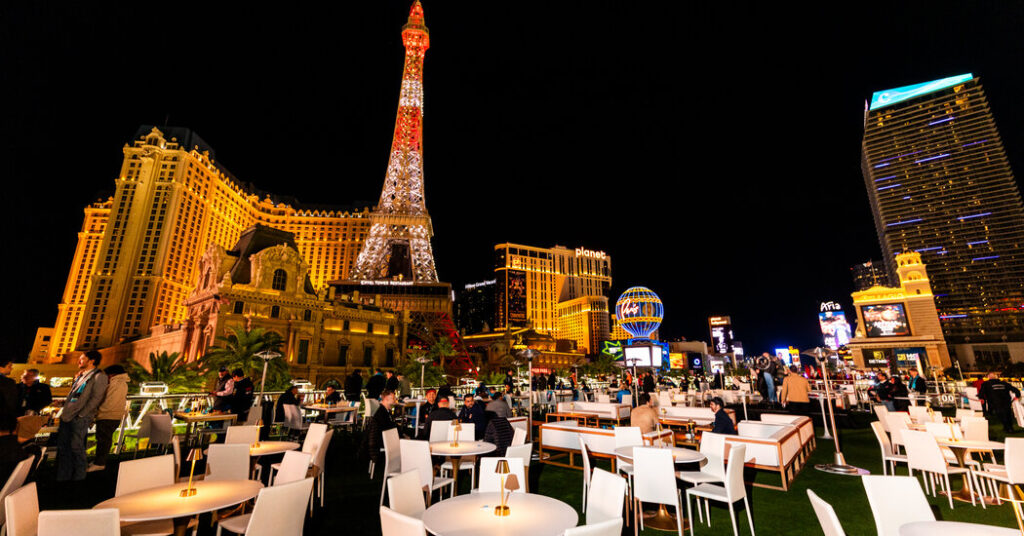
But what intrigued me most was the location of the pop-up: It would be constructed directly on top of the Bellagio hotel’s man-made lake. The venue was an extraordinary feat of engineering, and the experience seemed like a perfect opportunity to capture something unique about the lifestyles of the rich and famous and the over-the-top luxury of Vegas. The story was all the more striking, I thought, at a time when regular Americans were struggling to afford a Thanksgiving meal.
Unable to attend the 2024 event, I traveled to Las Vegas last month to observe the three-story restaurant on a water fountain, which had been erected in just 60 days.
The pop-up, now in its third year, was no small feat: I saw how dozens of hard-working chefs shared cramped quarters to churn out thousands of over-the-top hors d’oeuvres, carefully searing hundreds of lamb shanks and adding soupçons of caviar to the tops of deviled eggs. Diligent line cooks added flakes of gold leaf to raspberry tarts with tweezers, as F1 cars zoomed by at 200 miles per hour 50 feet away.
Upstairs, in the restaurant’s bustling, well-appointed dining room, the celebrity chefs shook hands and took photographs with guests, occasionally stepping behind the pass to inspect a pan of linguine or to plate a Wagyu beef carpaccio. Despite the hubbub in the kitchen, the atmosphere among the diners seemed relaxed and easygoing.
I asked the chef David Chang, whose Momofuku restaurant has a location inside another hotel on the Strip, what it was like to work one of these events. Was it more challenging or stressful to prepare top-notch food at a pop-up venue than in one of his own kitchens?
Mr. Chang is an old hand at these kinds of swanky catering setups, and, of course, he’s developed a system: “My goal is to be as forgettable as possible,” he told me, laughing uproariously.
“If your dish is too good, it creates all kinds of problems,” he explained. “The line gets too long. Word gets around. You run out of food.”
A little while later, I chatted with the restaurateur Mario Carbone, a close friend of Mr. Chang’s since they worked together on the line at Café Boulud on Manhattan’s Upper East Side in the ’90s. I asked him the same question about the challenges of such an event, mentioning that Mr. Chang had walked me though his own philosophy.
“Let me guess,” Mr. Carbone said. “Sandbagging.”
I confirmed his suspicion.
“I knew it,” he said.
The celebrity chefs were stationed back to back during the race dinner: Mr. Carbone was serving his famous meatballs and lobster ravioli, and Mr. Chang was whipping up some sort of duck. The meatballs and ravioli were flying off the table, and, by the middle of the service, there was a line of impatient diners waiting for reinforcements after Mr. Carbone ran out of food.
“That was, like, the best thing I’ve ever eaten,” one guest remarked, having just scarfed down a dish of meatballs.
Mr. Chang, seeing the commotion, just smiled.
As dinner service ramped down, the wait staff quickly and quietly disassembled the dining room, and the celebrity chefs disappeared into the night. I was exhausted and overwhelmed. Despite being surrounded by mounds of caviar and truffles, I just wanted to go home and devour Indian takeout from the place beneath my Berlin apartment.
Before leaving the event, though, I caught up with the same publicist who had first told me about this event.
“Now what?” I asked him.
“We take it all down,” he said, gesturing around him. The entire edifice would be disassembled over the next few weeks in preparation for the hotel’s annual New Year’s Eve party. Around 300,000 guests would soon be standing in its place to watch the fireworks and fountain show, an over-the-top extravaganza known as “America’s Party.”
I wouldn’t be attending, though. While it was fun to hobnob with the ultrawealthy for a night, I much prefer the quiet comfort of my own home in Berlin, watching a movie with my wife and our cat.
The post The View From My Seat at an Ultraluxurious Dinner appeared first on New York Times.