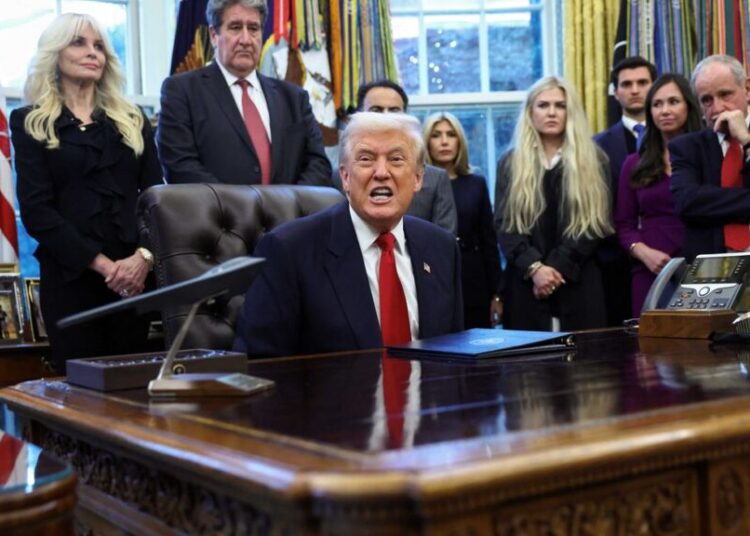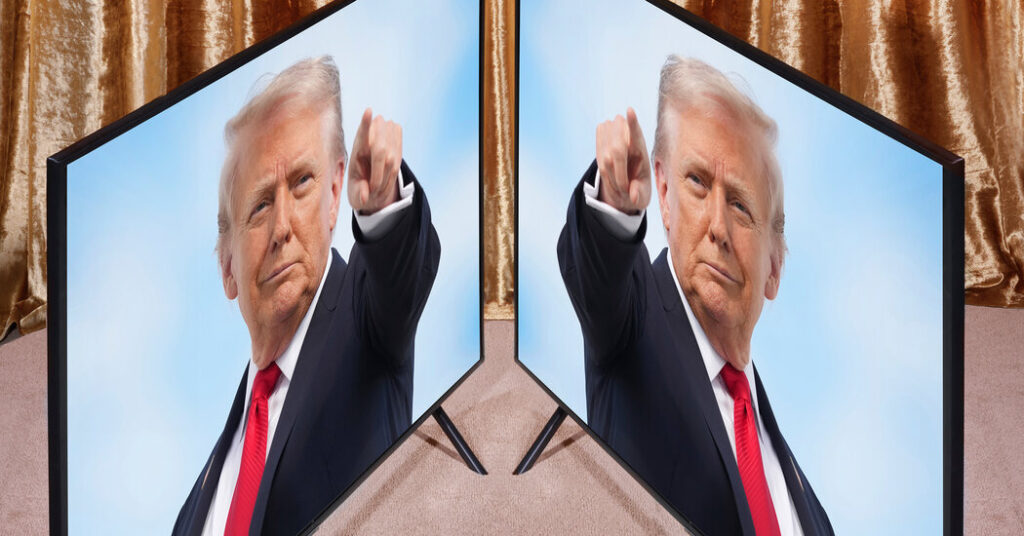
Peering into the Trump mind-set — the logic underpinning his priorities, his morality, his decision making — is like opening up a garbage pail left out for days during a summer heat wave.
The dominant theme is governing by narcissism: Make Trump Great Again.
President Trump can be persuaded with money, the purchase of his crypto coins, contributions and sometimes with plain old obsequious flattery.
The two shining lights that guide his notion of morality are his self-interest and the enhancement of his self-image, both of which crowd out consideration of the national interest and the public welfare.
The strongest example: his refusal to accept the humiliation of defeat in the 2020 election, resulting in the Jan. 6, 2021, assault on the U.S. Capitol by his followers determined to “stop the steal,” and Trump’s subsequent pardoning of the insurrectionists.
He is blind to the harms, up to and including death, that he and his policies have inflicted here and abroad. The notion that his actions have worsened the economy is, to Trump, intolerable. Asked by Politico to rate his handling of the economy, Trump replied, “A-plus-plus-plus-plus-plus.”
Trump relishes his hatreds. Revenge brings him joy. “I hate my opponent,” Trump told mourners for Charlie Kirk at a memorial service in Phoenix, with a tone of relish. “I don’t want what’s best for them.”
The profit motive — for himself, for his allies and for his donors — dominates Trump’s decision making across the gamut, from his pardons of convicted criminals to negotiation strategies with foreign leaders to the formulation of tax legislation.
Trump lacks a basic sense of fairness, exemplified by his disregard of the fact that Russia invaded Ukraine, and he feels no obligation to honor alliances designed to protect democratic states.
The key measure Trump uses in defining justice, on the one hand, is whether an individual, group, corporation or country supports him (the Jan. 6 insurrectionists), contributes to his wealth (crypto) or elevates his stature (Vladimir Putin’s praise.) On the other hand, he condemns and calls for criminal prosecutions of all those who challenged the legality of what he has done or suggested anything untoward about his relations with Russia.
Trump does not think strategically. Instead, his compulsive need to be a winner, to have his ego or bank account rewarded, precludes anything but short-term tactical calculations shaped by the pursuit of his self-interest.
To quote a once-famous Washington sportscaster, Warner Wolf, “Let’s go to the videotape”:
On Nov. 4, a delegation of Swiss industrialists gave Trump a high-end Rolex desktop clock and a 1 kilogram (2.2 pound) gold bar worth $130,000 inscribed 45 and 47. Ten days later, the Trump administration agreed to cut the 39 percent tariff on Swiss imports to 15 percent.
The initial 28-point peace plan to end the war in Ukraine, drawn by Russia and the United States, makes no mention of the fact that Russia invaded Ukraine, providing instead for Russian retention of land it now controls. The 28 points do provide for substantial American business investment in the region and the end of sanctions against Russia.
In a key article, “Make Money Not War: Trump’s Real Plan for Peace in Ukraine,” the Wall Street Journal reporters Drew Hinshaw, Benoit Faucon, Rebecca Ballhaus, Thomas Grove and Joe Parkinson wrote that the architects of the plan were “charting a path to bring Russia’s $2 trillion economy in from the cold — with American businesses first in line to beat European competitors to the dividends.”
Senator Chris Murphy, Democrat of Connecticut, posted a denunciation of the plan on X on Dec. 8:
It’s being described as a peace plan to end the Russian war in Ukraine, but if you look at the details, it has nothing to do with peace. It is a business deal to make the people around Donald Trump rich. It’s just corruption, through and through.
Rich Trump donors, Murphy continued,
are right now trying to get in on the action. One donor just recently paid hundreds of 1000s of dollars to a lobbyist that’s really close to Trump’s inner circle to try to buy the Nord Stream two pipeline that’s a Russian gas pipeline, once again, something that is only possible for these investors to get rich on if the war is over and the US lifts its sanctions. Another close Trump associate is in talks about acquiring a stake in a Russian Arctic gas project.
What does Ukraine get? Murphy asks and answers:
Nothing, nothing. This deal sells out Ukraine. In fact, this deal would require Ukraine to give to Russia territory that Russia doesn’t even currently control. It provides amnesty for all of the war crimes that Putin has committed.
There is no question that Trump is a sucker for praise.
On Dec. 5 in a ceremony at the Kennedy Center, Gianni Infantino, the president of FIFA, the international organization overseeing soccer, awarded Trump the first-ever FIFA Peace Prize, a gold medal and a golden trophy showing two hands holding up the earth.
“This is truly one of the great honor of my life,” Trump told the audience.
Trump’s transactional mind-set translates into a zero-sum mentality driving his trade and tariffs wars, based on his conviction that other countries are ripping off the United States, causing, in turn, self-inflicted damage through inflationary pressures and strained relations with allies and adversaries alike.
I asked Kim Lane Scheppele, a sociologist at Princeton who has written extensively on the rise and fall of constitutional government, to step back and describe the Trump administration. She replied by email:
Many autocrats have used their positions for self-enrichment — Orban, Erdogan, Putin, Modi and more. But none have raised this possibility for self-enrichment to the heights we have seen here in the U.S., in less than one year of Trump. Economists have called their governments predatory states because instead of providing services, these governments use public wealth for private benefit.
In the forward to a book about Hungary, “The Post-Communist Mafia State,” Scheppele wrote about the regime of Prime Minister Viktor Orban, but she said in her email that her comments apply equally well, if not more so, to the Trump presidency:
When a mafia-like organization goes from underworld to upperworld and controls the state itself, the resulting mafia state takes its newly acquired tools of governance and deploys them with the principles of a mafia — holding its own loyalists in line with rigorously enforced rules of discipline while benefiting them with the spoils of power, and threatening its enemies with criminal prosecutions, libel cases, tax audits, confiscation of property, denial of employment, surveillance and even veiled threats of violence.
Mafias also have another quality: They do not operate through formal rules, bureaucratic structures and transparent procedures. Because mafias have the mentality of criminal organizations, even when they are part of the upperworld, they are accustomed to making their crucial decisions in the shadows. Like in families on which they are modeled, the political relatives in mafias are rewarded for loyalty, not merit, and divorces occur on grounds of disloyalty rather than bad performance. The distribution of available resources within the family rewards solidarity and punishes improvisational deviation. It is precisely not based on law.
Along complementary lines, Erica Frantz, a political scientist at Michigan State University who specializes in the study of authoritarian politics, replied by email to my inquiries:
We know that strongman rule — where power is concentrated in the leadership — is associated with greater corruption. Examples from Viktor Orban in Hungary and Alberto Fujimori in Peru illustrate this well. The more power grows concentrated, the more that we see the leader, their close friends and family and loyal business elites profit.
We are observing this play out in the U.S. context, where Trump and those in his entourage are growing richer through a range of activities, from cryptocurrency to real estate deals in the Middle East.
At the extreme, Frantz continued, “this becomes a kleptocratic system.”
To be clear, she added,
the U.S. is far from a kleptocracy at this juncture. Kleptocracies are really the domain of full autocratic systems, given that democratic institutions make corruption on such a massive scale difficult to execute.
That said, we are certainly seeing a slide toward more corruption in the current administration that puts the U.S. out of step with what you would like to see in a healthy democracy.
While I agree in the main with Scheppele and Frantz, I think that in key respects Trump stands apart from Putin, Narendra Modi, Orban and Recep Tayyip Erdogan, distinctions that get lost when they are lumped together under such categories as the rulers of mafia states or nascent kleptocracies.
The most important characteristic separating the four foreign autocrats from Trump is that they think in the long term, calculating the broad implications of their decisions, while Trump’s thinking is short term, if not childlike.
Jonathan Martin, a senior political reporter for Politico, described this Trump characteristic well in his Dec. 4 essay, “The President Who Never Grew Up”:
Trump is living his best life in this second and final turn in the White House. Coming up on one year back in power, he’s turned the office into an adult fantasy camp, a Tom Hanks-in-”Big,” ice-cream-for-dinner escapade posing as a presidency.
Trump is one part Orban, Martin wrote,
making a mockery of the rule of law and wielding state power to reward friends and punish foes while eroding institutions. But he’s also a 12-year-old boy: There’s fun trips, lots of screen time, playing with toys, reliable kids’ menus and cool gifts under the tree — no socks or Trapper keepers.
Yet, as with all children, there are also outbursts in the middle of restaurants. Or in this case, the Cabinet Room.
Trump’s petulance is one of the reasons Putin, armed with the discipline of a former lieutenant colonel in the K.G.B., runs rings around our president. At the same time, Trump’s childishness underpins his submissive adoration of his Russian counterpart.
Finally, in an administration known for its erratic adoption and sudden abandonment of policies, Trump has demonstrated an unwavering determination to enhance the fortunes of the rich while doing little or nothing to ameliorate worsening conditions for the working-class MAGA electorate that helped bring him to power.
I wrote about this before, but the MAGA electorate stands out from other political constituencies in its disproportionate share of lower-middle-income and middle-income voters, whose families make from $30,000 to $100,000 a year.
When the effects of the “big, beautiful” domestic policy act — tax cuts and reduced spending on health care and food stamps — are combined with the effects of Trump’s tariffs, these moderate to middle-income voters come out behind.
The Yale Budget Lab calculated that virtually everyone in the $30,000 to $100,000 range would come out a net loser. Households making $75,730, roughly the middle of that range, would lose, on average, $1,060 this year.
The only group that would gain significantly is composed of households in the top income decile, with an average income of $517,700, who would make $9,670 more.
The one group that has done very well during Trump’s second term is made up of stockholders, who have gained at every income decile, according to my back-of-the-envelope estimates.
The gains, however, are tilted heavily toward the very rich, who hold a majority of the equities. Gains for those in the bottom half of the income distribution do not exceed $8,000 for any decile. For those in the sixth through ninth deciles, gains range from roughly $10,750 to $51,000. In the top decile, the gain balloons to just under $280,000.
The more than quarter-million dollars going to families in the top decile is, however, chump change compared with how well Trump and his family made out during the first months of his second term.
On Oct. 16, Cryptonews reported that “the family of U.S. President Donald Trump has generated pretax gains of around $1 billion in the past year from their diverse array of crypto-related ventures, a new investigation reveals.”
In the meantime, the Trump family’s search for ways to profit continues unabated, with Jared Kushner, Trump’s son-in-law, taking the lead in the most recent ventures.
On Dec. 11, The New York Post reported that Kushner had initiated talks with Marc Rowan’s Apollo Global Management and Henry Kravis’s KKR “to assist with postwar reconstruction in Ukraine.”
At the same time, Kushner’s firm, Affinity Partners, has put money up in Paramount’s hostile bid for Warner Bros. Discovery, joining the sovereign wealth firms for Saudi Arabia, Qatar and Abu Dhabi.
For Trump and his family, there is no separation of holding government office and making money.
I am reminded of a day in the distant past when I covered the Maryland legislature. Back in the early 1970s, Joseph J. Staszak, a state senator from East Baltimore, stood accused of a conflict of interest for his support of legislation prohibiting package stores from discounting liquor, wine and beer when he owned a tavern that owed a large part of its success to a brisk business in package sales.
Staszak, who rarely spoke in the chamber, rose from his seat and addressed his colleagues, struggling to suppress a smile, and plaintively asked, “How does this conflict with my interest?”
The Times is committed to publishing a diversity of letters to the editor. We’d like to hear what you think about this or any of our articles. Here are some tips. And here’s our email: [email protected].
Follow the New York Times Opinion section on Facebook, Instagram, TikTok, Bluesky, WhatsApp and Threads.
The post The Trump Mind-Set Is Not Complex appeared first on New York Times.