GRETNA, La. — Siomara Cruz wasn’t troubled when she saw two Latina immigrants handcuffed earlier this month by masked immigration agents outside a restaurant in this New Orleans suburb.
“They need to do things the proper way,” said Cruz, 59, a housewife whose parents immigrated from Cuba. “The law is the law. Every country has their law, and you’ve got to respect it.”
But across the street, Tracey Daniels said it was “awful” to see immigration agents in an unmarked SUV detain a Latino man outside the gas station kitchen where she was preparing lunch plates of red beans, rice and fried catfish.
“They’re just snatching these people, snatching them away from their families,” said Daniels, 61. “Now they got people afraid to come outside, businesses closing.”
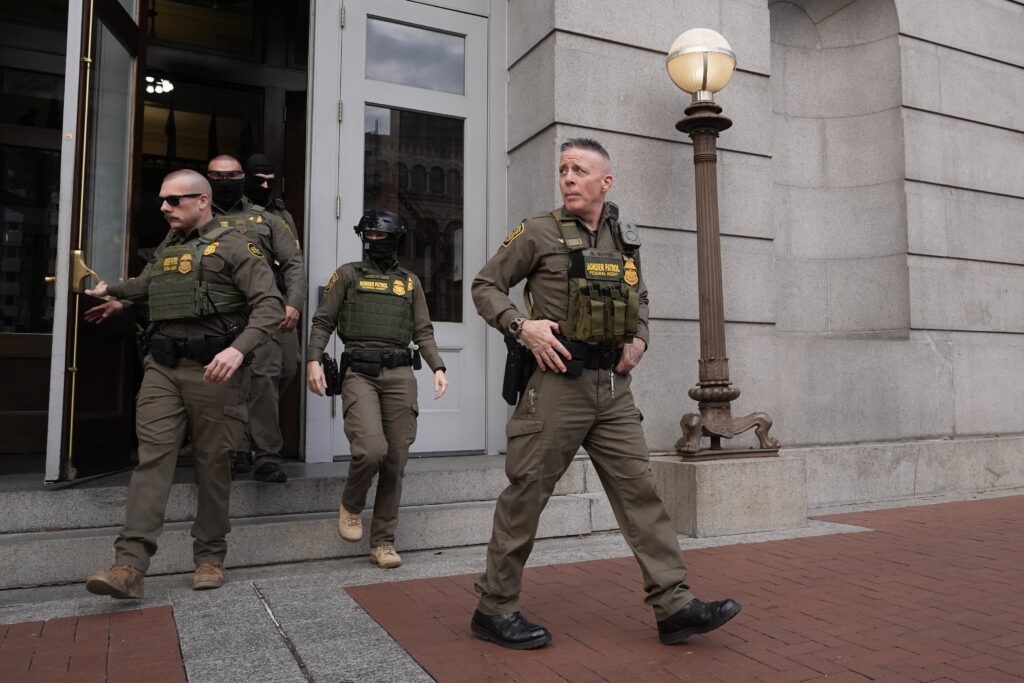
The immigration operation, dubbed Catahoula Crunch by the Department of Homeland Security, follows similar crackdowns in Chicago, Charlotte, Los Angeles and other cities. DHS Assistant Secretary Tricia McLaughlin said in a statement Thursday that 250 people had been arrested since the start of the operation.
The mission is exposing stark divides in and around New Orleans that reflect broader national reactions to the administration’s immigration raids — and who should help enforce them.
Across 10 national polls in November and early December, 43 percent approve of President Donald Trump’s handling of immigration, while 55 percent disapprove. The number of people who approve of Trump’s handling of immigration has dropped from about 50 percent in March. Last week, Illinois Gov. JB Pritzker (D) signed a law seeking to limit immigration enforcement in his state as he continues challenging the administration’s aggressive campaign there.
New Orleans is a “sanctuary city,” where officials have historically refused to support federal immigration sweeps. But new state laws designed to penalize those who impede immigration enforcement could put officials and officers at risk if their departments don’t cooperate with federal operations.
And some surrounding police departments, including Gretna, have signed 287(g) agreements to work with U.S. Immigration and Customs Enforcement to deport people who authorities say entered the country illegally.
Those agreements have also divided residents. Some said immigration enforcement should fall exclusively to federal agents — that having local officers partner on the issue risks alienating immigrant communities or violating people’s rights. But police supporting the operations said they get more complaints about crime in their communities than they do Catahoula Crunch.
Gretna Deputy Police Chief Jason DiMarco said his 150-person force needs to serve everyone in its diverse community, but added that having so many undocumented residents in the city makes it harder to identify suspected criminals. Last month, he said, local police accompanied ICE agents on a raid that picked up four suspects, including an alleged MS-13 gang member. DiMarco noted that within the past year, Gretna police have investigated several serious crimes committed by undocumented suspects, including one who fled the country after allegedly killing an immigrant who had come to the United States legally.
Now, because of the 287(g) agreement, officers can coordinate directly with ICE.
“If they run across an illegal immigrant in their day-to-day patrol activities … they can actually detain the person, check their legal status and if they aren’t here legally, we can contact ICE and they’ll come and get them,” DiMarco explained of the partnership during an interview at his office earlier this month.
DiMarco, who is from Gretna, has watched the city of nearly 18,000 grow more diverse, to include a member of his own family who immigrated from Honduras. Like many in the New Orleans area, his family tree includes immigrants from several countries, including France, Italy and Cuba.
“New Orleans is the original melting pot of the world,” he said. “ … People from every walk of life lived in this city. And they intertwined and managed to live together cohesively.”
So far, DiMarco said he hasn’t fielded any complaints about his department’s work with ICE. Even if people don’t agree, he said officers have a duty to enforce the law, including one signed by Gov. Jeff Landry (R) in June that criminalized “any act intended to hinder, delay, prevent, or otherwise interfere with or thwart federal immigration enforcement efforts.”
Anyone in violation could face jail time or fines.
“We don’t get to pick and choose which you can and can’t enforce,” DiMarco said.
But DiMarco also worries the ongoing raids may make immigrants even more hesitant to report crime.
“We don’t want somebody to get victimized and get picked on, whether they be illegal or not,” he said. “Nobody deserves to be a victim of a crime.”
Most Catahoula Crunch activity has been to the west of New Orleans in Jefferson Parish, which includes Gretna and other towns where law enforcement agencies signed 287(g) agreements. In last year’s presidential election, 55 percent of Jefferson Parish voted for Trump, while 82 percent of neighboring Orleans Parish voted for Democratic nominee Kamala Harris.
Kenner, Jefferson Parish’s most populous city, has more than 64,000 residents — about one-third of whom are Latino, according to U.S. Census Bureau data. Police Chief Keith Conley said Kenner partnered with ICE at the request of local business owners, including immigrants.
“We had members of our community pleading with us to keep our community safe,” Conley said, describing gang activity that he said had its roots in Central American countries that residents of Kenner had fled. “They saw the ways of their home countries coming here. When I have business leaders coming to me, I have to respond.”
Conley said his city has experienced “some pretty heinous crimes” in recent years, including murder and child sexual assaults.
“And we weren’t getting much cooperation” from federal officials, he said. “It was a failure at the top.”
Landry requested a National Guard deployment to New Orleans in September, citing an alleged increase in violent crime, even though police and city leaders say crime has decreased and federal support isn’t needed. The city’s homicide rate is nearly the lowest in 50 years. Violent crimes — including murders, rapes and robberies — have all decreased 12 percent through October compared with a year ago, according to New Orleans police.
Conley and some Jefferson Parish residents, however, said they are grateful the Trump administration has sent federal agents into their region. Outside a Lowe’s hardware store in neighboring Metairie, where immigration agents were spotted this month, Howard Jones, 71, said he was supportive of local law enforcement agencies joining the operation.
“I’m all for people being deported who are not here legally,” said Jones, a retired data warehouse analytics consultant and self-described moderate conservative who voted for Trump the past three presidential elections.
But Gloria Rodriguez, 38, a Mexican immigrant who works in construction, said she didn’t like seeing local police involved. Though she’s a legal permanent resident and her husband and 18-year-old son who were in the truck with her are U.S. citizens, they carried their passports and immigration paperwork in case they were stopped by federal agents.
“They should not cooperate with immigration, just do their job and get criminals out of the streets instead of hardworking people,” Rodriguez said, adding that she has been troubled by reports of U.S. citizens being caught up in the immigration crackdown.
“What if they take us?” she said.
Unlike Gretna, Kenner and other cities with 287(g) agreements, New Orleans officials have resisted cooperating with the Trump administration’s efforts.
New Orleans police adopted a policy that prohibits officers from assisting federal immigration enforcement except under certain circumstances, such as a threat to public safety. The policy resulted from a 2013 federal consent decree to address a history of unconstitutional practices, including racial profiling. Last month, a federal judge ended the consent decree, but Police Superintendent Anne Kirkpatrick said last month that immigration remained a civil issue, adding that police would not enforce civil laws but instead ensure that immigrants “are not going to get hurt and our community is not in danger.”
Louisiana Attorney General Liz Murrill (R) has since encouraged Kirkpatrick to have officers “fully cooperate” with federal immigration officials.
Murrill warned that New Orleans police policies “appear to conflict with current state law,” referencing this year’s statute that says thwarting federal immigration efforts could be considered obstruction of justice.
Kirkpatrick did not respond to a request for comment, but a department spokesman said in a statement this month that “NOPD is not involved in, informed of, or responsible for any enforcement activity conducted by ICE, DHS, or U.S. Border Patrol.”
The police department’s role, the statement added, “is to enforce state and municipal criminal laws. We do not handle or participate in federal immigration enforcement.”
Murrill is also embroiled in a legal battle with the Orleans Parish Sheriff’s Office, which operates city jails under a federal consent decree and has refused to cooperate with ICE.
Chief Border Patrol Agent Gregory Bovino has appeared in the French Quarter of New Orleans, Kenner and other areas with agents, where he’s been met with protests and signs of support. Anti-ICE protesters confronted Bovino and temporarily shut down a New Orleans City Council meeting this month, but other residents posed for photos with Bovino while holding a homemade sign that read, “Thank you ICE.”
New Orleans Mayor-elect Helena Moreno is already pressing federal officials to prove they are targeting only immigrants with violent criminal histories. Moreno, a Democrat who will be the city’s first Latina mayor, won’t take office until Jan. 12. But she said she’s concerned Catahoula Crunch is creating a “culture of fear” and forcing businesses to close and workers to stay home. She created a website advising residents of their rights, and the city council launched an online portal where they can report alleged abuse by federal officers.
Some New Orleans business owners posted “Ice Keep Out” signs this month, while others said they worried that doing so could make them targets. Antoine’s Restaurant in the French Quarter held meetings with employees — all documented — to address their fears after seeing reports of masked immigration agents conducting raids in armored vehicles.
“It’s giving a lot of people anxiety, including our employees,” said Lisa Blount, whose family owns the restaurant, as she stood near the packed bar. “We are in a busy season, an important, celebratory time in New Orleans. We’re not going to let them bully their way in.”
A few streets away, Dominican immigrant Diomedes Beñalo was unloading gold chairs for a wedding and said he wished local police would do more to protect residents’ rights. He questioned why federal agents are hiding their faces.
“That seems like a thing that can make them violate people’s rights,” said Beñalo, 40, adding that undocumented immigrants’ civil rights should not be violated.
“The police should make sure that doesn’t happen,” he said. “That’s what we pay police to do.”
The post The Trump administration’s immigration raids are testing this sanctuary city appeared first on Washington Post.