ALBURTIS, Pa. — The Trump administration’s attempts to calm persistent affordability concerns have run into a stiff opponent: the U.S. economy.
President Donald Trump, who ran for a second term pledging to lower costs on “Day One,” is still grappling with stubbornly high consumer costs, some of which are due to his worldwide tariffs trade war. And Vice President JD Vance arrived Tuesday in this Eastern Pennsylvania town that Trump lost by more than 2 percentage points in the 2024 election to declare the White House was on the case.
“I promise you there is no person more impatient to solve the affordability crisis than Donald J. Trump,” Vance said at a rally-style event at a shipping warehouse.
Even though inflation remains elevated, Trump has attempted to swat away voters’ jitters by declaring cost of living issues a “hoax” on par with scandals that he has baselessly classified as political persecution, while Republican allies have urged patience for the White House’s massive new tax law and efforts at deregulation to kick in.
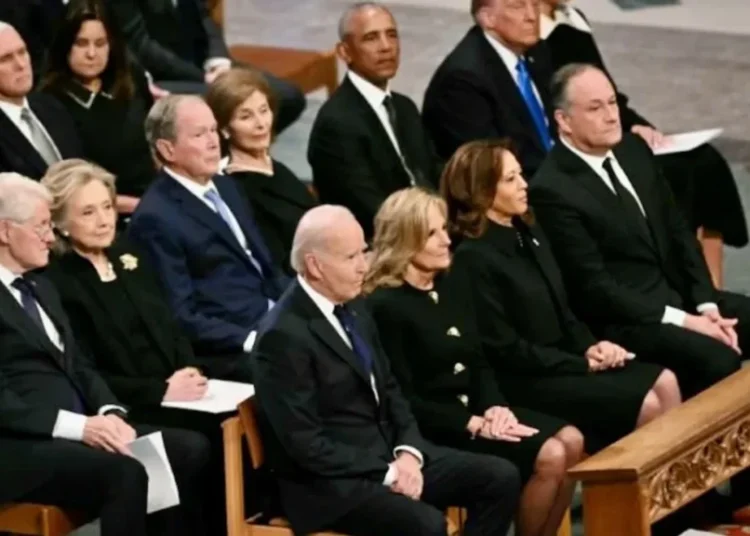
But now Trump finds himself facing the same challenge that depressed President Joe Biden’s approval ratings even before the 2024 campaign began: Voters say they don’t like the economy, even if conventional metrics show it’s still performing fairly well.
Inflation spiked early in Biden’s term, then dropped closer to normal levels without a recession by the time he left office. But his administration was unable to persuade voters that things were improving. Biden tried to argue that affordability concerns were temporary, then blamed corporate greed. After the 2022 Inflation Reduction Act, he promised that better times were just around the bend.
Voters didn’t buy it.
When Trump campaigned last year — first against Biden, then against Vice President Kamala Harris — he courted voters as consumers, telling them he was singularly capable of putting the economy back on track through a combination of income and business tax cuts, tax hikes on imported goods and stark regulatory rollbacks.
Now, privately, some GOP allies worry Trump could face a backlash — the president and Republicans in Congress made good on many of those promises, and yet people still cite the high cost of living as a prime concern.
Patience, they worry, is not something voters are conditioned to handle.
“It’s hard to tell the American public, ‘Trust us, it’s coming,’” said Alfredo Ortiz, chief executive of the Job Creators Network, a Trump-aligned advocacy group for small business owners.
The Trump administration and Republicans in Congress passed a mammoth tax and immigration law over the summer, the One Big Beautiful Bill, and White House budget director Russell Vought has bragged that the administration’s efforts to strip many of the Biden administration’s climate regulations have moved at a historically rapid pace.
The legislation featured Trump’s campaign promises to end taxes on tips and overtime wages, as well as a larger standard deduction for seniors to replace his campaign pledge to end taxes on Social Security benefits.
At the rally Tuesday, Pennsylvania Treasurer Stacy Garrity led attendees in a call and response cheer of “Promises made!” then “Promises kept!”
Ortiz sees those moves as progress. A free-trader at heart, he says he even sees new merit in the import taxes Trump has implemented, the highest tariff rate since 1935, according to the Yale University Budget Lab.
Other Trump allies say they’re confident voters will come around.
“They all take time to really make a huge difference in people’s lives,” said Jenny Beth Martin, the co-founder and chief executive of Tea Party Patriots. “And I think that we’re going to see a snowball effect as all of these changes that he’s made continue to build on one another as we head into 2026.”
Biden administration veterans, though, say they learned the hard way that swaying voters is not that easy.
“Any president is going to want to be optimistic about the economy and the economy under their watch,” said Daniel Hornung, the deputy director of Biden’s National Economic Council. “And it’s an inherent challenge when people are frustrated with the economy for a president to convey the kind of empathy that people want without seeming pessimistic.”
Representatives from the Trump administration did not immediately respond to a request for comment.
Some of the optimistic talk from Trump and Vance echoes similar tactics that Biden used.
The president and vice president have been talking up their economy in recent weeks, even as parts of it show signs of stress.
The job market posted job gains in November, but not enough to offset losses in October, pushing the unemployment rate to 4.6 percent, according to federal data released Tuesday, the highest since November 2021.
“If the American people had $3,000 taken out of their pocket, it’s going to take a little bit of time before they really feel like that money’s been put back in their pocket,” Vance said at the warehouse rally. “That just takes a lot of time. It’s a lot of work.”
Standing in front of a banner reading “LOWER PRICES BIGGER PAYCHECKS,” Vance told the crowd that “every single affordability crisis that we talk about in the United States of America today, it’s because we inherited a nightmare of an economy from Joe Biden.”
When Biden left office, inflation had fallen from generationally high levels and stabilized, but it still exceeded policymakers’ target rate of 2 percent annual price increases. The unemployment rate stood at 4 percent.
Presidents have a long history of blaming their predecessors for economic trouble: Biden himself argued at times that the inflation under his administration was Trump’s fault, claiming the economy was in tatters because of how Trump had managed the pandemic at the end of his first term.
Under Trump, prices have generally been stable, but costs have ticked up slightly in recent months, according to the Bureau of Labor Statistics. Jerome H. Powell, chair of the Federal Reserve Board, said last week that Trump’s tariffs were responsible for “causing the most of the inflation overshoot.”
Vance said he hoped voters would reward the Trump administration and Republicans during the midterm elections, and he forecast a brighter economic year in 2026.
“The American people are smart,” he said. “They know Rome wasn’t built in a day.”
Lauren Kaori Gurley in Washington contributed to this report.
The post The Trump administration is trying to talk voters into liking the economy appeared first on Washington Post.