The title character of Molière’s “Tartuffe” benefits from one of the greatest buildups in theater. Long before he appears, the members of a wealthy bourgeois household can’t stop picking on Tartuffe, accusing him of being a sanctimonious, lecherous con man who has somehow mesmerized the family patriarch into besotted subservience. After such counter-hype, you cannot wait to meet this charismatic master manipulator.
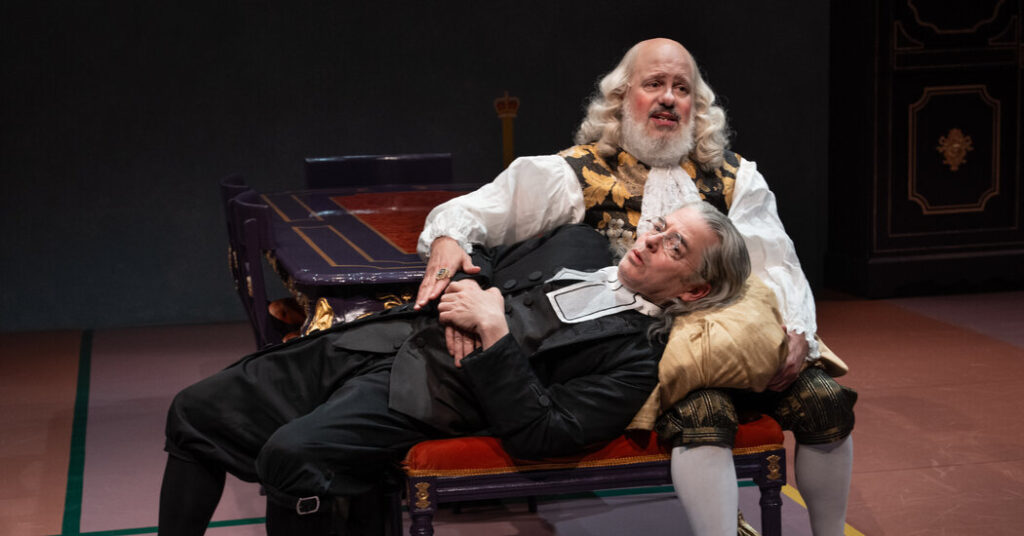
But when Tartuffe finally turns up in the revival that just opened at New York Theater Workshop, he is not the cross between Bernie Madoff and Rasputin we had been conditioned to expect, but an avuncular, diffident Everyman played by Matthew Broderick in peak milquetoast form. As for Tartuffe’s naïve prey, Orgon, he is portrayed by David Cross, who is more associated with a certain abrasiveness.
A more traditional production might have switched the actors playing the two men, considering Broderick’s and Cross’s styles, but the counterintuitive casting keeps the show on its toes. In fact, casting in general is the ace in the director Sarah Benson’s sleeve as the company ably navigates Lucas Hnath’s fluid, if sometimes unnecessarily profane, verse adaptation of this classic 17th-century French comedy. (Admittedly, I did shudder hearing Hnath rhyme “Tartuffe” with words like “goof” since it should be pronounced with a hard “u” sound.)
Orgon’s beleaguered inner circle includes Amber Gray as his second wife, Elmire; Emily Davis and Ryan J. Haddad as his children, Mariane and Damis; and Lisa Kron as Dorine, the kind of wily soubrette so beloved by classical French comedies. It’s a pleasure to watch them shamelessly hunt laughs. Davis (“Is This a Room”), for instance, displays an uncanny sense for physical comedy, turning the simple act of exiting the stage into an epic display of frazzled befuddlement. When Orgon kicks the whimpering Damis out, telling him to go “somewhere else,” Haddad makes a meal of his comeback, plaintively asking, “But do you mean somewhere else inside this house?”
The suspense of the play lies in whether Orgon’s “spiritual adviser” will be exposed as a crook. Tartuffe’s foes have their work cut out for them since he appears to be made of pure Teflon. Even Elmire’s brother, Cleante (Francis Jue), whose faith is sincere, can’t expose the machinations. Orgon even plans to give away his daughter to Tartuffe, telling Mariane, “It comforts me to know that a man of divinity will get to be the one who takes your virginity.” Meanwhile, the swindler has designs on Elmire, piously informing her that “when I feel the feeling of, say, lust for ladies’ busts, my lust for busts is actually a lust for God’s creation.”
Benson — who tends to embrace bold, highly theatrical choices, as illustrated by her stagings of “An Octoroon,” “Fairview” or “The Welkin” — seems content to let her cast have at it. (Let’s also mention Bianca Del Rio as Orgon’s mother, Madame Pernelle, and Ikechukwu Ufomadu as Mariane’s lover, Valère.) But this doesn’t mean that the show knows where it’s going.
The production certainly feels deluxe, with choreography by Raja Feather Kelly, original music by Heather Christian and gorgeous period (except for Dorine’s sneakers) costumes by Enver Chakartash. All that’s lacking is a strong perspective on the material.
Benson’s main staging concept is a reference to tennis, with lines drawn on the floor of the dots collective’s relatively minimalist set and some characters occasionally brandishing rackets or a fuzzy yellow ball. But these are cosmetic touches that don’t add much to the interpretation of the play. It’s hard not to be reminded of the Wooster Group pushing its badminton-themed deconstruction of Racine’s “Phèdre” in “To You, the Birdie!” (2002) into near-incomprehensibility — at least that company fully committed. Or of Ivo van Hove’s brutal take on Molière’s “The Misanthrope” (2007), which turned the playwright’s “overrefined hypocrites into a wallowing, rutting, howling menagerie of beasts,” according to the review in The New York Times.
Here, there is not much to grab onto, and Benson even resorts to a brief musical number to conclude the show. Then again, Molière pulled a king out of his hat — a rex ex machina, if you will — to wrap up “Tartuffe,” so a coda that feels tacked on is fitting.
Tartuffe Through Jan. 24 at New York Theater Workshop, Manhattan; nytw.org. Running time: 2 hours.
The post ‘Tartuffe’ Review: Casting Keeps a Deluxe Molière Revival on Its Toes appeared first on New York Times.