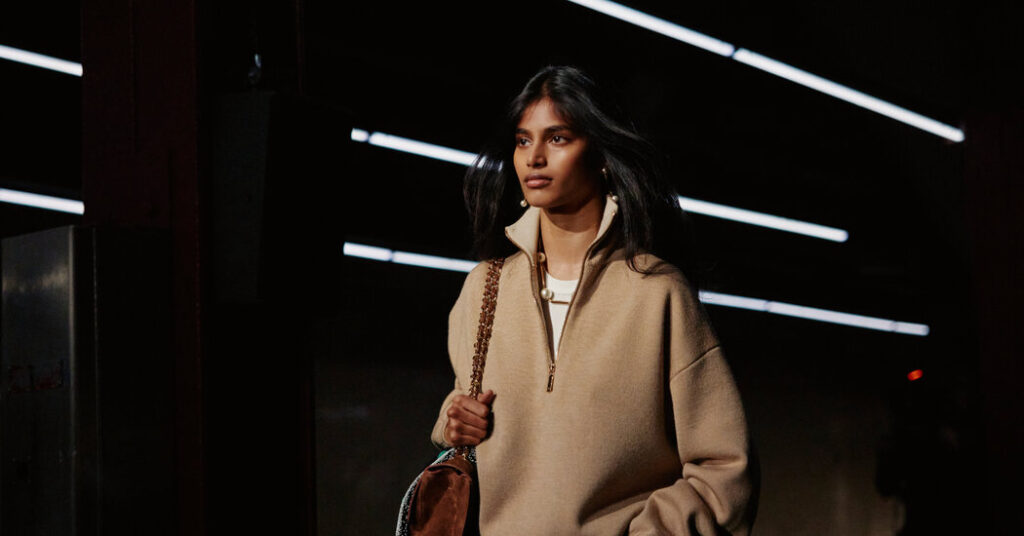
As far as origin stories go, Bhavitha Mandava’s seems plucked out of fiction.
Last summer, Ms. Mandava, 25, was doing what most college students do: studying late at the library, working a campus job and applying for internships.
Within a year, she was catapulted from that college life to the tippity top of the fashion world, walking runways in Milan, Paris and, earlier this month, for an unconventional Chanel Métiers d’Arts show staged inside an abandoned subway station in New York. The show opened not on a runway, but with Ms. Mandava nonchalantly walking down subway stairs. Clips of her strutting onto the platform, her hand in her jeans pocket, have become internet catnip and inadvertently turned her into a face of the luxury house.
“Yesterday, I went to my laundromat, and I got recognized,” she said. “People were like, ‘Can we take a selfie?’ It’s crazy. When something like this happens, it’s so easy to lose yourself. It can change the way you perceive life.”
Her Cinderella-esque trajectory is also a story of the ever-changing world of fashion, immigration in the United States and pure chance. And it all began, as it turns out, on a subway platform.
In August 2024, Ms. Mandava, who had moved to New York in 2023 from the southern Indian city of Hyderabad to pursue a master’s degree in product design at New York University, was homesick and had interviewed for so many unpromising internships that she lost count.
“I didn’t have anybody here,” she said. “I had to learn how to live again, from scratch. That’s how it felt. And the job market was really bad.”
To cheer her up, a friend offered to treat her to biryani from her favorite spot, Hyderabadi Zaiqa. While waiting on the Atlantic Avenue platform in Brooklyn for a train into Manhattan, she was spotted by Showin Bishop, founder of the model agency 28Models.
Mr. Bishop decided to introduce himself despite being worried about coming across to as too forward or too creepy.
“I’m, like, taking off my hood and trying to tuck my hoodie in my pants,” he said. “I have my phone in hand, email open, Instagram, website, everything. I have to, like, overcompensate.”
He asked if she wanted to be a model. She said no. She gave him her email address anyway. Later, when Mr. Bishop told her in an email that modeling gigs could help her pay off her student debt, she began to change her mind and went to visit him at his studio.
Mr. Bishop took some unfiltered images of her and sent them to casting directors. “When I tell you I have never experienced my email blowing up like that off some digitals …,” he said. “Every. Single. Casting. Director was like, ‘We want to see her.’”
The problem was that Ms. Mandava was in the United States on a student visa, which wouldn’t have allowed her to work here.
She applied instead for a pan-European Schengen visa, which allows for short business, tourism or family visits. Within two weeks, in September, she was on a flight to Milan, where she met with Matthieu Blazy, then the creative director of Bottega Veneta.
Ms. Mandava, who grew up in a middle-class family far removed from the fashion world, didn’t know who he was and had never heard of the Italian luxury label. She had never even been to Italy. Or worn heels. (She is 5 feet 9 inches tall.)
But there she was, in a casting call in heels, for what would become one of Mr. Blazy’s last shows at Bottega.
After the casting, Ms. Mandava called Mr. Bishop. “I was like, ‘Hey, how was it?’” he recalled in a joint interview. “And she goes, ‘It was good. We talked, and he hugged me.’ I was like, ‘Who is he? Are you saying Matthieu?’”
“I didn’t know his name,” Ms. Mandava interjected. “I never was able to afford any of these brands, never was interested either. I just did not know.”
“I was like, ‘That is the guy,’” Mr. Bishop said. A designer doesn’t hug a model during casting, he added. Never happens.
“There was a light in her eyes,” Mr. Blazy said in an email about the encounter. “I immediately knew I wanted to work with her.”
Ms. Mandava made her runway debut for Bottega a few days later. In the next weeks and months, she booked Dior and Courrèges, and when Mr. Blazy became the artistic director of Chanel, he cast her in his debut show there.
At the same time, she was still attending evening classes and working her day job as a campus lab coordinator that paid $30 an hour. And because she still didn’t have a visa to work full-time in the United States, she would fly to Europe on weekends to model. She graduated in May.
It was only a week before the Chanel Métiers d’Arts show in New York that Ms. Mandava was able to obtain a visa that allowed her to work in the city. She emerged at the start of the show wearing jeans and a beige quarter-zip knit, a look that Mr. Blazy described by email as a Chanel “interpretation of the look she was wearing a year before on the subway” when she was scouted. It was a full-circle moment that encapsulated Mr. Blazy’s efforts to ground and modernize Chanel, inserting it into the quotidian and serendipitous environment of the subway.
The reaction to the show and to Ms. Mandava’s story was immediate. A video that she posted of her parents’ excitement while watching the Chanel livestream back in Hyderabad has more than 20 million views and more than two million likes on Instagram (and another two million views on TikTok). As the first Indian woman to open a Chanel show, she has been hailed in new media coverage as “history-making” and “the internet’s new muse.”
But as exhilarating as the attention has been, it is also a little scary. The thing about being widely considered a fresh face in fashion, Ms. Mandava said, is that the flashy lights and glamour can end as abruptly as they start.
“It’s like, ‘Oh, this brand thinks you’re the look,’” she said. “And there’s nothing I can do about it. If one season, you’re just not the look, then you’re just not the look.”
Alisha Haridasani Gupta is a Times reporter covering women’s health and health inequities.
The post She Was Discovered on the Subway. Then She Walked a Chanel Runway. appeared first on New York Times.