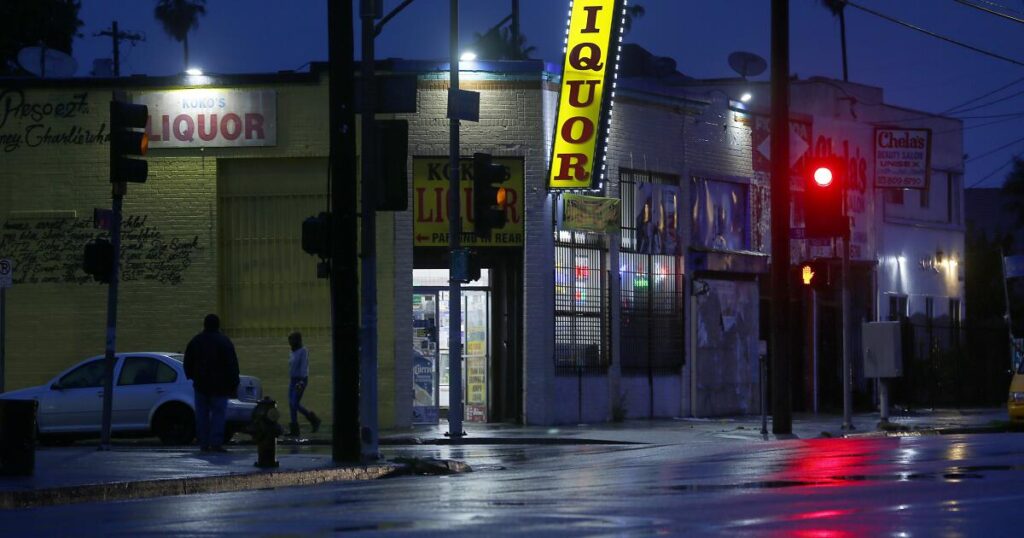
California gubernatorial candidate Steve Hilton on Monday visited a notorious sex-trafficking corridor in South L.A. and vowed to rescind a law that decriminalized loitering, a measure critics say endanger, not help, victims.
Standing at the corner of Figueroa and 77th streets, Hilton promised to repeal the 2022 Safer Streets for All Act, which eliminated a misdemeanor law for prostitution-related loitering.
Hilton blamed the state’s Democratic leadership for the sex trafficking corridor, arguing that Gov. Gavin Newsom and others are neglecting the “evil” trade.
“Our children are being sold here,” said Hilton, who spent Friday night in the area with advocates fighting sex trafficking. He said he witnessed a young girl who he said looked to be about 8 years old being sold to a customer.
“Totally out in the open — this is one of the most shocking things I have seen,” said Hilton, holding up blurry photos of girls and young women taken on Friday night.
A former advisor to British Prime Minister David Cameron, Hilton is one of a handful of Republicans running for office in next year’s election. Newsom faces term limits and must step down.
Nicknamed “The Blade,” the Figueroa Corridor is by far the most notorious sex trade hub in the city. Scantily-clad girls and young women strut alongside this section of Figueroa Street at all hours of the day.
In August, a federal indictment charged 11 alleged gang members and associates with controlling prostitution along a 3.5 mile stretch of Figueroa. Gang members and associates allegedly recruited vulnerable minors and young women — including runaways and children from the foster care system — through social media and branded them with tattoos, prosecutors charged.
As Hilton’s team live-streamed his campaign event Monday morning, two young women — one in ribbon-like stockings that exposed her buttocks and another in black shorts and clear-colored stilettos — paced back and forth across the street.
The 2022 Safer Streets for All Act didn’t repeal prostitution, which is illegal in the state of California. But it stopped police from being able to arrest people for loitering with the intent to engage in prostitution.
Advocates said police harassed sex workers and LGBTQ people and used subjective criteria when pursuing an arrest, such as the type of clothing or makeup a person wears.
Sen. Scott Wiener (San Francisco) authored SB 357, arguing that police officers indiscriminately arrested people for the prostitution loitering and disproportionately targeted Black and Brown transgender women.
Some law enforcement groups, however, opposed it over concerns it would stop them from being able to protect sex trafficking victims. A recent New York Times feature on the Blade reported that police officers blame the law for not being able to rescue minors who are forced into sex work.
“I understand the intention of [this law] but the consequence has been to hamper law enforcement’s ability to fight this evil trade,” Hilton said on Monday.
The Los Angeles Police Protective League, which represents rank and file LAPD officers, said in a statement Monday that Sb 357 “was a human sex trafficker and pimp’s dream come true and should be repealed.”
“California’s legislature and governor should revisit the detrimental impacts this legislation has had on sex trafficked women and children and rethink this wrongheaded approach. This type of legislation is shameful, wrong and not supported by the facts.”
Support for SB 357, even among Democrats in California, wasn’t uniform and some moderates joined Republicans in either voting against the bill or withholding their vote.
Representatives for Newsom didn’t respond on Monday to request for comment.
The post Sex trafficking in L.A. made worse by California law, Republican candidate for governor says appeared first on Los Angeles Times.