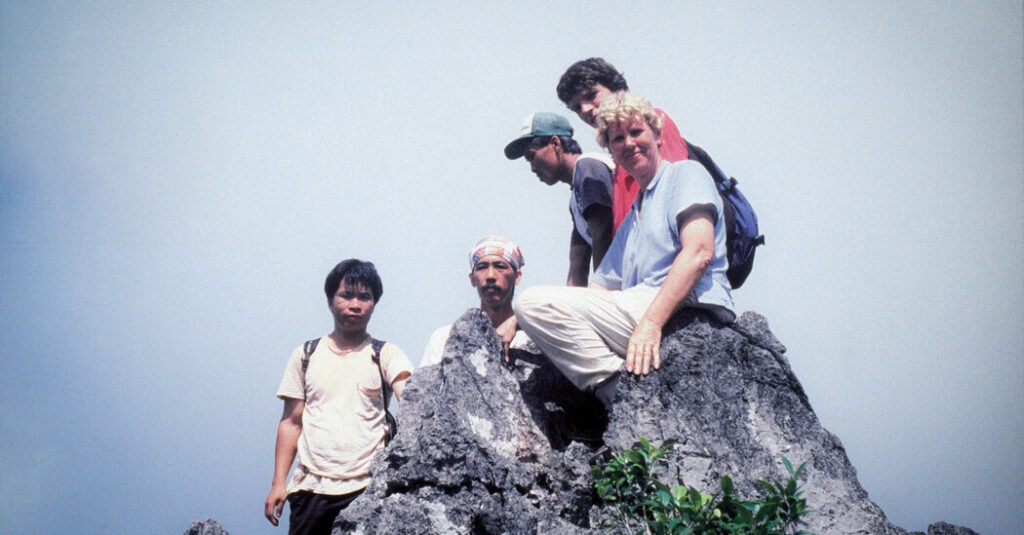
Ruth Kiew, a British-born, Cambridge-trained botanist who walked through remote tropical forests and climbed steep cliffs in her adopted country of Malaysia to discover and name scores of rare plant species, died on Nov. 20 in Kuala Lumpur, the capital. She was 79.
Her death, in a hospital, from cancer, was confirmed in a Facebook post by the Forest Research Institute Malaysia, where she was a research fellow.
Dr. Kiew was the rare botanist who trekked where few others would, scouring the underbrush for humble but rare plants, particularly begonias, and meticulously recording them. Plants like the hoya endauensis, small and waxy leaved, were discovered on obscure river banks in Malaysia, a triumph that she quietly insisted was as valuable as finding a new animal species. She discovered more than 150 new plant species in all.
Fascinated by the biodiversity in Malaysia, she acquired citizenship there after long years of fieldwork. In 2002, she became the first woman to be awarded the David Fairchild Medal for Plant Exploration, a sort of Nobel Prize for botanists given by the American nonprofit group the National Tropical Botanical Garden.
“She’s one of the greatest botanists who ever lived,” Paul Alan Cox, who was the director of the organization when the award was presented, said in an interview. “She was going into places where few men would go. She was like an astronaut. She was going into places, driven by her curiosity. She was going alone into these remote forests in Borneo.”
Dr. Kiew first went to Malaysia in 1969, to do field work for her Ph.D. in tropical plant taxonomy at the University of Cambridge. (The doctorate was awarded in 1972.) Bowled over by what she saw in a land teeming with undiscovered plants, she never left.
“It was all completely new,” she told Claudia Dreifus of The New York Times in a Q&A interview in New York after winning the Fairchild medal. “The flora was bigger and brighter than anything in Europe. I had read about these things in books, but to see these specimens and the diversity, was incredible.”
Her focus, modest-size plants on the forest floor or on the sides of hills, was particularly well-chosen because she could gather them herself, without the aid of assistants.
“I found that nobody was studying herbaceous plants, which I actually found to be an advantage, because I could collect specimens myself without having to climb,” she told the Malaysian newspaper Sin Chew Daily not long before her death.
Until the end of her career, Dr. Kiew remained dazzled by the profusion and diversity of plant life in the ancient forests of Malaysia and Borneo, the island off the Malay Peninsula, part of which belongs to Malaysia.
“I still find new plants, and I spend lots of time identifying them,” she told Sin Chew Daily. In her interview with Ms. Dreifus, in a Manhattan apartment, she said, “One hectare of land — a hundred meters by a hundred meters — had about one hundred different tree species on it.”
“Any area one goes to in Borneo will have something new to be discovered,” she added. “In an area the size of this living room, you might find 200 to 300 different plants, many of them existing only on the spot where they were growing.”
In a 2021 talk at the Heritage of Malaysia Trust (a nongovernmental group also known as Badan Warisan Malaysia), Dr. Kiew warned of the dangers to plant and animal life posed by a quarry near the Gunung Kanthan limestone hill, in the western state of Perak. “It has very peculiar flora and fauna, because it is such a difficult place to live,” she said. “There are many endemic species only known to one hill. And many are endangered because of mining.”
This profusion of plant life and the growing threats it faced from mining and development were what motivated Dr. Kiew, said Dr. Cox, who is now executive director of Brain Chemistry Labs, a research group in Jackson, Wyo., that focuses on discovering from plants new cures for human diseases.
“She became a spokesperson for this tremendous biodiversity in the Malaysian rainforest,” he added. “The places she went were mind-blowing.”
Helen Margaret Ruth Evans was born on April 14, 1946, in Cambridge to Jessie Margaret (Hadfield) Evans, a biology teacher, and Clifford Evans, a botanist who taught at the University of Cambridge.
After first studying psychology at the university, Ruth Evans followed her father’s path and switched to botany. She came under the supervision of a celebrated botanist at the university, E.J.H. Corner, who had been assistant director of the Singapore Botanic Gardens during World War II.
She later defended him against accusations that he had collaborated with the invading Japanese after they had allowed him to continue his botanical work there. “He used to be very annoyed that people refused to believe him,” she told the newspaper The Straits Times of Singapore.
In 1969, Professor Corner suggested that she do her doctoral research in Malaysia, telling her that it was a place “suitable for a single woman to travel alone,” she recalled for Sin Chew.
She taught in the biology department at the Universiti Putra Malaysia from 1972 to 1997. She accompanied her husband, Dr. Kiew Bong Heang, a zoologist who studied frogs, on his field trips.
From 1997 to 2005, Dr. Kiew was keeper of the herbarium and library at the Singapore Botanic Gardens, one of the world’s premier such institutions. After Dr. Kiew’s death, officials with the gardens paid tribute to her on Facebook, writing that “she played a central role in strengthening and modernizing the national collection.”
Dr. Kiew was the author of several books that are considered landmarks in botany, including “Begonias of Peninsular Malaysia” (2005); “A Guide to Begonias in Borneo” (2015); and “Flowers of Fraser’s Hill, Peninsular Malaysia” (2025, with Jana Leong-Skornickova).
She is survived by two children, Lisa Kiew and Nick Kiew; a brother; and two grandchildren. Her marriage ended in divorce.
Dr. Kiew worried that amid rising concern over threats to biodiversity around the planet, plants were getting short shrift.
“What you mostly hear about are animals being lost,” she told Ms. Dreifus in 2002. “Plants seem to have less charisma than tigers and elephants.”
Adam Nossiter has been bureau chief in Kabul, Paris, West Africa and New Orleans and is now a writer on the Obituaries desk.
The post Ruth Kiew Dies at 79; Botanist Made Discoveries in Remote Forests appeared first on New York Times.