Robert J. Samuelson, an economics columnist for Newsweek and The Washington Post who explored, in reader-friendly vernacular, the perils of inflation, the fiscal consequences of entitlement spending and the slow-motion crisis of the bulging national debt, died on Saturday in Bethesda, Md. He was 79.
His death, in a hospital, was caused by complications of Parkinson’s disease, his daughter, Ruth Samuelson, said.
With no formal training in economics, Mr. Samuelson viewed himself as an outsider who translated dense but important policy debates for a broad audience.
“I don’t have an economics degree, and I think in some ways that’s a strong point, because I’m always trying to explain things to myself, and if I can explain them to me, I think I could try to explain them to my readers,” he said on the C-SPAN program Q&A in 2010. “I’m not trying to impress economists.”
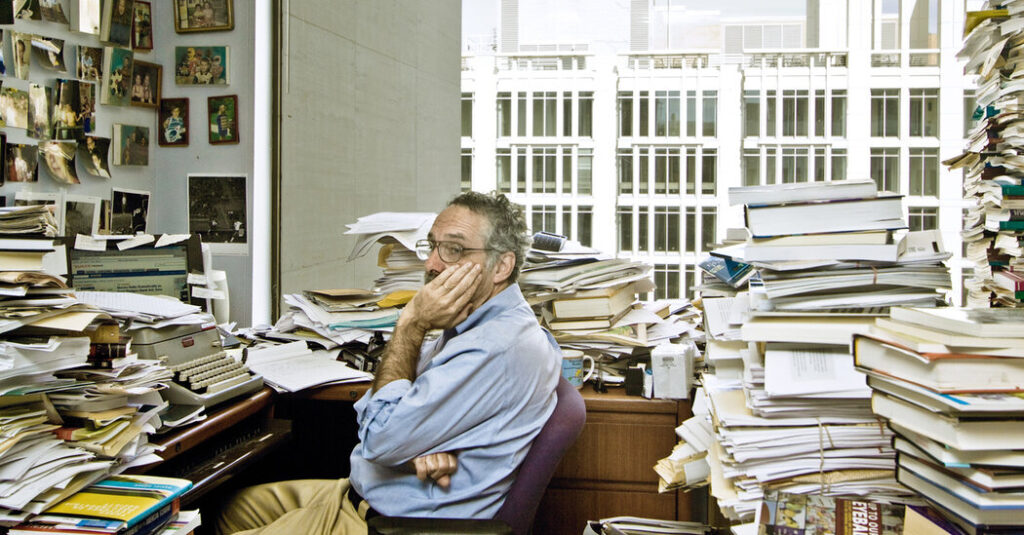
Typically disheveled in appearance and surrounded by mountains of papers on his desk, Mr. Samuelson often resembled an absent-minded professor. In reality, he was among a dwindling breed of Washington journalists who find intellectual delight in think tank debates and policy briefings.
“When many of us used to think, ‘If I have to go to one more I.M.F. annual meeting, I’m going to shoot myself,’ he was always really excited to be there,” Steven Pearlstein, a former business columnist at The Washington Post, said in an interview, referring to the International Monetary Fund. “He had more energy and enthusiasm than the youngest reporter in the room.”
Mr. Samuelson began writing an economics column in 1976 while working at The National Journal, a magazine specializing in public-policy issues, and The Post soon began printing it, too. He joined Newsweek in 1984 as a contributing editor, and his column ran in the magazine and its sister publication, The Post, for decades. Over the years, he earned the National Magazine Award for reporting as well as three Gerald Loeb Awards for distinguished financial commentary.
Though Mr. Samuelson choose to view himself as “sensible” rather than beholden to a particular political party, many of his columns bemoaned what he viewed as the fiscal excesses of entitlement spending on Medicare and Social Security benefits — policies favored by Democrats.
“He didn’t really care what conventional wisdom was, or what was cool, or what was in vogue,” Evan Thomas, a former editor at Newsweek, said in an interview. “He would constantly puncture liberal shibboleths. But he could go after the other side, too, and he had the goods.”
A column from 2010 was a case in point.
“Our political culture prefers delusion to candor,” Mr. Samuelson wrote. “Liberals would solve the budget problem by taxing the rich and cutting defense. Think again. The richest 5 percent already pay about 45 percent of federal taxes; they may pay more but not enough to balance the budget.”
He went on: “Defense spending constitutes a fifth of federal spending; projected deficits over the next decade are similar. We won’t shut the Pentagon. Republicans and Tea Partyers think that eliminating ‘wasteful spending’ would allow more tax cuts. Dream on. The major spending programs, Social Security and Medicare, are wildly popular with roughly 50 million beneficiaries.”
Robert Jacob Samuelson was born on Dec. 23, 1945, in Manhattan and raised in White Plains, N.Y. His father, Abe Samuelson, was in the industrial cable business. His mother, Joan (Kahn) Samuelson, was a party planner.
He graduated from Williston Academy, a prep school in western Massachusetts. At Harvard University, he received a bachelor’s degree in 1967 in government after serving as editor of The Harvard Crimson.
The Post hired him as a metro reporter in 1968, but when he arrived to start, the paper’s editor, Ben Bradlee, told him that there was an opening on the business desk and suggested that he take it.
“I thought it was not a great idea to contradict my new boss, so I took it,” Mr. Samuelson said in a 2019 interview with the Mercatus Center at George Mason University.
In addition to his columns, he published several books, most notably “The Great Inflation and Its Aftermath” (2008). In it, he argued that the elimination of double-digit inflation in earlier decades led to years of prosperity that made Americans — especially bank executives and ordinary homeowners — overconfident, enabling the reckless behavior that caused the 2008 financial crisis.
“The fact that Samuelson gives us so much to chew on proves the ultimate importance and success of his effort,” the publishing executive Steve Forbes wrote in The Claremont Review of Books, a conservative journal. “‘The Great Inflation and Its Aftermath’ is a timely piece of scholarship that will serve us well in the debates now unfolding on the nature and future of democratic capitalism.”
Mr. Samuelson married Judy Herr in 1983. In addition to his wife and daughter, Ruth, he is survived by two sons, Michael and John; a brother, Richard; and two grandchildren.
Upon retiring in 2020, Mr. Samuelson wrote a final column assessing his career.
“So far as I can tell,” he wrote, “nothing that I have written has ever had the slightest effect on what actually happened.”
For instance, his frequent complaints about Amtrak.
“I’ve routinely suggested shutting down Amtrak,” he wrote, “not because I dislike trains (I don’t) but because Amtrak is an excellent example of how the federal government has acquired so many nonessential functions.”
Still, the trains kept running.
“I’m resigned to this,” he wrote. “No one elected me to anything. In our system, the people rule, not the pundits; and that’s how it should be.”
The post Robert Samuelson, Award-Winning Economics Columnist, Dies at 79 appeared first on New York Times.