Scientists from the United States, Canada and Europe will soon start research flights over the Atlantic Ocean to learn more about atmospheric rivers in the hopes of giving battered residents of both Europe and the West Coast of the United States more time to prepare for the deluges they bring.
Atmospheric rivers, high-altitude plumes of tropical moisture, are dumping heavy rainfall and causing floods across the Pacific Northwest this month.
Beginning in January, France and Germany will launch flights from Ireland, while a NASA aircraft based in the Canadian town of Goose Bay, will also begin high-flying surveys, according to Marty Ralph, a research meteorologist at the Scripps Institution of Oceanography at the University of California, San Diego. Scripps is coordinating the research effort along with the National Oceanic and Atmospheric Administration.
“By adding measurements of an atmospheric river in the Atlantic, it will actually help the longer lead time forecasts for the West Coast,” Dr. Ralph said. The program was announced Tuesday at the annual meeting of the American Geophysical Union, an association of earth and space scientists.
Ocean winds cause evaporating seawater to form bands of moisture-laden air that flow from the tropics toward the Earth’s poles. Atmospheric rivers stretch about 500 miles wide and 1,000 miles long on average, and they can carry an amount of moisture equivalent to 25 times the average water flow at the mouth of the Mississippi River. These rivers in the sky release their water when upward movement causes the water vapor to cool, condense and fall as rain, snow or ice.
The Pacific Northwest has been battered by a series of these airborne moisture plumes for the past week. Rivers overflowed their banks, roadways became streams and homes and farms were submerged across Washington state. Additional rain is in Wednesday’s forecast.
While Washington state is feeling the destructive power of these storms this month, communities in California’s Sierra Nevada may benefit from atmospheric rivers that drop rain and snow that is critical for summertime water supplies.
“The storms will be really big and can be locally pretty damaging, but they’re bolstering the snowpack, or they’re filling reservoirs up enough to be helpful,” Dr. Ralph said.
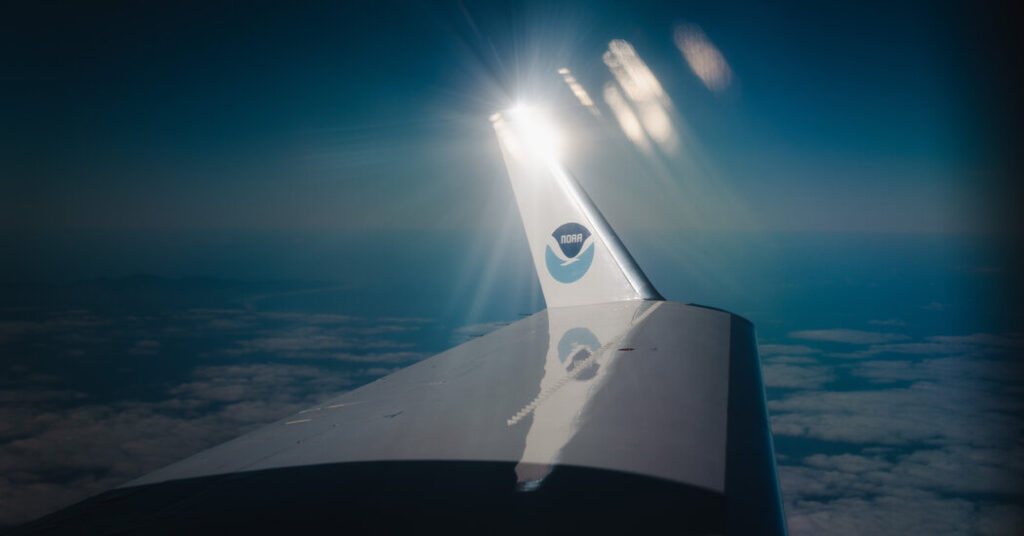
The U.S. Air Force and the NOAA have been sending up crews in specially designed aircraft across the Pacific Ocean since 2016 to monitor atmospheric rivers.
The new flights beginning in January will investigate the upper atmosphere and track meteorological features over the North Atlantic Ocean using a similar suite of instruments. These include multi-frequency radar and foot-long cylindrical devices called dropsondes that are released through a tube in the back of the aircraft and record temperature, pressure and wind speed as they plummet to earth.
The German high-altitude research aircraft HALO and a French ATR-42 aircraft will be flying out of Shannon Airport in Ireland beginning in mid-January.
American aircraft, many that are more than 50 years old, are used to monitor atmospheric rivers in the winter in addition to hurricanes in the summer and fall.
A March 2025 Government Accountability Office study found increasing demand to cover Pacific flights has strained NOAA’s and the Air Force’s crews and aircraft, including missing two flights over Hurricane Helene in 2024. NOAA officials said they expect to replace one Gulfstream aircraft next year and add another plane by 2029.
The data collected on these flights will be fed into computer weather models and used to try to increase lead time for weather forecasts of atmospheric rivers from the current one week to two weeks, Dr. Ralph said. The new data will help increase the skill of forecasts for both Europe and the West Coast of the United States.
“Atmospheric rivers are a global phenomenon and the Atlantic is a good source of moisture,” said Christine Shields, a project scientist at the National Center for Atmospheric Research in Boulder, Colo.
Dr. Shields said that the warming climate is boosting atmospheric rivers.
“Because the atmosphere is a little bit warmer, there’s more moisture that’s actually available,” Dr. Shields said, “and so the intensity of these things is definitely getting worse.”
The post Research Flights Over the Atlantic Could Help Improve Atmospheric River Forecasting appeared first on New York Times.