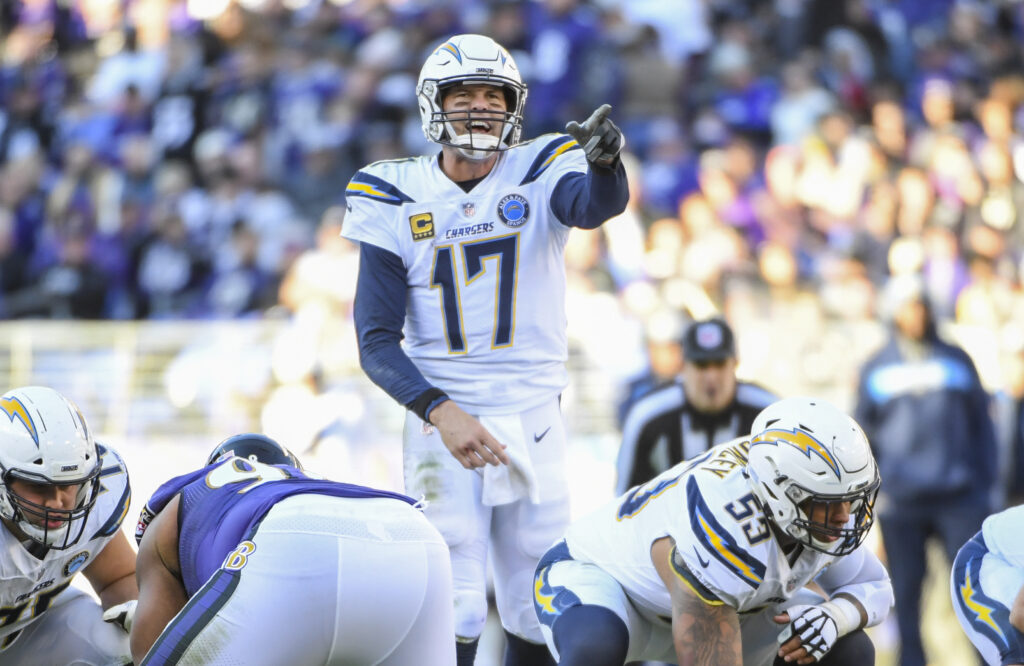
Regarding Will Leitch’s Dec. 13 op-ed, “Go get ’em, Grandpa! The Colts throw a Hail Retiree.”:
The return of 44-year-old Philip Rivers, a grandfather, as quarterback for the Indianapolis Colts is an inspiration for older folks. But I am announcing I will not be joining him in the NFL for these reasons: I have never played football. I have a fear of 300-pound men in helmets. And I am 86 years old.
After eight decades of watching football (go Ohio State), I have seen that mature quarterbacks can succeed. George Blanda played from 1949 to 1975, until he was 48. Blanda attributed his longevity to eating “steak and potatoes and green vegetables. I smoke and I drink.”
Tom Brady was a starting quarterback until he was 45. Warren Moon, Steve DeBerg and Vinny Testaverde played until they were 44.
My favorite was Sonny Jurgensen of the Washington Redskins, who in his final season, in 1974 at age 40, led his conference in passing proficiency. By then, Jurgensen stood with a noticeable tummy paunch as he fired passes. “I don’t throw with my stomach,” he responded to critics.
Now I will sit in my recliner to watch Rivers back in action with one thought: Win one for the rest of us grandpas.
Ronald G. Shafer, Williamsburg
The U.S. needs you to buy all those dolls
The president advises parents to reduce spending on toys for children, whose price has increased in response to tariffs: “You don’t need 37 dolls for your daughter. Two or three is nice, but you don’t need 37 dolls.” Taken more broadly, the president is telling consumers that their response to inflation caused by tariffs is to hold on to their money and not spend it. Coined by economist John Maynard Keynes, the “paradox of thrift” occurs when people save money instead of spending it. In an economy in which about 70 percent of gross domestic product depends on consumer spending, decreased spending risks economic stagnation or even recession. The president would do well to learn a bit about the principles on which the U.S. economy is based.
Stanley A. Rubin, Santa Monica
Precision matters
The Dec. 9 news article “Trump announces $11 billion relief for farmers in bid to soften tariff blow” underscored an important reality of trade policy: When broad levies fall across entire supply chains, they don’t spare America’s producers. Instead, they hit them first. Soybean growers are experiencing this acutely, just as electrical manufacturers, utilities and infrastructure builders are facing higher costs for the equipment needed to power the economy.
Farmers deserve support when trade tensions disrupt markets. And their experience illustrates why tariff design matters for other sectors, too.
In electrical manufacturing, companies are investing heavily to expand U.S. production of transformers, switchgear and other essential equipment. Yet many of the components required for these products cannot be sourced domestically at the scale or speed dictated by rising electricity demand, especially as industrial facilities and data centers place intensifying pressure on the grid.
When tariffs are applied indiscriminately to inputs that lack American substitutes, the result isn’t faster reshoring. It’s higher costs for the very producers and consumers the policy aims to help. As The Post’s reporting shows, that dynamic is playing out in agriculture today, and it is quietly affecting the grid projects communities depend on.
There is a practical alternative: Instead of blanket exemptions or one-time payments, a coalition of manufacturing, energy and infrastructure partners has proposed targeted, temporary tariff incentives tied to domestic-content standards and U.S. investment. These earned credits would support U.S. manufacturing expansion, ease pressure on electricity bills and allow critical infrastructure projects to move forward without delay.
Whether in farming or manufacturing, tariff policy done right shouldn’t require serial bailouts. Precision matters. And targeted incentives that reward U.S. production are a stronger foundation for long-term competitiveness than reactive relief.
Debra Phillips, Arlington
The writer is president and chief executive of the National Electrical Manufacturers Association.
Tipping tips
Miss Manners’s declaration that you “absolutely must tip those workers whose jobs traditionally require it,” even if you question why wages should “depend on the whims of customers,” calls to mind the anti-tipping research of longtime Post columnist Colman McCarthy half a century ago. [“Miss Manners: I hate being expected to tip, so I don’t,” online, Dec. 9]
In his Jan. 15, 1977, column, “My Little War Over Tipping,” McCarthy described his research method: “For 12 months, the opened palms of waiters, maids, porters, delivery men, taxi drivers, doormen, parking lot attendants, ushers and elevator operators went ungreased by me.”
He recorded what he called the “grimmer statistics”: “By unofficial tally, I endured 194 curses, 132 sneers, 75 threats, 13 blocks at the exit … six fracases, four near-beatings and one windshield-pounding.”
And he concluded: “It isn’t likely that legislation can elevate waiters and the others to the dignity they deserve — a fair salary. People will have to do that.”
But as Miss Manners knows, people didn’t.
Steven T. Corneliussen, Poquoson, Virginia
The post Philip Rivers, win one for us. Signed, your fellow grandpas. appeared first on Washington Post.