Maryland lawmakers returned to Annapolis on Tuesday for a one-day special legislative session to choose a new speaker to lead the House of Delegates and to override 18 vetoes, including Gov. Wes Moore’s veto of a bill to study reparations for descendants of enslaved people.
Lawmakers did not take up congressional redistricting during the special session, putting the issue on ice until the General Assembly reconvenes for its regular session in January.
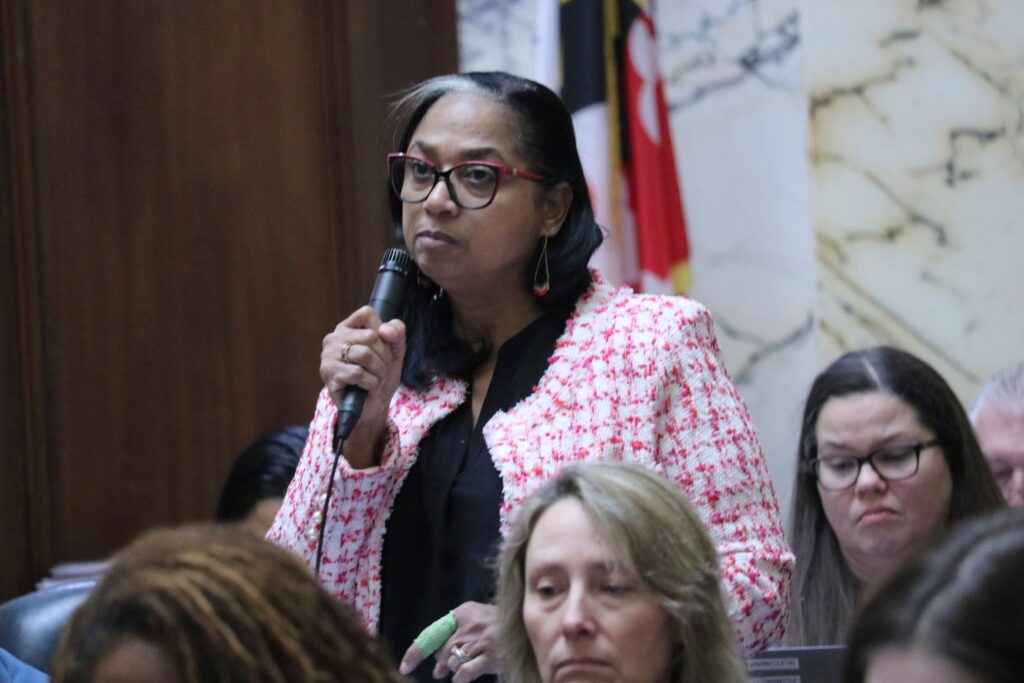
Delegates selected Joseline A. Peña-Melnyk, a Democrat first elected to represent parts of Prince George’s and Anne Arundel counties in 2006, to serve as the next speaker, elevating her to one of the most powerful legislative positions in the state. Born in the Dominican Republic, she is the first immigrant and Afro-Latina woman to hold the position.
In a speech after her swearing-in, Peña-Melnyk recounted how her family lived in a home without indoor plumbing and sometimes struggled to put food on the table, before moving to the United States when she was 8 years old. That upbringing, she said, influenced her approach to politics and leadership.
“Those memories are not shared for sympathy, but for truth,” she said. “They are reminders of where I come from and the resilience that hardship can forge. We are all capable of becoming the best person we can if people invest in us.”
The new speaker also vowed to maintain her reputation for inclusivity by working across the aisle and respecting differences of opinion among the members of the House.
“I will fight for everyone, I don’t care where you come from — especially those who feel unseen and unheard,” she said.
Days after former speaker Adrienne A. Jones (D-Baltimore County) stepped down, Peña-Melnyk marshaled enough support to clinch a nomination from the Democratic caucus, which controls the House with a supermajority. The process unfolded with far less public dispute than the last speaker election in 2019, when the Democratic caucus split between two other candidates in a divisive and heated contest before Jones secured the nomination.
After 18 years in the General Assembly, Peña-Melnyk will lead the House through a legislative session that is already teed up to deal with a number of issues, including a $1.4 billion budget deficit, immigration policy, rising health care costs and a push for congressional redistricting that has divided Democrats in Annapolis.
Peña-Melnyk said she would prioritize pursuing policies that ensure a more just future, while also addressing Maryland’s serious budget problems. She said that lawmakers will have to make tough choices about spending, while also protecting working families.
The new speaker was nominated by her district mate Del. Mary A. Lehman (D-Prince George’s) and Legislative Black Caucus chair Jheanelle K. Wilkins (D-Montgomery), who emphasized Peña-Melnyk’s history-making rise to the position of leadership. Delegates told stories on the House floor about her dedication to the work, including taking the time to visit constituents at graduation ceremonies and in hospitals.
“We all know that Joseline A. Peña-Melnyk puts her heart and soul into everything she does,” said Del. Ben Barnes, who represents the same district as the new speaker.
Peña-Melnyk, 59, has used her nearly two decades in the State House to push for left-leaning policy. She worked as a criminal defense attorney and, later, a prosecutor for the U.S. attorney’s office before she held public office. Peña-Melnyk first ventured into politics as a member of the College Park City Council, where she served two terms. As a state legislator, Peña-Melnyk served as chair of the Health and Government Operations Committee and focused much of her energy on bills involving health care, social equity and criminal justice.
“She’s a real workhorse,” said Sen. James C. Rosapepe (D-Prince George’s), who has served in the same district as Peña-Melnyk since 2007. “I don’t know a legislator who works any harder than she does.”
Rosapepe described Peña-Melnyk as a “pragmatic progressive” with a knack for building consensus even around divisive or novel policy proposals. He compared her leadership style to that of U.S. Rep. Nancy Pelosi (D-California).
“She’s progressive and actually gets things done,” he said.
In a statement, Moore said Jones left “big shoes to fill,” and he was confident that Peña-Melnyk would build on her legacy.
“We’ve stood shoulder-to-shoulder on issues that touch all Marylanders, from protecting reproductive freedom to fighting back against a White House that wants to make health care more expensive,” Moore’s statement said.
Peña-Melnyk received support even from members of the minority party.
“The mere fact that I’ve been asked to stand to close the nominations, is a testament to the type of leader that the nominee is and will continue to be,” said Del. Tom Hutchinson, a Republican from Dorchester County and a member of Peña-Melnyk’s committee, who closed out the speaker nominations on the floor. “She is a leader who is always willing to listen and understand regardless of the side of the aisle on which you stand.”
Lawmakers in both chambers also voted to override 18 of Moore’s vetoes, a striking move for a state legislature that is politically aligned with the governor.
When former Republican governor Larry Hogan was in office, the General Assembly routinely overturned most, if not all, of his vetoes, including on bills to expand abortion access, create a statewide paid family leave program, and adopt a landmark education restructuring plan known as the Blueprint for Maryland’s Future.
Legislators reversed Moore’s veto of a bill to form a commission to study the economic harm to Black descendants of enslaved people in Maryland. Moore, the nation’s lone Black governor, said the veto was “the most challenging” among the 23 bills he rejected in May, but he was focused on signing bills that addressed the state’s economic challenges under federal policy changes enacted by the Trump administration.
That veto put Moore at odds with the influential Black Legislative Caucus, which had pushed the reparations bill as one of its signature policy priorities last session.
Sen. Charles E. Sydnor III (D-Baltimore County) argued that the reparations commission is essential to ensure that any actions taken by the state have “credibility” rooted in objective findings that can “withstand legal scrutiny.”
“Slavery may have ended 150 years ago, but segregation, redlining and systemic discrimination stretch well into our lifetimes,” Sydnor said. “The commission is not about blaming individuals, it’s about fixing systems.”
The veto overrides easily passed through the Senate. In the House, lawmakers debated the reparations bill for about an hour before voting 93-35 to override the veto.
“The time is now,” Del. Terri L. Hill (D-Howard) said on the floor. “We cannot continue to delay on doing what we need to do … If we want to do better, we have to know better.”
Moore said he disagreed with the General Assembly’s decision, but was “eager to move forward in partnership on the work of repair that we all agree is an urgent and pressing need.”
“That mission is especially vital, given the immediate and ongoing effects of this federal administration on our constituents, including communities that have been historically left behind,” Moore said in a statement. “Leading with impatience will fulfill our obligation to ensure everyone can achieve success, no matter their race or background.”
Lawmakers also overturned Moore’s veto of 17 other bills, including the Responding to Emergency Needs from Extreme Weather Act, or RENEW Act, that included a study of climate change impacts across the state. Ahead of the special session, Moore reversed his position and said that he would be funding the $500,000 climate study despite his prior veto.
In his statement, the governor said he respected legislators’ constitutional authority to overturn his vetoes, though he maintained his previous concerns that some of those bills came with unfunded mandates or required multiyear analyses. He said his attention was firmly on the future, especially as the state grapples with the ongoing consequences of federal policy changes.
“As we move toward the New Year, I hope to find ways to partner with the General Assembly to drive results that make life better for Marylanders right now — with urgency, and without delay,” he said. “We’ve made real progress, yet there is still more to do.”
Despite a pressure campaign led by Moore and national Democrats, the General Assembly declined to take up congressional redistricting during the brief special session. Senate President Bill Ferguson (D-Baltimore City) has staunchly opposed calls to gerrymander Maryland’s congressional map to eek out an 8-0 advantage for Democrats by making the state’s sole Republican-leaning district more competitive. Legislative leaders and the governor agreed to set the issue aside during the December special session so that the House could choose a new leader before the new year.
The issue will likely resurface when the General Assembly convenes again for its regular session in just under one month. State lawmakers will return to Annapolis again on Jan. 14 for the start of the 90-day legislative session.
The post Maryland House selects first immigrant speaker during special session appeared first on Washington Post.