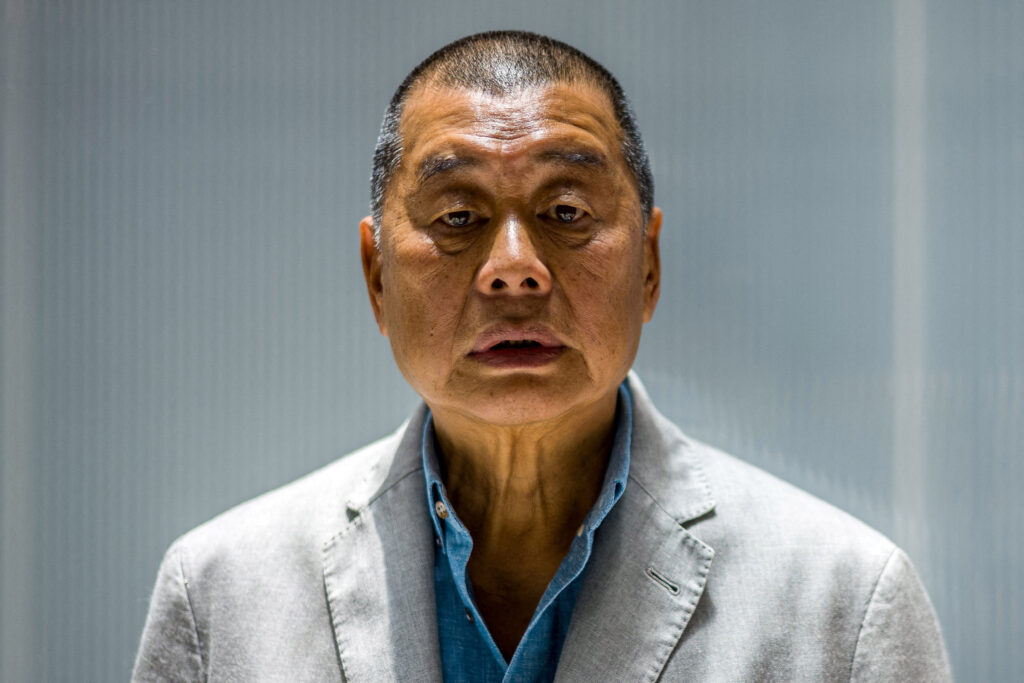
The guilty verdict handed down to Hong Kong media mogul Jimmy Lai Monday — a ruling that is likely to see the 78-year old spend his final years in prison — was more than just another conviction for political crimes in a city where dissent is no longer tolerated.
The ruling represents a capstone in the ongoing effort to rewrite the history of Hong Kong, its pro-democracy movement and even of Lai himself — using the once-respected courts as the final word in this narrative revision, analysts say.
Since the imposition of the national security law in Hong Kong five years ago, Beijing has sought to reengineer the ostensibly semiautonomous territory in its image. Every institution from universities to museums have bent to the new order.
Alongside this effort, authorities worked to identify a mastermind behind the 2019 protests that, at their height, saw more than a third of the city’s 7 million people take to the streets.
Instead of recognizing their yearning for greater democratic freedoms in Hong Kong or acknowledging flaws in governance, Hong Kong authorities and Beijing have placed blame almost squarely on Lai and his foreign backers.
The Communist Party “has never run across somebody with his combination of money, a media platform, and an unwavering commitment to principles,” said Mark Clifford, the author of “The Troublemaker,” a book on Lai, and a former business associate at Lai’s media company, Next Digital.
Still, Clifford added, Lai is “actually a rather shy and retiring person” who “never had any intentions to lead” a movement.
“It was easier for them to blame one man who was the alleged black hand or puppet master behind the protests than to think seriously about the aspirations of the Hong Kong people,” Clifford said.
Lai, a media tycoon who became a leading figure in the city’s pro-democracy movement and an ardent critic of the Chinese Communist Party, was arrested at the end of 2020 and charged with sedition and collusion with foreign forces under the national security law that Beijing imposed on Hong Kong earlier that year.
The pro-democracy newspaper he published, Apple Daily, was forced to close the following year.
He has been in detention for the past five years, almost all of it in solitary confinement, awaiting judgment. That came Monday, when three government-approved judges convicted Lai, a British citizen.
He is expected to be sentenced next month, and analysts say they expect the courts to impose a penalty that would mean he spends the rest of his life in prison.
The judge’s 885-page verdict goes back to Lai’s origins in Hong Kong — a story of displacement from mainland China and of seeking better opportunity in the then-British-controlled city, an experience shared by many Hong Kongers — to paint a picture of a man who has long held “deep resentment and hatred for the Chinese Communist Party.”
Through WhatsApp messages and other evidence, the case was mostly built on Lai’s connections with Americans and other foreigners who have long publicly supported Hong Kong and the aspirations of its pro-democracy camp.
Donald Trump is mentioned 195 times in the text of the verdict, and Mike Pence, the vice president during Trump’s first administration, 88 times. A lengthy section of the verdict is titled the “U.S. Line,” and describes how Lai had supporters within the first Trump administration and more broadly across officials critical of Beijing within the U.S. government.
Messages showing Lai’s associates arranging meetings with U.S. officials at that time and Lai’s public tweets in support of Pence’s speeches, for example, were offered by judges as evidence behind Lai’s maneuvering with foreign adversaries to topple China.
One example cited acknowledged that Lai “did not dare” request anything in particular from Pence during a meeting in 2019, asking Pence only to “support” Hong Kong.
The descriptions of the crimes largely constitute lobbying for support for Hong Kong’s democracy movement through actions including, but not limited to, calls for sanctions. Additionally, most of these actions happened before the national security law was enacted — when such lobbying would not have been illegal.
Authorities had said the law, which came into effect on June 30, 2020, would not apply to past acts, but these were used in this case to establish Lai’s guilt.
“The court has blurred non-retrospective principles and the actual consideration of the [facts], thus failing to handle the case in a non-retrospective way,” said Eric Lai, an expert on Hong Kong’s legal system at the Georgetown Center for Asian Law in Washington, who is no relation to the jailed tycoon.
This will “further erode the reputation of Hong Kong’s courts and rule of law … especially since the case involves corporations, Lai’s companies, as defendants,” he said.
None of Lai’s actions, as described in the verdict, were violent. Notably, the verdict mentions numerous occasions where Lai was advocating for nonviolence and seeking to moderate more extreme factions of the 2019 movement, acknowledging that violence would lose them support.
International condemnation poured in after Monday’s verdict, including from the European Union, the United Kingdom and Australia.
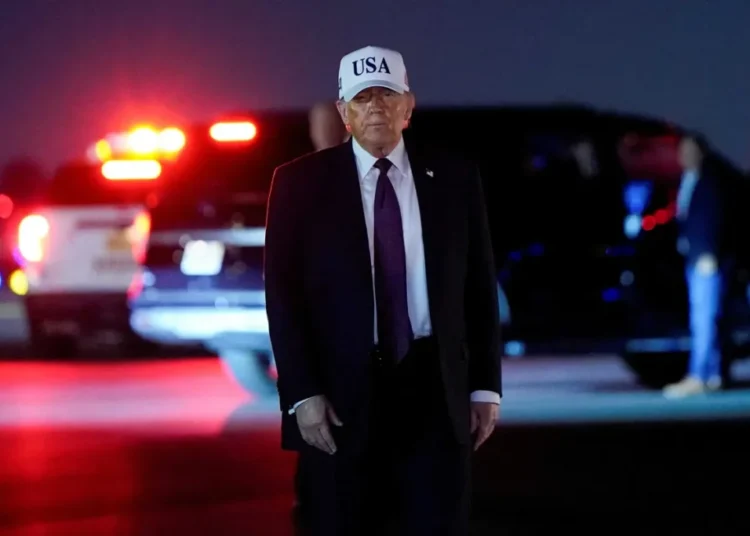
In Washington, Trump Monday said he wanted Chinese leader Xi Jinping to release Lai. “I feel so badly. I spoke to President Xi about it, and I asked to consider his release,” Trump told reporters on Monday. “He’s an older man, and he’s not well. So I did put that request out. We’ll see what happens.”
Reuters had previously reportedthat Trump raised Lai with Xi when the two leaders met in South Korea in October.
Beijing and Hong Kong authorities instead doubled down on their narrative.
The Hong Kong and Macao Affairs Office of the State Council, China’s body that oversees the territories, said it endorsed the conviction, describing Lai as a mastermind of anti-China activities who was a “running dog” for foreign forces.
“The days of external forces and anti-China elements acting with impunity are gone forever,” the office said.
The Hong Kong government has also maintained that Lai and defendants in his case were found guilty “only after a fair trial,” noting that the court found Lai’s “hatred” of China goes back years.
“Long before the enactment of the Hong Kong National Security Law, Lai had already been applying his mind as to what leverage the United States could use against the PRC,” a spokesman for the Hong Kong government said in a statement.
Those who have criticized the verdict or judicial proceedings, the statement added, have “through despicable political manipulations and lies, attempted to glorify the criminal acts of Lai and his syndicate.”
The post Jimmy Lai case shows how China is rewriting Hong Kong’s history appeared first on Washington Post.