The persistent ISIS threat
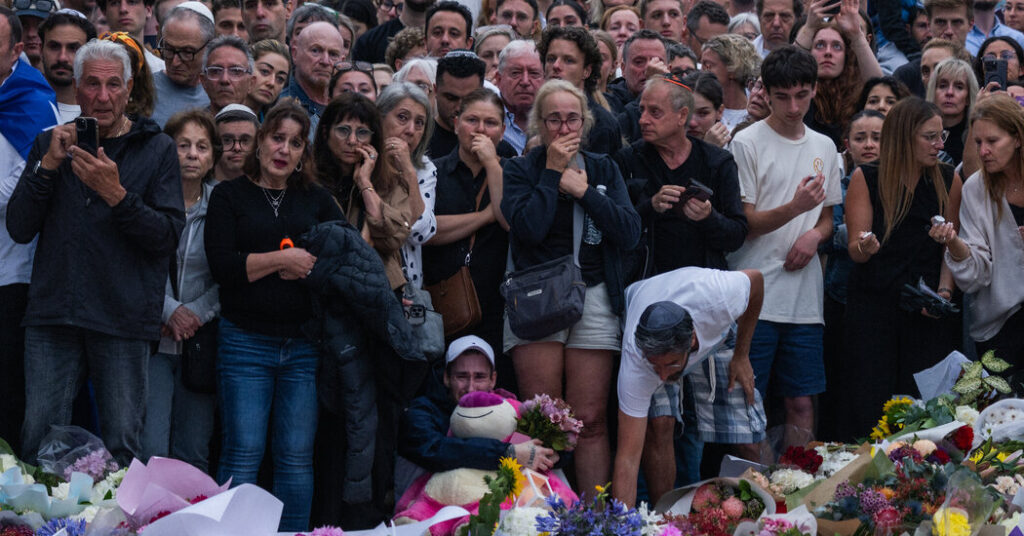
After the shooting that killed 15 people at a Hanukkah celebration on Bondi Beach last weekend, Australia’s prime minister revealed what investigators had learned so far about the shooters’ motivations: They were driven, he said, by “Islamic State ideology.”
Two homemade Islamic State flags were found in the car that police said belonged to the suspects, Sajid and Naveed Akram. The authorities say the men, a father and son, had recently traveled to the southern Philippines, an area where ISIS remains active.
ISIS once controlled a territory in Syria and Iraq larger than Portugal. It trained thousands of young jihadists and inspired many to carry out a steady stream of terrorist attacks throughout the mid-2010s. Some were carried out by people who received training from the group. Others came from so-called lone wolf attacks that were inspired by the group’s extremist ideology.
As I wrote last month, Islamist attacks in the West succeed less frequently today. By 2017 the group had lost almost all its territory, and with it, seemingly, the capacity to execute sophisticated operations that once killed dozens of people at a time.
So what does it mean that ISIS has once again been linked to a deadly attack? I turned to some of my colleagues to understand the group’s persistent influence, despite its decline.
A familiar pattern
The mass shooting in Bondi Beach matches the patterns of many ISIS-inspired attacks. From its inception in 2013, ISIS has ordered its followers to target gatherings of non-Muslims and maximize casualties using whatever means are available, my colleague Lizzie Dearden wrote.
It has long asked followers to target countries, like Australia, that joined the U.S. in bombing ISIS forces in Iraq and Syria. Peter Neumann, a terrorism expert at King’s College London, told me that in the last two years, the war in Gaza has also become a radicalizing force.
Despite the presence of ISIS flags, we don’t yet know if the Bondi Beach shooters interacted with ISIS or what their motivation was. The connections between the group and its adherents are often ambiguous. But ISIS tells followers that they don’t need permission for an attack, Lizzie writes, only that they should “leave behind evidence or insignia” to indicate who inspired them.
A trip to the Philippines
The authorities say the Akrams recently traveled to Davao in the southern Philippines, where an ISIS affiliate still has influence. It’s a region where Muslim insurgents have long sought to carve out an independent state, according to my colleagues Jason Gutierrez and Sui-Lee Wee.
In 2017, fighters linked to ISIS besieged the city of Marawi for five months. The Philippines unleashed a massive assault to unseat them. Even after the group was routed, attacks have continued. In 2023, militants detonated an explosive device during a Catholic Mass at Mindanao State University in Marawi, killing four and injuring dozens.
Australian investigators say the Bondi Beach suspects traveled to the region in early November and stayed for about a month. They are just beginning to examine what the Akrams were doing there.
Dangerous affiliates
ISIS’s presence in its main former stronghold — territory straddling Syria and Iraq — has been much diminished. But it never disappeared entirely.
A suicide bomber who appeared to have ties to the group attacked a Greek Orthodox Church in Damascus over the summer, killing at least 20.
This weekend, a member of Syria’s security forces opened fire on U.S. forces, killing two soldiers and an American civilian interpreter.
We still know very little about the gunman and his motivations. President Trump said the attack had been carried out by the Islamic State, without citing evidence. A Syrian government spokesman said the gunman held “extremist” views. ISIS has not claimed responsibility.
Experts told me the fact that ISIS no longer holds the territory it once did means the group’s ability to plan large-scale attacks is vastly diminished.
But the Akrams’ trip to the Philippines may hint at the importance of smaller patches of territory where ISIS still holds sway. The ISIS affiliate in Afghanistan, known as ISIS-K, was behind an attack on a concert hall in Moscow last year that killed 149. The same group was linked to a planned attack on a Taylor Swift concert in Vienna, which was foiled.
As one counterterrorism analyst, Colin P. Clarke, told my colleague Eric Schmitt, the Bondi Beach attack “is further proof of how dangerous the Islamic State’s affiliates still are.”
MORE TOP NEWS
A plan to back up Ukraine’s Army
U.S. and European diplomats, who have been meeting with Ukraine’s leaders over the past two days in Berlin, have come up with a plan to bolster Ukraine’s Army as part of a push to reach a cease-fire.
The plan calls for expanding the size of the Ukrainian military, increasing the use of American intelligence and deploying European forces inside Ukraine to deter another invasion, according to officials familiar with documents. But Russia is not part of the talks and has shown little willingness to negotiate.
This week is shaping up to be a pivotal moment for the war, as European leaders prepare to decide on a separate proposal to finance Ukraine and its war effort, using Russian frozen assets.
Trump’s chief of staff, unfiltered
An explosive new article recounted a year’s worth of unguarded conversations with the usually guarded Susie Wiles, the White House chief of staff, who spilled on everything from President Trump’s “alcoholic’s personality” to the brewing war in Venezuela.
Wiles described Vice President JD Vance as a “conspiracy theorist” and called Russell Vought, the White House budget director, “a right-wing absolute zealot.”
She was also scathing about Elon Musk. “He’s an odd, odd duck, as I think geniuses are,” she said. “You know, it’s not helpful, but he is his own person.” She also called him “an avowed ketamine” user. Here are the takeaways.
OTHER NEWS
-
E.U. officials proposed revising the bloc’s 2035 ban on gasoline-powered cars.
-
France passed a new budget, a rare win after two prime ministers in less than a year failed to do so.
-
Brigitte Macron, the French first lady, apologized after using a slur aimed at feminist protesters. Sort of.
-
Trump filed a $10 billion defamation lawsuit against the BBC just hours before the once-a-decade review of the broadcaster’s royal charter.
-
A student in the Moscow area killed a 10-year-old in a knife attack that appeared to be inspired by white-supremacist ideology.
-
With Israelis rapidly building in the West Bank, Palestinian hikers are increasingly unable to walk across the land.
SPORTS
Football: Paris St.-Germain owes 60 million euros to Kylian Mbappé, a Paris court ruled.
Tennis: After complaints from players, the men’s tour will introduce heat breaks during matches.
QUOTE OF THE DAY
“Those robots are in love — we’re not”
— To mark the holidays (an especially popular time to end a relationship), The Times asked readers for their best breakup lines. Lu Valena from Boston said the above line to her boyfriend of five years as the credits rolled on the Disney movie “Wall-E.”
MORNING READ
Jane Austen’s 250th birthday was this week.
Her books had a trailblazing impact around the world, for their romantic plots, for their insights into the lives of the English gentry and for their sly humor. In her honor, The Times has compiled a sampling of the wealth, wonder and weirdness Austen has brought to our lives.
We’ve captured her work in 25 objects, including the walnut table where she wrote, and compiled an Austen trivia quiz. And for “Pride and Prejudice” fans, the Book Review endeavored to answer a contentious question: Who is the ultimate Mr. Darcy?
AROUND THE WORLD
Panic-buying booze in Canada
Canadians are buying American liquor like there’s no tomorrow.
At least four provinces — Manitoba, Nova Scotia, Prince Edward Island and Newfoundland and Labrador — pulled U.S. bourbon, whiskey and other alcohol from liquor stores months ago to protest President Trump’s tariffs.
Now they’ve decided to sell off the stockpiles. Once those bottles are gone, they have no plans to buy more. The result has been a shopping frenzy.
“Our joke was that the only thing more popular than taking U.S. booze off the shelves was putting U.S. booze back on the shelves,” said Wab Kinew, the premier of Manitoba. “People are stocking up.”
RECOMMENDATIONS
Listen: These new holiday albums will make you gasp, laugh and sway.
Treat: Rosacea can intensify with age. Here’s how to manage it.
Celebrate: To avoid disappointment on your birthday, bake your own cake.
Ski: Visit the coziest new lodges in the Alps.
RECIPE
These meatballs are enhanced with Parmesan and berbere seasoning, the fenugreek-and-chile-laced spice mix at the heart of Ethiopian and Eritrean cuisines. Serve them with rice and salad or vegetables.
WHERE IS THIS?
This river flows over rocks engraved with poetry. Where is it?
TIME TO PLAY
Here are today’s Spelling Bee, Mini Crossword, Wordle and Sudoku. Find all our games here.
You’re done for today. See you tomorrow! — Katrin
We welcome your feedback. Send us your suggestions at [email protected].
Katrin Bennhold is the host of The World, the flagship global newsletter of The New York Times.
The post ISIS and the Bondi Beach Attack appeared first on New York Times.