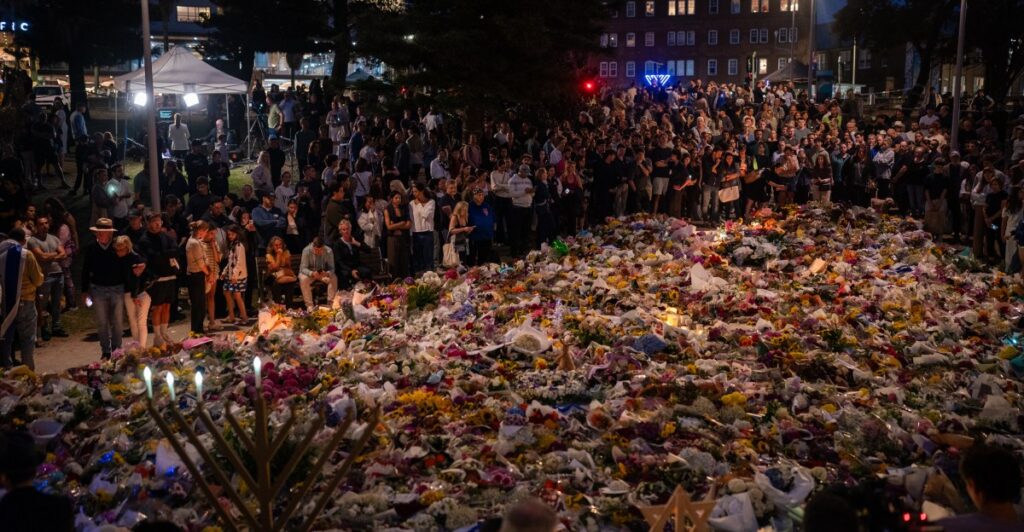
Australian Prime Minister Anthony Albanese today described the deadly terrorist attack at a Hanukkah celebration at Sydney’s Bondi Beach as being “motivated by Islamic State ideology.” But, this may be an understatement.
The father and son pair who carried out the attack on Sunday, killing at least 15 people and wounding 40, traveled to the Philippines last month, to an area where an Islamic State, commonly known as ISIS, affiliate is active. According to Australian media reports, the two received military training there.
That means the attack is more than just motivated by ISIS; it’s an ISIS-“directed” or at least “enabled” attack, Colin Clarke, counterterrorism analyst and executive director of the Soufan Group, told Vox. “Clearly this wasn’t just two guys sitting around reading Telegram deciding that they want to hatch a plot,” Clarke added.
The Bondi Beach massacre came a day after a gunman, believed by the Pentagon to be affiliated with ISIS, killed two US soldiers and a civilian interpreter in Syria — the first American casualties in the country since the fall of Bashar al-Assad one year ago.
The perpetrators was a member of the Syrian security forces, a grim echo of similar “green on blue” attacks in which local forces attacked the Americans they were partnered with that dominated the final years of US military operations in Afghanistan.
The two high-profile attacks in one weekend, coming at a time when western governments have largely shifted attention from jihadist violence to other threats, raise the discomfiting question: Is ISIS back?
ISIS: down but not out
To be sure, ISIS is not the same group it was a decade ago, when it controlled an area the size of Great Britain in Syria and Iraq and had as many as 80,000 fighters in its ranks. Now, the territorial “caliphate” has been entirely eliminated, and its numbers have probably shrunk to less than 3,000.
ISIS’s attacks and grisly beheading videos once dominated global headlines, prompting a major US military intervention in the Middle East. Now, jihadist-motivated attacks — by ISIS or other groups — are now far outnumbered by attacks by right-wing and left-wing extremists in the United States. And numbers are way down in Europe, as well.
But, the truth is thaat ISIS never really went away. This year began, after all, with an ISIS-inspired car attack in New Orleans that killed 15 people. Last year saw mass casualty attacks by the Afghan affiliate ISIS-K in Russia and Iran, as well as a thwarted plot targeting a Taylor Swift concert in Austria.
Most of the recent ISIS violence, however, has taken place in the countries where the group’s various affiliates are based. This includes Syria, where the number of attacks are up since Assad’s downfall and the removal of a significant number of US troops. But, the group is believed to be growing fastest in Africa, with major affiliates operating in West Africa’s Sahel region, the Democratic Republic of the Congo, and Somalia.
Little is known about ISIS’s current global “caliph” — Abu Hafs al-Hashimi al-Quraishi, who took over in 2023. According to some reports, he is based in Somalia. Even though the group is no longer a physical “state” in any sense, experts believe there’s still a high degree of centralization and coordination between its various affiliates throughout Africa, Asia, and the Middle East.
Much of ISIS’s work radicalizing and recruiting new members, though, occurs online via social media. The group has taken advantage of the global anger over Israel’s war on Gaza for recruitment purposes, which is somewhat ironic given that ISIS and Hamas are longtime enemies.
Many of the recent attacks and foiled plots in Europe do, in fact, appear to be the work of “lone wolves” radicalized online, many of them teenagers. As the French terrorism analyst Wassim Nasr told me last year, would-be attackers are often given instructions and logistical support by “cyber-coaches” they meet online, a cheaper and less risky process than bringing them to another country for training.
This makes the Australia case, in which the suspects legally purchased firearms and may have traveled to an area where ISIS operates in the Philippines despite one of them having been previously investigated for links to terrorism, all the more noteworthy.
Returning to the previous war on terror
President Donald Trump’s first campaign for the White House prominently featured his pledge to “bomb the shit” out of ISIS, but he’s since pivoted to other priorities. Trump has also expressed the wish, dating back to his first term, to remove the last US troops from Syria, where they are still working in conjunction with local Kurdish forces to fight ISIS.
ISIS may hope that attacks like last weekend will accelerate that departure — just as the surge in “green on blue” attacks helped push the US toward the exit in Afghanistan — but it could also have the opposite effect. Trump has vowed “very serious retaliation” against the perpetrators of the attack.
The shift of US attention and resources away from fighting terrorism — or, at least “terrorism” as it was typically defined in the post-9/11 years — picked up under the Biden administration, during which foreign policy emphasized “great power competition” with China and Russia. That idea has continued into Trump’s second term, where the emphasis is more on combating narcotics and migration in the Western Hemisphere, as well as, judging by the recently released National Security Strategy, culture war conflicts with Europe.
The NSS, which does not mention ISIS, warns against sustained counterterrorism campaigns, stating that “terrorist activity in an otherwise less consequential area might force our urgent attention. But leaping from that necessity to sustained attention to the periphery is a mistake.”
The shift can be overstated. The US carried out significantly more airstrikes in Somalia this year — many of them targeting ISIS — than in the Caribbean, where they got far more attention. But, when this administration invokes “terrorism,” it’s more likely referring to drug cartels, leftist governments, or Antifa than al-Qaida or ISIS.
But, if ISIS deadly attacks targeting US troops or on the streets of western cities become more common again, that could change quickly.
The post Is ISIS back? appeared first on Vox.