The new focus of the hunt for the Brown University shooter appears to be a stocky person of medium height, who hours before the attack was walking a few blocks from campus in dark clothes and a medical mask.
Officials released surveillance video and photos of that person late Monday afternoon, trying to generate leads in the two-day-old investigation after detaining, then releasing, a 24-year-old Wisconsin man they had initially described as a person of interest.
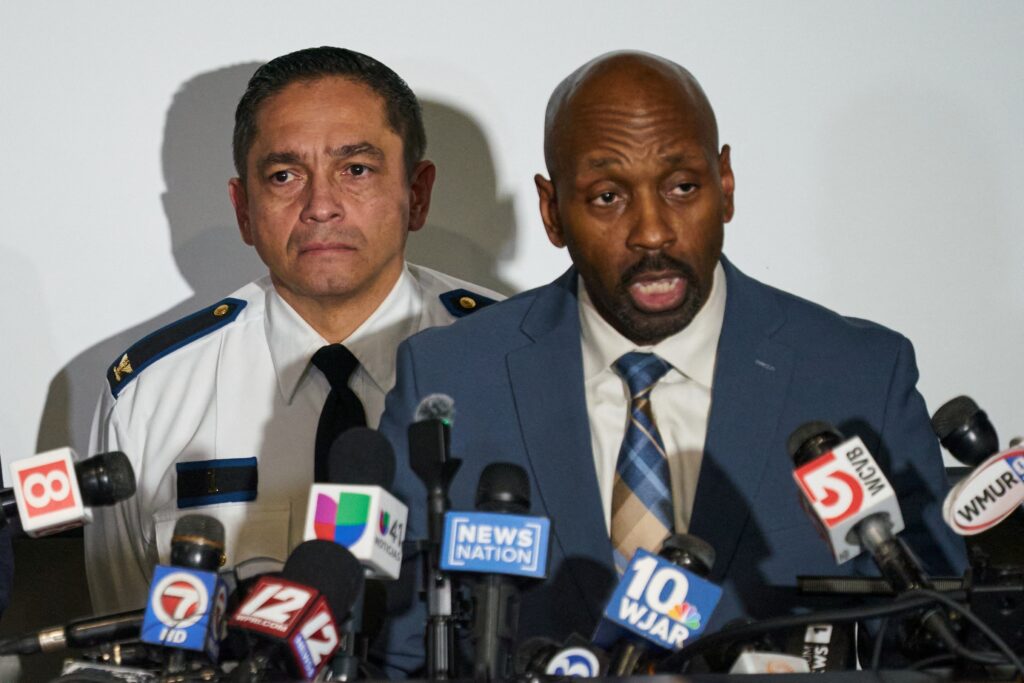
“We want to see the individual who pulled the trigger on these young kids identified, apprehended and brought to justice,” Rhode Island Gov. Dan McKee (D) said at a news conference Monday.
The chief of the Providence Police Department, Col. Oscar Perez, echoed his plea.
“We’re at the 49th hour, and there’s no one who wants to put this individual in handcuffs more than us,” he said. “Every minute counts.”
The minimal progress made Monday generated some exasperation on campus, with students and others expressing concern that the pursuit of the initial person of interest may have wasted valuable time.
The gunman opened fire inside a lecture hall at the end of a final exam prep session, killing two students, wounding nine and leaving the community shaken.
“You had such conflicting information come out when there was still an active shooter around, and you had this manhunt go on for eight hours before they got anybody, and then it turned out that they still didn’t have the guy,” Brown freshman Eli Smith said. “So I can say I’m very frustrated that this was allowed to happen.”
Tension also rose between local and federal officials, who have been working together on the case and have publicly sought to present a united front in their push to locate the gunman.
Speaking to reporters in the Oval Office, President Donald Trump blamed the university for delays in making an arrest, referring to the protracted search as “a school problem.”
“They had their own guards. They had their own police, had their own everything,” he said. “You’d have to ask that question really to the schools, not to the FBI. We came in after the fact, and the FBI will do a good job, but they came in after the fact.”
Rhode Island Attorney General Peter Neronha, interviewed on CNN, responded that “it’s not a Brown problem, it’s a national problem, a symptom that happened here in Rhode Island.”
“What we’re focused on here is solving this crime,” he said. “It’s not Brown’s fault. It’s the fault of this gunman.”
On campus and in its nearby neighborhoods, police and federal agents fanned out for a third straight day, gathering evidence and working to develop new information. Officers went door to door, asking residents and business owners for security-camera footage that might aid their efforts, a police department spokesperson said.
The FBI is offering a $50,000 reward for any information leading to an arrest in the shooting. Police said they hoped someone might recognize the man in the images released Monday from his clothing or gait.
Ted Docks, special agent in charge of the FBI field office in Boston, said the suspect should be considered armed and dangerous.
As the university mourned, classes were canceled and the campus notably emptied. Students headed home for winter break under the whir of helicopters hovering overhead. False rumors of further gunfire Sunday persisted, though authorities said they had not received any credible calls of shots fired near the campus since Saturday’s attack.
Officials’ open request for public assistance Monday stood in contrast to the confidence they had projected days earlier when they announced they were close to bringing the killer to justice.
The ongoing manhunt left students and the surrounding community on edge. Family, friends and public officials identified the two students killed in the attack as Ella Cook, a sophomore from Mountain Brook, Alabama, and vice president of the college Republican Club, and Mukhammad Aziz Umurzokov, an 18-year-old freshman from Midlothian, Virginia.
“It’s going to be hard for my city to feel safe going forward,” Providence Mayor Brett P. Smiley (D) told reporters at a news conference Monday evening. “This has shaken us.”
Neronha declined to address Monday what had prompted investigators to release the person of interest whom investigators took into custody Sunday, but he said that individual had been “effectively cleared.”
“The scientific evidence that we have available to us, after it was analyzed, made clear that this was not someone who should be detained in connection with this case,” he told ABC News early Monday. “So we released him and then moved on, looking at other evidence and pursuing other leads pointing at additional potential individuals.”
A law enforcement official briefed on the investigation told The Washington Post that several pieces of evidence and results from forensic tests did not align with the first person of interest. The official spoke on the condition of anonymity because he was not authorized to publicly discuss details of the probe.
“These investigations are like threads you pull on a garment,” Neronha said Monday evening. “Some of them you pull and the garment doesn’t open up. Some of them you pull and the garment comes undone.”
In the end, though, investigators’ early theory of the case fell apart soon after it came together.
FBI Director Kash Patel said in a social media post early Sunday that federal agents, acting on a tip received by Providence police, had begun tracking the man they eventually took into custody within hours of the attack.
They eventually located him around 4 a.m. Sunday at a Hampton Inn in Coventry, Rhode Island, about 15 miles from the university campus. Two firearms were recovered in the man’s possession, including one equipped with a laser sight, according to a law enforcement official briefed on the arrest.
But as the day wore on, signs of doubt began to set in. Local authorities released almost no information about the man, including his name or what led them to believe he could be the shooter.
They did not describe him as a suspect, referring to him only as a “person of interest” — a term law enforcement officials use to describe someone they believe may have relevant information about an investigation.
By Sunday evening, investigators’ inability to make headway on linking that person to evidence seized at the crime scene prompted a growing concern that they might have detained the wrong man.
The announcement late Sunday night that officials would be releasing him and effectively starting their investigation anew set off a wave of second-guessing.
Acknowledging that his department had initially received the tip that had led to the person of interest, Perez, the Providence police chief, stressed Sunday evening that it was the FBI that had investigated the lead, vetted the information and eventually taken the man into custody.
“They followed through with it. They ended up coming and located this individual of interest,” Perez said.
On Monday, Perez thanked all of the agencies aiding the investigation, saying the progress authorities had made was a “team effort.”
Others, though, were quick to point out similarities between the setbacks in the Brown shooting investigation and other recent high-profile blunders by federal law enforcement.
Even as terrified students remained huddled in lockdown Saturday afternoon, Trump posted to social media that a suspect had been taken into custody, only to later retract that claim. The manhunt had barely begun.
Patel has previously drawn criticism for prematurely announcing an investigation’s results. In September, after a gunman assassinated right-wing commentator Charlie Kirk on a college campus in Utah, Patel posted on social media within hours that “the subject” of the investigation had been arrested. He walked back that post hours later once law enforcement realized they had the wrong person.
Rep. Seth Magaziner (D-Rhode Island) expressed hope that Trump and Patel would “take a lesson” from Rhode Island law enforcement’s more cautious approach to releasing information on the Brown investigation.
“They have been careful about the language they’ve used,” he told CNN. “That does stand in contrast to the president and the FBI director, who, similar to in the hours that followed the Charlie Kirk assassination, seemed to be very eager to break news before they’re confident whether it’s true or not.”
Christopher O’Leary, a former FBI agent with extensive experience in counterterrorism investigations, described the apparent friction on display between federal and local law enforcement officials as “atypical.”
“It is not a recipe for success in these matters,” he said.
In the normal course of an investigation like this, O’Leary said, local police and the FBI make sure to act in concert, even if there is tension behind the scenes.
“When you put out information, you put it out together,” he said. “When you take action, you take action together.”
Wallack reported from Providence, Rhode Island. Emily Davies, Mariana Alfaro, Ben Brasch and Gaya Gupta contributed to this report.
The post Hunt for Brown University gunman starts anew as tension rises appeared first on Washington Post.