At this year’s Annecy International Animation Film Festival, there were some big events – including, but not limited to, screenings of a pair of French animated movies that had just premiered at Cannes, footage from upcoming blockbusters like “Toy Story 5” and a panel that brought back the foundational animators from Cartoon Network’s heady early days.
But the one thing that was mentioned, more than anything else, that week in France was a new “Teenage Mutant Ninja Turtles” animated short called “Chrome Alone 2: Lost in New Jersey.” It was an extension of “Teenage Mutant Ninja Turtles: Mutant Mayhem,” which had premiered at Annecy in 2023, and, judging from what everyone exclaimed, it had to be seen to be believed.
Now, a few months later, the short will be attached to “The SpongeBob Movie: Search for SquarePants,” which Paramount is releasing later this week. Grab a slice of pizza, as we go behind-the-scenes of this miraculous mini-movie.
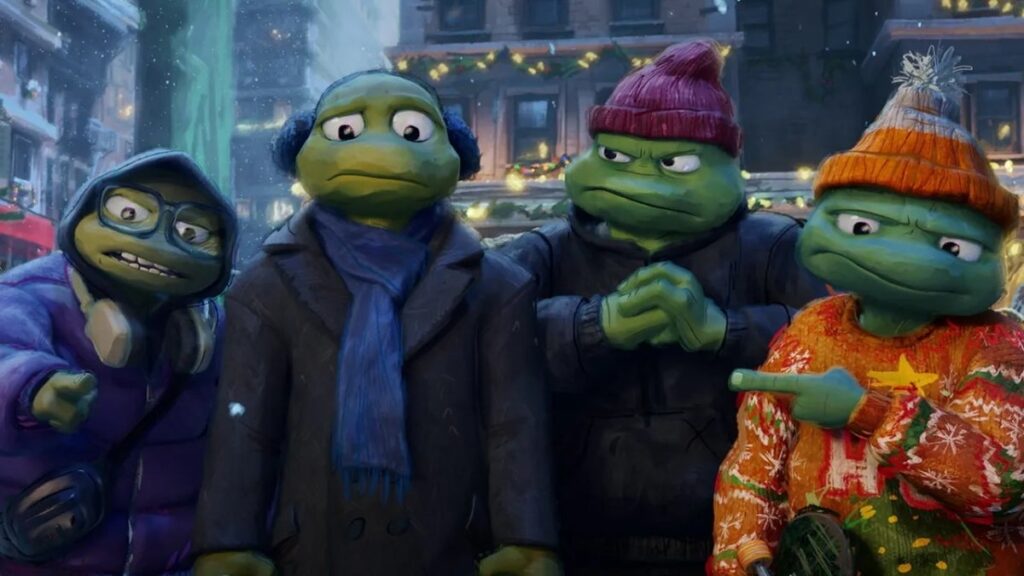
In “Teenage Mutant Ninja Turtles: Chrome Alone 2 – Lost in New Jersey,” the Turtles are shopping for Christmas presents when they see a storefront hawking “Tubular Tortoise Karate Warriors,” knockoff Turtles that originate from a mysterious warehouse in New Jersey. When the Turtles go there, they discover that the toys were created by Chrome Dome (Zach Woods). Chrome Dome, a fairly famous baddie in other Turtles media (first introduced in the animated series), is presented here as a soul-sucking AI death-bot, without an original thought in its shiny head.
“There was a notion that we needed something to tide people over before the sequel came out. And with the strikes and all of the inevitable delays that happened, they were like, ‘Well, we can do this short. We can find the money to do this short, and it’ll be something that we can put in front of ‘SpongeBob’ or one of the other films,’” explained Kent Seki, the director of the short. “That’s how the genesis of this all came about – all of that desire to keep the ‘Mutant Mayhem’ universe alive in the audience.”
Seki was the head of cinematography on “Teenage Mutant Ninja Turtles: Mutant Mayhem” (and is currently working on the sequel, due out in 2027) and is a legend in the visual effects and pre-visualization world. He said he got the opportunity to direct through Ramsey Naito. Naito, who was recently replaced at Paramount, ran the animation division and “really believed in me and was willing to take a chance on me, which is rare. It was by the grace of a lot of other people that I got my chance to direct this short.”
Not that everyone was initially as jazzed about the idea. Jeff Rowe, who directed “Mutant Mayhem” and who is hard at work on the sequel, was reluctant at first.
“The first time someone broached the idea of making a short to me, I was like, I need that like I need a hole in my head. We’re trying to make the movie too. And then thinking about it for a minute, it was like, Oh, this is actually a chance to do something really fun,” Rowe shared. “I have this really high bar for a feature film, and what a feature film is and what it should deliver on in terms of excitement and spectacle and emotional truths and everything. Sometimes that eliminates dealing with ideas that are smaller or less ambitious in their scope and it’s like, well, this is a great chance to do some other kind of idea, something that doesn’t have the same demands as a feature. Then you start doing it and you end up putting all those same demands on the short just in a seven-minute period of time.”
Rowe pitched the idea of them discovering the bootleg toys and the setting of Christmas. “I have a deep love of holiday films and I love returning to them every year,’ he said.
This time around, Seki could push the look of the film, based on the fact that the Turtles are now part of society, having emerged out of the sewers as heroes at the end of the first movie. “That’s a story point that we wanted to reinforce,” said Seki.
In an early sequence, on the streets of New York, we see them bobbing and weaving through traffic and other pedestrians. “We went with a longer lens than we normally would shoot that, to stack the image a bit more, to sandwich them into that space. And then we also wanted the movement to be one where we lost them for a little bit and brought them back,” Seki said. The team was inspired by the work of the Safdie Brothers, particularly “Uncut Gems,” and how “they have these insert shots to break up the long shots,” along with Aaron Sorkin’s “The West Wing,” since the scene was a walk-and-talk.
As they worked on the design for Chrome Dome, there was actually a different design that was approved. But it was Jeff Rowe who put a halt to that design. “He pulled me aside and said, ‘Look, this design is fine, but let’s try to push it a little bit more. Can you guys find something more iconic?”” Seki said. The team turned to Woodrow White, who designed the characters from the first film and found inspiration from Radu Molasar, the monster from Michael Mann’s “The Keep;” and TARS, the boxy robot from Christopher Nolan’s “Interstellar,” with a face inspired by Patrick Nagel’s iconic artwork from the 1980’s.
“I probably have some kind of oppositional defiance disorder or something. I see a thing and I’m like, This looks like a thing that I’ve seen done before. How do we push it to defy animation conventions?” Rowe said. “If this is a short where we’re attacking derivative things and AI, like, how can we do something truly inventive? And for this character who is human and AI, what’s our human interpretation of how a computer would design itself?”
“If you look really closely, there’s a floppy disk drive on the front of him. It became this amalgamation of these different references that created Chrome Dome. And it was a really amazing process to be a part of – a master class in how to reset and how to get all of us creatives together,” said Seki. “And it was really Jeff that was inspiring in that in that particular killer moment.”
Chrome Dome is also evocative, of course, of the threat of AI. Part of what makes “Chrome Alone 2” such a galvanizing blast is the fact that it addresses the issue head-on, at a time when filmmakers are being told to downplay the parallels between the threat of artificial intelligence and their own work. (This hasn’t stopped people like Guillermo del Toro from loudly chanting “F–k AI” at screenings of “Frankenstein.”)
At one point in the development of “Chrome Alone 2,” they too muted the anti-AI messaging.
“We went back and really challenged ourselves to rewrite the film and focus more on the questions and feelings we had, as artists and filmmakers, about AI, because we felt that discussion was important and felt it was underplayed. What was amazing is the more we use that as our touchstone, the artists themselves, individually, brought stuff to it, as well as the writing, just took another step up. It allowed us a way in to have a discussion, to talk about the collective anxiety over what has been described to us, from all different sides as an existential threat,” Seki said. “The problem with existential threats is it renders you powerless. You feel like, oh, there’s nothing I can do about it. In a way, making this short was a way of taking back our agency and we threw all of our collective anxiety. I think that’s why, whenever I show it to people, it resonates with so many people. I think it transcends the ‘Teenage Mutant Ninja Turtles’ thing, and it’s relatable in some visceral way to a lot of people who have been hearing about this knocking on society’s door but not really knowing how to deal with it.”
At one point, when they realized that the short would be debuting this Christmas, the team worried that it would be too late. “Thank God we did wait a year, because I think it’s more relevant now. That’s the thing that I could not have predicted, is every once in a while you hit the timing of something just right. It just happens that way, and it was the same,” Seki said.
Rowe added: “I think it’s landing at a really good moment in society’s relationship with AI and where that’s at right now.”
The short was designed, Rowe noted, as “a celebration of human artistry. AI does not have the soul or emotion in what it makes. It was the chance to say, These animated films are made by humans. This is artist forward. It’s made on a computer but everything we do in our show style is to make it feel hand drawn. You feel the impression of artists and human hands.”
Simply put, Rowe said, AI is “stolen artwork. It’s like a form of neocolonial extractivism. Things that are earned and built and developed by individual artists are now being replicated and without any kind of compensation or acknowledgement to the people who did it. That’s very alarming to me as an artist and as a person who has spent my career trying to support artists’ rights and authorship and ownership of their work, and the proper credit that goes with that.”
The idea of “stolen artwork” is beautifully displayed through Chrome Dome’s backstory, a hodgepodge amalgamation of different IP – everything from “Star Wars” to the Marvel Cinematic Universe. At first, Chrome Dome had a more conventional backstory, but producer Ramsay McBean pushed for what eventually wound up in the film.
“We went back very quickly, rewrote it, and focused it much more on Chrome Dome as a character that was an AI robot that really ripped off their identities — and the backstory took a very long time. I kind of was sitting there after months and months of trying to figure out what Chrome Dome’s story could be. We were sitting there for ages, we had various different backstories, and I thought to myself one day, What would ‘South Park’ do?, which is kind of a weird way of thinking about things,” said McBean. “But having grown up watching ‘South Park,’ I thought they would probably just fully embrace the whole idea of AI and just do what the AI thing would actually say, which is, they would steal all of the IPs and just recreate it. That was kind of how we landed on the whole backstory thing.”
The revised backstory was one of the last things that the team worked on for the short. At one point, McBean said, the backstory even included a reference to “Madame Web,” of all things. The short’s writer, Andrew Joustra, used the “Madame Web” joke as the jumping off point.
“That was the initial thing. And then Andrew really expanded it. He did a great job with hitting all the sort of key milestones of great IPs that have been out there,” said McBean.
But, as a producer, was he worried about potential legal ramifications of using all of that bootleg IP?
“We had a lot of conversations with the studio and stuff about it, and once people understood it, and I think one of the things was, is that, because we were also making fun of ourselves and making fun of our own IP in that way, it kind of opened the door to being able to, like, kind of play with it a little bit more,” McBean said. “I think that the self-reflective nature of the whole short and where we sit in the world of making movies that sell toys and that industry that we’re a part of is like a big piece of it that makes it work well.”
Before you ask, yes, you can actually buy the off-brand Turtles. It’s something that Seki is really thrilled about.
“I’m so excited about the Tubular Tortoise Karate Warriors,” he said. “They actually used the packaging that we designed for the short in the packaging of the toys that you can actually buy.” The pack comes with the knockoff Turtle, along with one of the actual turtles in their winter wardrobe, “So you could keep it in that crazy packaging for itself,” said Seki.
An excellent new “Teenage Mutant Ninja Turtles” short and killer new merchandise? It’s a Christmas miracle.
The post How a Thrilling New ‘Teenage Mutant Ninja Turtles’ Animated Short Tackled AI Head-On appeared first on TheWrap.